Castillo San Cristóbal
The largest Spanish fortification built in the Americas, guarding San Juan from the land side with tunnels, moats and outlying forts.
Updated 18 October 2026
AI illustration
UNESCO World Heritage
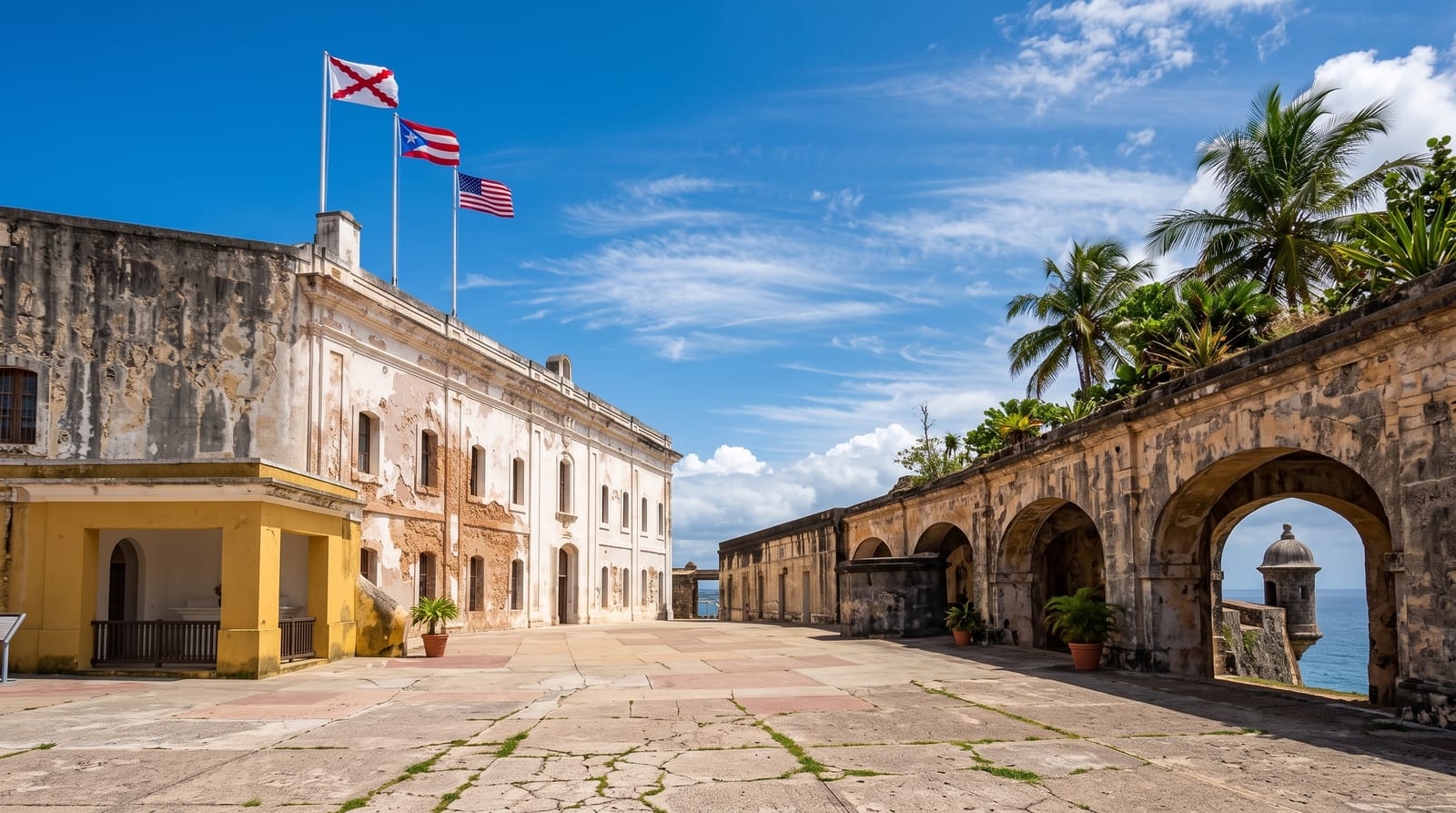
El Morro guarded the harbour mouth, but San Juan's weak point was always the land approach, and after an English force took the city from behind in 1598 the Spanish spent much of the eighteenth century building the answer. San Cristóbal covers around eleven hectares, which makes it the largest fortification the Spanish built anywhere in the Americas, and it works as a system rather than a single fort: a main plaza, five independent outworks connected by tunnels and dry moats, each able to hold out if the one in front fell. A sentry box called the Garita del Diablo stands on a rock at the water's edge, reached by a tunnel and attached to a good deal of folklore.
History
After the English attack of 1598 and the Dutch one of 1625 showed that San Juan could be taken by land, the first defences rose in 1634 on a hill once called Gallows Hill and renamed for Saint Christopher, among them the sentry box known as the Garita del Diablo. By 1765 the site held a hornwork behind a dry moat, crowned by the Caballero de San Miguel gun platform, and in 1764 Charles III had ordered Field Marshal Alexander O'Reilly and the engineers Tomás O'Daly and Juan Francisco Mestre to make the island a first-rank stronghold, which added the ravelin of San Carlos, the counterguard of La Trinidad, the El Abanico fort and the La Princesa battery. Completed in 1783 over about 27 acres, it is considered the largest fortification Spain built in the New World; after close to a century of peace, about a third of it, with its gates, was pulled down in 1897 to ease traffic in and out of the walled city (Wikipedia, Castillo San Cristóbal (San Juan)).
Highlights
- The tunnels - passages linking the outworks beneath the fort.
- The Garita del Diablo - the isolated sentry box on the rocks.
- The main plaza and ramparts - views over the Atlantic and the old city.
- The dry moats - the layered defences facing the land approach.
When to go
December to April is drier and cooler. Mornings are best, before the heat and the cruise ship groups. The same ticket covers El Morro, so many visitors do both in one day, which works if you start early and walk the ramparts between them.
Good to know
There is very little shade and the ramparts are hot by mid-morning. Cruise days fill both forts and the tunnels become congested. The Garita del Diablo is often closed for maintenance or safety. Old San Juan's cobbled hills are hard going in the heat.
Nearby
El Morro is at the other end of the old city; the city walls run between them.
Key facts
Source: Wikidata, item Q3748608, read on 18 October 2026.
What to pack for Castillo San Cristóbal
Chosen from what this place is for. Tap a kit for the full checklist.
- Comfortable walking shoes - Sightseeing means kilometres of pavement and cobbles daily. Find on Amazon
- A slim anti-theft daypack - Zips that close properly; keep it in front in crowds and on transit. Find on Amazon
- A refillable water bottle - Many cities have public fountains; save money and plastic. Find on Amazon
- A light layer + compact umbrella - For museum air-con and a sudden shower. Find on Amazon
Some links on this page are Amazon affiliate links - if you buy through them we may earn a small commission at no extra cost to you.
All packing kitsPlan your trip
Where to start if Castillo San Cristóbal is going on the list.
Booking links on this page are affiliate links - if you book through them we may earn a small commission at no extra cost to you. It never changes what we write about a place.
Opening times, ticket prices and seasonal closures change - check the official source before you go: official site.