Batalha Monastery
The victory abbey - flamboyant Gothic and Manueline stone raised after 1385, from the Founder's Chapel to the roofless Unfinished Chapels.
Updated 18 October 2026

AI illustration
UNESCO World Heritage
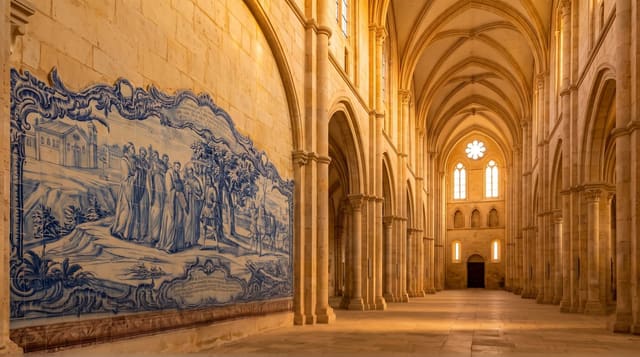
Batalha is a vow made permanent: King Joao I promised a monastery for victory at Aljubarrota in 1385, and construction begun the following year ran for well over a century, long enough for Gothic to flower into Manueline and for the building to become the pattern-book of Portuguese late-medieval stone. The Founder's Chapel gathers the dynasty under its star vault - Joao and his English queen Philippa of Lancaster hand in hand in effigy, their son Henry the Navigator along the wall - while the Royal Cloister laces its arcades with carved tracery of ropes, shells and armillary spheres. The masterstroke is unfinished: the Capelas Imperfeitas, an octagon of soaring buttresses and a portal carved to lace, abandoned open to the sky, where rain and swallows complete what the masons never did. UNESCO listed the ensemble in 1983.
History
King John I vowed the monastery to the Virgin Mary for the victory over the Castilians at Aljubarrota in 1385, which ended the crisis of 1383-1385, and it was built from 1386 to about 1517, across the reigns of seven kings and under fifteen masters of works. Afonso Domingues drew the plan and led the work until 1402 in a Rayonnant Gothic with echoes of the English Perpendicular, and Huguet, probably of Catalan descent, brought in Flamboyant Gothic from 1402 to 1438, raising the nave to 32.46 metres and building the Founder's Chapel, but died before he could finish the Unfinished Chapels. Fernão de Évora added the Cloister of Afonso V from 1448, Mateus Fernandes the Elder worked in the Manueline style from 1480 to 1515 and with Diogo Boitac made the tracery of the Royal Cloister, and João de Castilho added a Renaissance tribune in 1532; work came to a halt when John III turned all his efforts to the Jerónimos Monastery in Lisbon, and in 1983 Batalha was listed as a World Heritage Site (Wikipedia, Batalha Monastery).
Highlights
- The Founder's Chapel - royal effigies under the star vault.
- The Unfinished Chapels - the roofless octagon open to the sky.
- The Royal Cloister - Manueline tracery filling Gothic arcades.
- The great portal - tiers of carved apostles and angels at the west front.
When to go
Spring and autumn for angled light on the limestone - the west front burns gold at sunset. Midday coach traffic passes through quickly; early and late hours give the cloisters back their silence.
Good to know
The surrounding town is modest and the visit is the monastery, full stop - pair it with Alcobaca or Tomar to fill the day. Sections periodically hide behind restoration scaffolding. The combined monastery tickets are good value if you are doing the circuit.
Nearby
Alcobaca's abbey, Fatima's sanctuary and Nazare's coast - all within half an hour.
Key facts
Source: Wikidata, item Q174779, read on 18 October 2026.
What to pack for Batalha Monastery
Chosen from what this place is for. Tap a kit for the full checklist.
- Comfortable walking shoes - Sightseeing means kilometres of pavement and cobbles daily. Find on Amazon
- Modest clothing - Shoulders and knees covered - the single most common requirement. Find on Amazon
- A slim anti-theft daypack - Zips that close properly; keep it in front in crowds and on transit. Find on Amazon
- A scarf or shawl - To cover the head or shoulders on entry; women especially at mosques. Find on Amazon
Some links on this page are Amazon affiliate links - if you buy through them we may earn a small commission at no extra cost to you.
All packing kitsPlan your trip
Where to start if Batalha Monastery is going on the list.
Booking links on this page are affiliate links - if you book through them we may earn a small commission at no extra cost to you. It never changes what we write about a place.
Opening times, ticket prices and seasonal closures change - check the official source before you go: official site.