Las Lajas Sanctuary
A neo-Gothic basilica built on a bridge across a river gorge near the Ecuadorian border, its spires rising from the canyon like something out of a fable.
Updated 19 October 2026
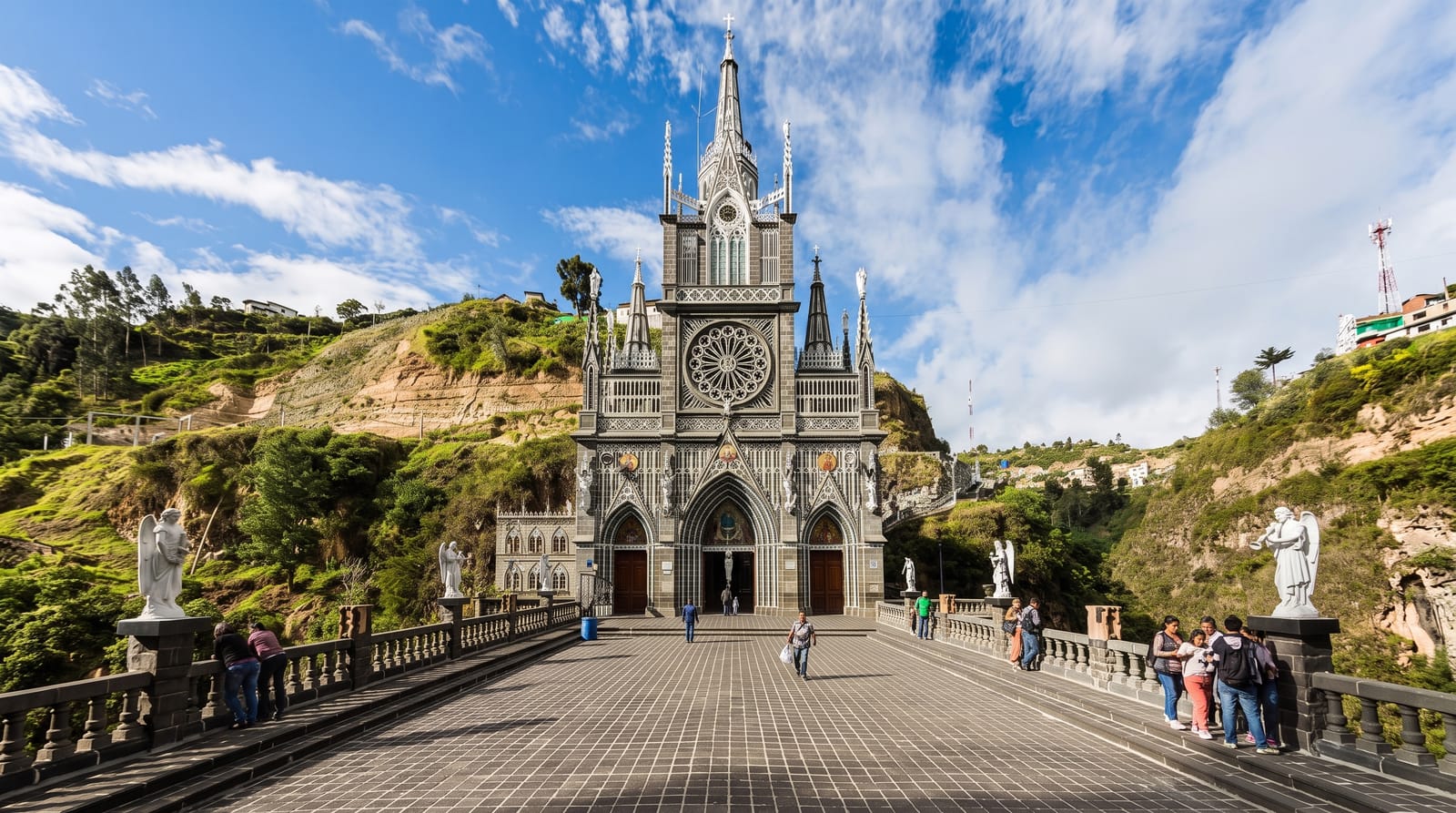
AI illustration
Las Lajas is one of the most improbably sited churches anywhere: a grey neo-Gothic basilica built directly onto a bridge that spans the gorge of the Guáitara river, so that its spires and flying buttresses rise straight out of the canyon with the water rushing far below and forested cliffs on either side. The present church was built between 1916 and 1949 on a site of pilgrimage that goes back to the eighteenth century, when an image of the Virgin was said to have appeared on the rock face, and that rock still forms the sanctuary's back wall behind the altar. The approach path down into the gorge is lined with thousands of plaques left by pilgrims giving thanks, and the whole complex is floodlit at night. It sits at the far southern end of the country, and most visitors come as a detour on the way to or from Ecuador.
History
Tradition places the start of the shrine around 1754, when María Mueses de Quiñones and her deaf-mute daughter Rosa, sheltering from a storm among the flat stones, the lajas, saw an image of the Virgin on the rock, and pilgrims soon followed. The friar Juan de Santa Gertrudis recorded a shrine here on his journey of 1756 to 1764; a first chapel of straw and wood was replaced by a brick chapel in 1795-1796 and a larger shrine from 1802, joined to the far side of the canyon by a bridge in the later 19th century. The present church, rising 100 metres from the canyon floor on a 50-metre bridge, was built with local donations between 1 January 1916 and 20 August 1949; Pius XII crowned the image on 31 May 1951 and made the shrine a minor basilica on 30 August 1954 (Wikipedia, Sanctuary of Las Lajas).
What's there
- The bridge basilica - the church rising from the gorge on its own bridge.
- The rock sanctuary - the cliff face behind the altar where the image is venerated.
- The plaque-lined path - thousands of thanksgiving tablets along the descent.
- The gorge at night - the whole complex floodlit above the river.
When to go
Open year-round; June to August is generally drier, though this is a cool, damp corner of the Andes at altitude in any season. Weekends and religious feast days bring large numbers of pilgrims. Late afternoon into evening catches both the light in the gorge and the floodlighting.
Things to know
It is a long way south, and most people reach it as a stop between Colombia and Ecuador rather than a destination in itself; from Ipiales it is a short taxi or colectivo ride. The descent into the gorge is steep, with a funicular for those who need it. It is an active pilgrimage site, busiest and most crowded exactly when it is most atmospheric. The town of Ipiales itself is unremarkable.
Nearby
Ipiales and the Ecuadorian border are minutes away; Pasto and the Galeras volcano lie north.
Key facts
Source: Wikidata, item Q2227269, read on 18 October 2026.
What to pack for Las Lajas Sanctuary
Chosen from what this place is for. Tap a kit for the full checklist.
- Comfortable walking shoes - Sightseeing means kilometres of pavement and cobbles daily. Find on Amazon
- Modest clothing - Shoulders and knees covered - the single most common requirement. Find on Amazon
- A slim anti-theft daypack - Zips that close properly; keep it in front in crowds and on transit. Find on Amazon
- A scarf or shawl - To cover the head or shoulders on entry; women especially at mosques. Find on Amazon
Some links on this page are Amazon affiliate links - if you buy through them we may earn a small commission at no extra cost to you.
All packing kitsPlan your trip
Where to start if Las Lajas Sanctuary is going on the list.
Booking links on this page are affiliate links - if you book through them we may earn a small commission at no extra cost to you. It never changes what we write about a place.
Opening times, ticket prices and seasonal closures change - check the official source before you go: official site.