Halo-halo
Shaved ice layered with sweet beans, jellies, fruit and ube, topped with leche flan and eaten by mixing everything together.
Updated 25 August 2026
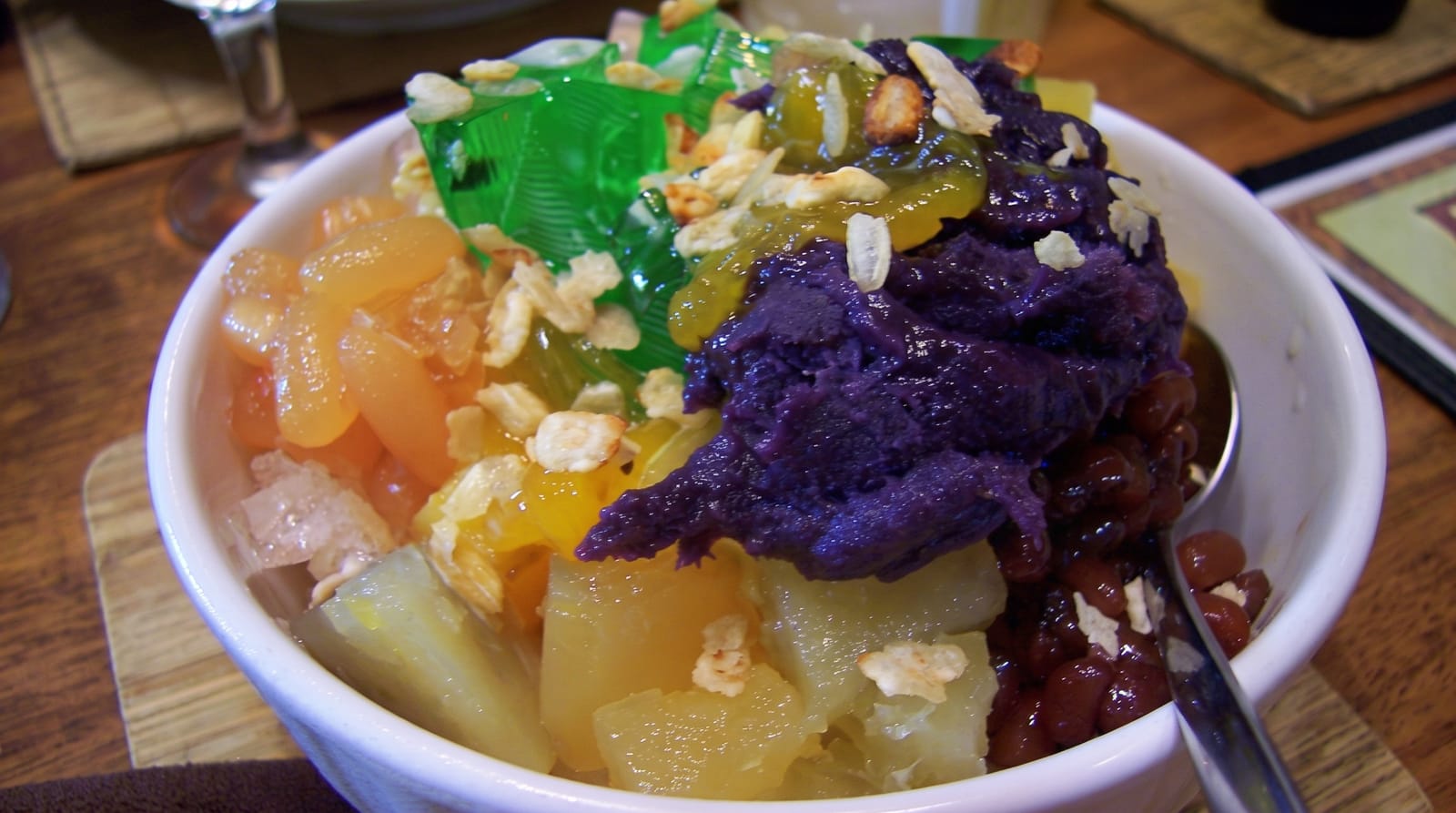
AI illustration
Halo-halo means mix-mix, and that is the instruction: a tall glass is loaded with sweetened beans, nata de coco, kaong palm fruit, macapuno, saba banana in syrup, jackfruit, sago and whatever else the establishment favours, buried under shaved ice, doused in evaporated milk, and topped with ube halaya, leche flan and a scoop of ice cream. The eater stirs the whole thing into a purple slush before eating it. Nobody agrees on the correct ingredient list, and every region and household has its own; the dish descends from Japanese kakigōri, brought by prewar immigrants and elaborated locally beyond recognition. Pampanga makes the strongest claim to the best versions, with Razon's minimal three-ingredient style at one extreme and maximalist Manila versions at the other. It is the country's defining dessert and, in a climate like this one, an entirely rational way to spend twenty minutes.
What you'll find
- The layered glass - beans, jellies and fruit under shaved ice.
- The toppings - ube, leche flan and ice cream on top.
- The mixing - the stir that turns it purple.
- The regional variations - minimal Pampanga style to loaded Manila versions.
When to go
Year-round, and essential in the March-to-May heat. Afternoons, when it does the most good.
What to expect
Ingredients vary wildly between establishments - there is no standard version to compare against. Ice quality matters; stick to places with turnover. Prices range from a few pesos to genuinely expensive at named halo-halo houses.
Nearby
Pampanga's halo-halo houses are the pilgrimage; every province has its own favoured versions.
Key facts
Source: Wikidata, item Q120769437, read on 18 October 2026.
What to pack for Halo-halo
Chosen from what this place is for. Tap a kit for the full checklist.
- A reusable bag or container - For market produce and cutting down on packaging. Find on Amazon
- Modest clothing - Shoulders and knees covered - the single most common requirement. Find on Amazon
- Wet wipes + hand sanitiser - Street food and washbasins do not always go together. Find on Amazon
- A scarf or shawl - To cover the head or shoulders on entry; women especially at mosques. Find on Amazon
Some links on this page are Amazon affiliate links - if you buy through them we may earn a small commission at no extra cost to you.
All packing kitsPlan your trip
Where to start if Halo-halo is going on the list.
Booking links on this page are affiliate links - if you book through them we may earn a small commission at no extra cost to you. It never changes what we write about a place.
Opening times, ticket prices and seasonal closures change - check the official source before you go: official site.