Pukekura Park
A Victorian-era public garden in a New Plymouth gully, with lakes, a part-underground fernery and a natural amphitheatre.
Updated 21 October 2026
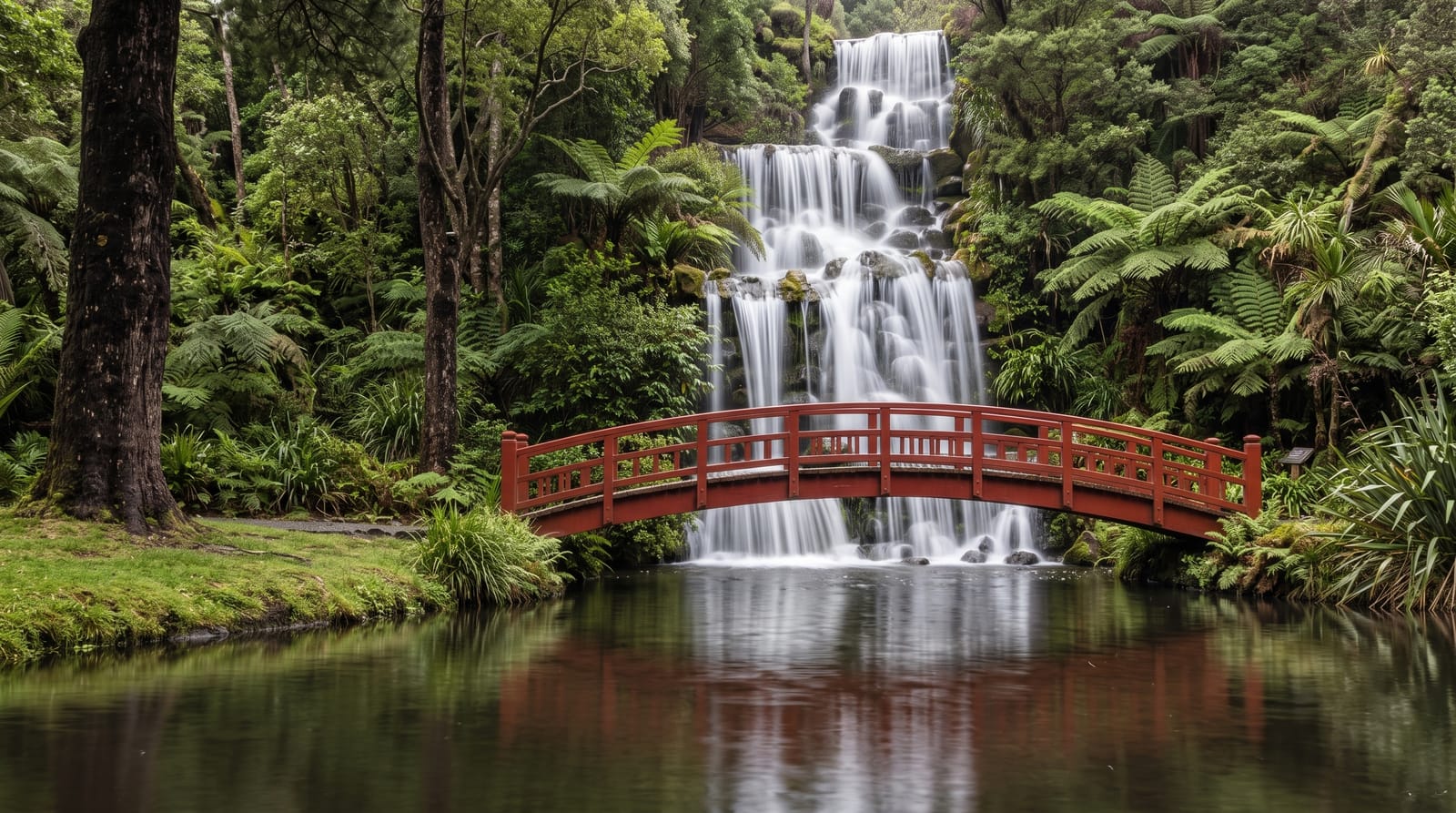
AI illustration
Pukekura Park runs through a gully in the middle of New Plymouth and has been a public garden since the 1870s, grown into a landscape of lakes, bush-covered slopes and planted terraces rather than formal beds. Paths cross the water on a curved wooden bridge, rowing boats go out on the main lake in summer, and a fernery and display houses are built into the hillside, half underground, holding begonias and orchids. A small free zoo of birds, monkeys and farm animals adjoins the park at its southern end, and a natural amphitheatre with a stage across the water is used for outdoor concerts. For several weeks around midsummer the trees and lake are lit at night.
History
New Plymouth's 15-hectare Recreation Ground opened on 29 May 1876, when Jane Carrington planted the first trees: an oak, a pūriri, a Norfolk Island pine and a Pinus radiata. It was renamed Pukekura Park in 1907; the Poet's Bridge, paid for by a sweepstake win on a horse named The Poet, opened on 11 March 1884, and the band rotunda was finished in 1891 (Wikipedia, Pukekura Park).
What to look for
- The main lake and bridge - rowing boats and the curved wooden bridge, with the mountain sometimes beyond.
- The fernery and display houses - part-underground glasshouses cut into the hillside.
- Brooklands Zoo - the small free zoo at the park's southern end.
- The Bowl of Brooklands - the natural amphitheatre with its stage across the water.
When to go
December to February is when the boats run, the planting is at its fullest and the evening light display runs for several weeks around the holidays. Spring brings rhododendrons, which the region is known for. Winter is quiet and often wet, though the display houses give somewhere dry to stand. Most people spend two or three hours here.
Good to know
It is a city park rather than a scientific botanic garden, so labelling and collections are modest. Paths are steep in places and involve steps, which makes parts of it hard going with a pram or with limited mobility. The lit evenings draw large crowds and nearby parking disappears. Taranaki rain is frequent and much of the park has no shelter.
Nearby
The New Plymouth coastal walkway and the city galleries are close, with Mount Taranaki half an hour inland.
Key facts
Source: Wikidata, item Q7259118, read on 18 October 2026.
What to pack for Pukekura Park
Chosen from what this place is for. Tap a kit for the full checklist.
- Head torch + spare batteries - Hands-free light is essential; caves are truly dark. Find on Amazon
- Comfortable walking shoes - Sightseeing means kilometres of pavement and cobbles daily. Find on Amazon
- Grippy closed shoes - Cave floors are wet, muddy and slick with formations. Find on Amazon
- A slim anti-theft daypack - Zips that close properly; keep it in front in crowds and on transit. Find on Amazon
Some links on this page are Amazon affiliate links - if you buy through them we may earn a small commission at no extra cost to you.
All packing kitsPlan your trip
Where to start if Pukekura Park is going on the list.
Booking links on this page are affiliate links - if you book through them we may earn a small commission at no extra cost to you. It never changes what we write about a place.
Opening times, ticket prices and seasonal closures change - check the official source before you go: official site.