Moeraki Boulders
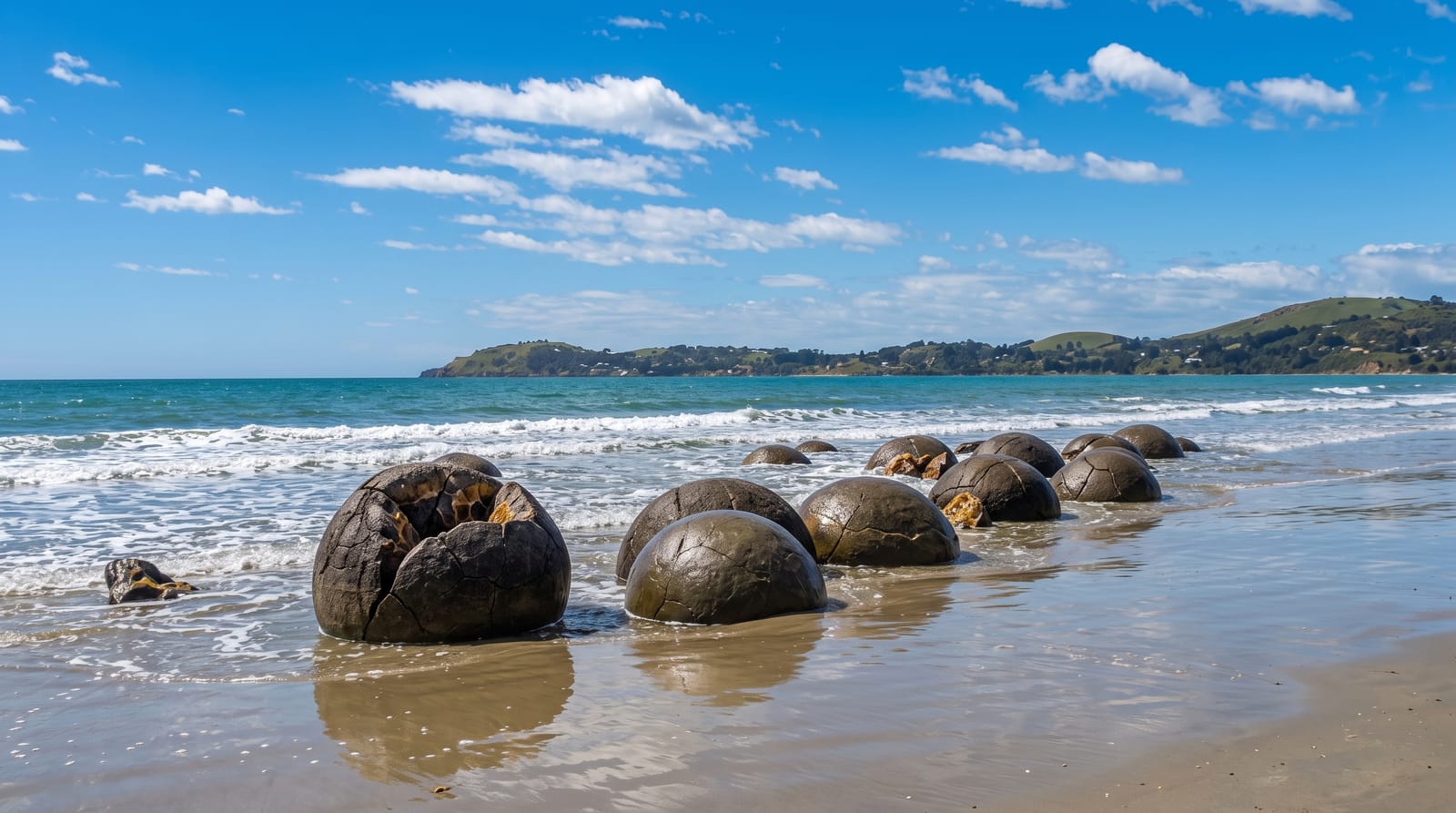
Dozens of grey spherical concretions on an Otago beach, freed from an eroding mudstone bank and exposed at low tide.
Updated 18 October 2026
AI illustration
On Koekohe Beach, just north of Moeraki village, several dozen grey spheres sit on the sand, the largest more than two metres across. They are concretions: mineral cement that formed around a core in seafloor mud a very long time ago, hardening into balls that the sea has since freed from the eroding cliff behind. Some are whole and smooth, others cracked open in a pattern of veins that looks like the inside of a shell. More are still emerging from the mudstone bank at the back of the beach. At low tide they stand clear on wet sand; as the tide comes in they sit half drowned in the surf.
History
The boulders began forming in the Paleocene, as parts of the marine mud near the seafloor were cemented together - their round shape shows that the calcium spread by diffusion rather than with flowing water. The largest, two metres across, are reckoned to have taken 4 to 5.5 million years to grow while 10 to 50 metres of mud piled up above them. Later they cracked inside, and when the sea level dropped, fresh groundwater filled the cracks with brown and yellow calcite, a little dolomite and quartz - the veins you see on the broken ones. Coastal erosion of the mudstone cliffs has since freed them onto the beach, now a scientific reserve (Wikipedia, Moeraki Boulders).
Highlights
- The whole spheres - intact grey balls standing on open sand at low tide.
- The cracked ones - broken boulders showing the vein pattern inside.
- The cliff face - concretions still half buried in the mudstone bank behind the beach.
- Katiki Point - the headland south of Moeraki with a lighthouse, seals and nesting penguins.
When to go
Tide matters more than season: low water exposes the sand around the boulders and lets you walk between them, while high tide leaves only the tops showing. Sunrise is the classic time and draws photographers, since the beach faces east. Any month works, though winter mornings on this coast are cold and often frosty.
Practical notes
The site is small and most people are done in half an hour. It is signposted from the highway and coaches stop here, so the beach is rarely empty around midday. Several boulders have been broken and others are chipped from people climbing on them. Access from the cafe car park charges a small fee; the public route from the northern car park is free but a longer walk.
Nearby
Moeraki village and Katiki Point are just south, with Oamaru and its Victorian precinct half an hour north.
Key facts
Source: Wikidata, item Q516651, read on 18 October 2026.
What to pack for Moeraki Boulders
Chosen from what this place is for. Tap a kit for the full checklist.
- Reef-safe sunscreen - High SPF that will not bleach the coral you are swimming over. Find on Amazon
- Quick-dry clothing - Board shorts or synthetics that shrug off spray and dry fast. Find on Amazon
- Binoculars - The single best wildlife tool - even a compact pair transforms a sighting. Find on Amazon
- Quick-dry towel - A microfibre towel packs small and dries in minutes. Find on Amazon
Some links on this page are Amazon affiliate links - if you buy through them we may earn a small commission at no extra cost to you.
All packing kitsPlan your trip
Where to start if Moeraki Boulders is going on the list.
Booking links on this page are affiliate links - if you book through them we may earn a small commission at no extra cost to you. It never changes what we write about a place.
Opening times, ticket prices and seasonal closures change - check the official source before you go: official site.