Dar Batha Museum
A late nineteenth-century palace holding the best collection of Fes blue-and-white ceramics, round an Andalusian garden.
Updated 21 October 2026
UNESCO World Heritage
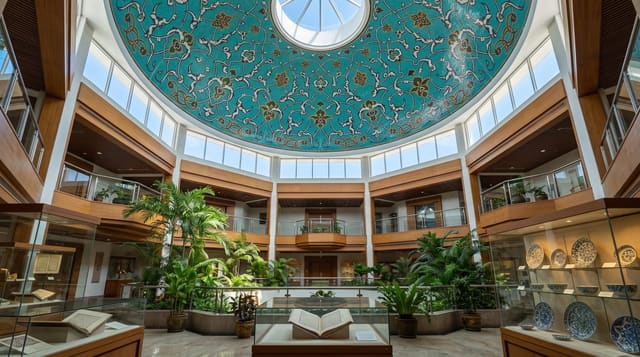
Dar Batha was built as a summer palace for Sultan Hassan I and finished under his successor Abdelaziz, in a Hispano-Moorish idiom with rooms round a large Andalusian garden of orange, jacaranda and a great Barbary oak, and it became a museum in 1915. The strength of the collection is ceramic: Fes blue-and-white, the cobalt-on-white ware the city produced from the seventeenth century, in the largest and best-documented holding anywhere, along with Fes polychrome and pieces showing the technical and stylistic sequence. There are also carpets, carved cedar architectural fragments taken from buildings that could not be saved, astrolabes, embroidery and Amazigh jewellery. The garden is used for concerts during the Festival of World Sacred Music. The museum has been under restoration in periods recently and parts have been closed, so it is worth checking.
History
Before the reign of Hassan I (1873-1894) the ground between Fes el-Bali and Fes el-Jdid held only scattered buildings, until he linked the two with walls and filled the space with royal gardens such as Jnan Sbil and with palaces; the land for Dar Batha was bought from the Ben Jelloun family. Begun by Hassan I as a summer palace and a residence for distinguished guests, it was finished and embellished by Abdelaziz (reigned 1894-1908), by one account between 1886 and 1907, and its neighbour Dar el-Beida was completed by Abdelhafid. In 1915 Dar Batha became a museum of local arts, in 1924 a national monument, and after renovation from April 2019 it reopened on 26 February 2025 as the Al Batha Museum of Islamic Arts (Wikipedia, Dar Batha).
What's there
- Fes blue-and-white - the best and best-documented collection of the city's cobalt ware.
- A late nineteenth-century palace - begun as a summer residence for Hassan I, museum since 1915.
- Architectural fragments - carved cedar rescued from buildings that were lost.
- An Andalusian garden - orange and jacaranda round the courtyards, used for concerts.
When to go
October to April. Two hours. The museum reopened in February 2025 after a full restoration, as the Al Batha Museum of Islamic Arts.
Good to know
It was closed for restoration from 2019 and reopened in February 2025. Labelling is in Arabic and French. Entry is charged. The garden is the best part and can be busy during the June festival.
Nearby
Bab Boujloud and the medina are east; the Talaa Kebira runs from there.
Key facts
Source: Wikidata, item Q3330322, read on 18 October 2026.
What to pack for Dar Batha Museum
Chosen from what this place is for. Tap a kit for the full checklist.
- Comfortable walking shoes - Sightseeing means kilometres of pavement and cobbles daily. Find on Amazon
- Modest clothing - Shoulders and knees covered - the single most common requirement. Find on Amazon
- A slim anti-theft daypack - Zips that close properly; keep it in front in crowds and on transit. Find on Amazon
- A scarf or shawl - To cover the head or shoulders on entry; women especially at mosques. Find on Amazon
Some links on this page are Amazon affiliate links - if you buy through them we may earn a small commission at no extra cost to you.
All packing kitsPlan your trip
Where to start if Dar Batha Museum is going on the list.
Booking links on this page are affiliate links - if you book through them we may earn a small commission at no extra cost to you. It never changes what we write about a place.
Opening times, ticket prices and seasonal closures change - check the official source before you go: official site.