Mount Kenya
The sacred roof of Kenya - the second-highest mountain in Africa, an extinct volcano of jagged glaciated peaks, alpine moorland and rare plants, a UNESCO wilderness for trekking and climbing.
Updated 18 October 2026
AI illustration
UNESCO World Heritage
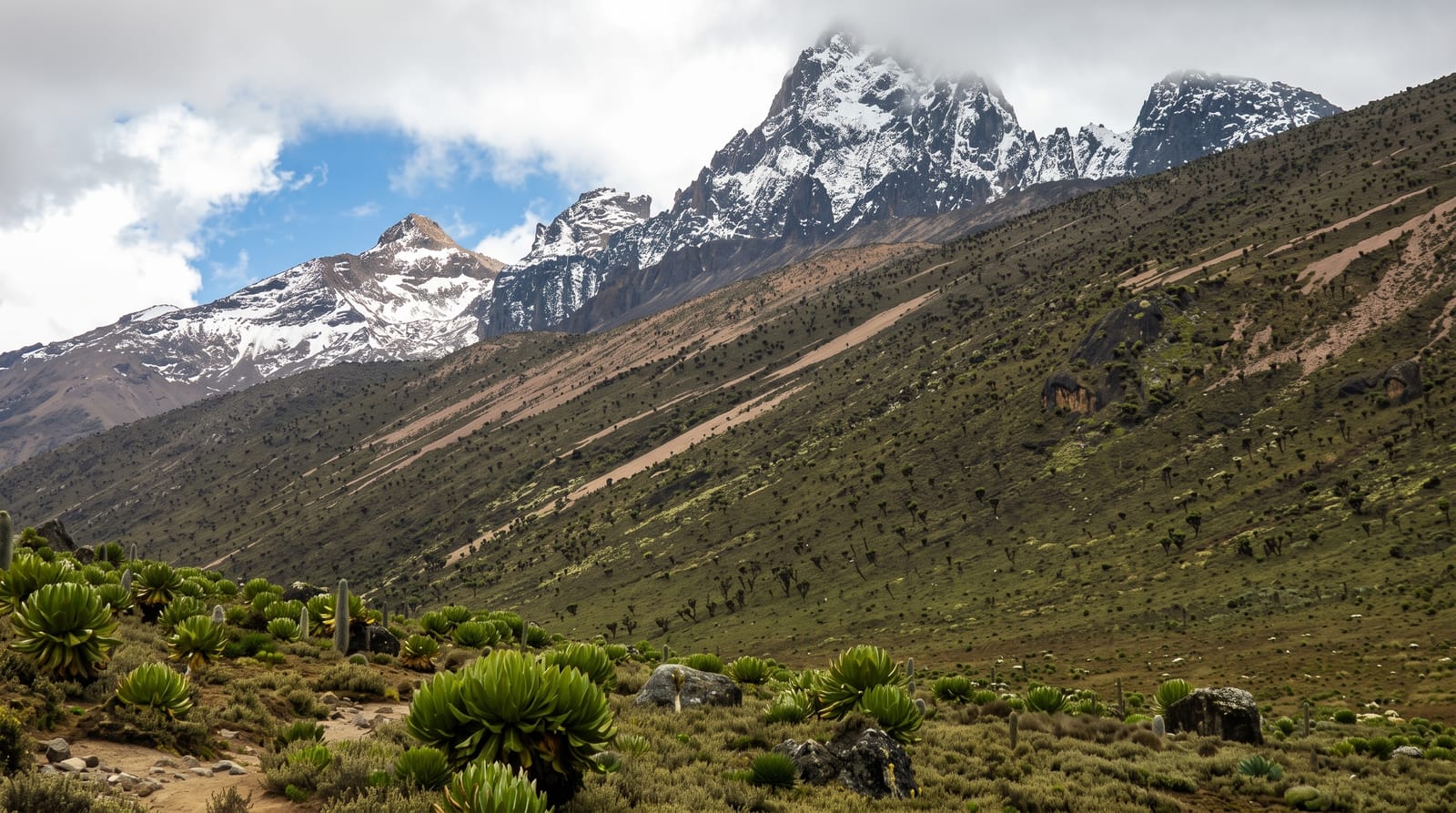
Mount Kenya, which gives the country its name, is the second-highest mountain in Africa, a dramatic extinct volcano of jagged, glacier-clad peaks rising to over 5,100 metres in the central highlands. A sacred mountain to local peoples and a UNESCO wilderness, it is ringed by forest, bamboo and unique alpine moorland dotted with giant lobelias, and offers superb multi-day trekking to the accessible summit of Point Lenana, below the technical climbing peaks.
History
The mountain's name comes from the Kamba Kĩĩ-Nyaa and related names in Kikuyu and Embu, often read as mountain of whiteness, and the German missionary Johann Ludwig Krapf, who sighted it from Kitui on 3 December 1849, recorded it as Kenia, the name the country later took. Sir Halford Mackinder set out from the site of Nairobi on 28 July 1899 and made the first recorded ascent that year, and on 6 January 1929 Percy Wyn-Harris and Eric Shipton made the first ascent of Nelion. The main peaks honour Maasai leaders, Batian after the laibon Mbatian, Nelion after his brother and Lenana after his son, while others carry the names of climbers such as Shipton and Tilman. The area became Mount Kenya National Park in 1949 and a World Heritage Site in 1997 (Wikipedia, Mount Kenya).
The landscape
- The jagged peaks - the glaciated summits of Batian, Nelion and Point Lenana.
- The trek to Point Lenana - the accessible trekking summit.
- The alpine moorland - the unique giant lobelias and groundsels.
- The forest and wildlife - the encircling forest, elephants and colobus monkeys.
When to go
The two dry seasons, January to February and August to September, are best for trekking, with clearer weather and safer trails; the mountain makes its own weather, so cold, rain and mist are possible any time at altitude.
What to expect
Reaching even the trekking summit of Point Lenana is a serious multi-day, high-altitude endeavour requiring fitness, a guide, warm gear and acclimatisation to avoid altitude sickness; the higher peaks are for technical climbers only. The weather is cold and changeable at altitude. It is far less crowded than Kilimanjaro, a rewarding challenge.
Nearby
The Aberdare National Park and the Laikipia conservancies are nearby.
Key facts
Source: Wikidata, item Q172070, read on 18 October 2026.
What to pack for Mount Kenya
Chosen from what this place is for. Tap a kit for the full checklist.
- Broken-in walking shoes or boots - Grip and ankle support matter more than looks; never hike in brand-new boots. Find on Amazon
- Binoculars - The single best wildlife tool - even a compact pair transforms a sighting. Find on Amazon
- Warm base layers - Merino or synthetic against the skin - never cotton, which chills when damp. Find on Amazon
- Layers for big temperature swings - Warm sun by day, near-freezing at night, even near the equator. Find on Amazon
Some links on this page are Amazon affiliate links - if you buy through them we may earn a small commission at no extra cost to you.
All packing kitsPlan your trip
Where to start if Mount Kenya is going on the list.
Booking links on this page are affiliate links - if you book through them we may earn a small commission at no extra cost to you. It never changes what we write about a place.
Opening times, ticket prices and seasonal closures change - check the official source before you go: official site.


