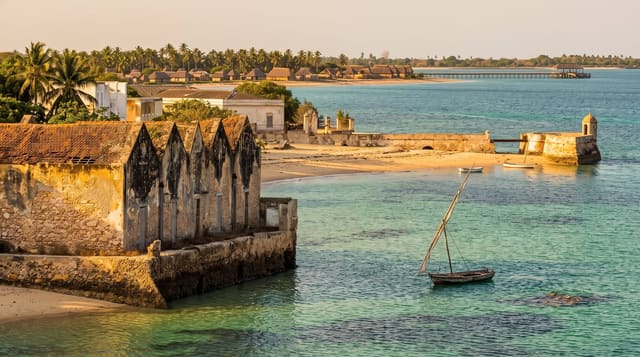
Lamu Old Town
A timeless Swahili island town - the oldest and best-preserved Swahili settlement in East Africa, a UNESCO maze of coral-stone houses and carved doors, where dhows sail and donkeys replace cars.
Updated 18 October 2026

AI illustration
UNESCO World Heritage
Lamu Old Town, on an island off Kenya's northern coast, is the oldest and best-preserved Swahili settlement in East Africa, a UNESCO site that has changed little in centuries. A labyrinth of narrow lanes winds between coral-stone and mangrove-timber houses with intricately carved wooden doors, and with no cars on the island, life moves by donkey and by the wooden dhows that have plied these waters for a thousand years, in a timeless, deeply atmospheric blend of African, Arab and Indian cultures.
History
The town's original name was Amu, which the Portuguese turned into Lamon and applied to the whole island; believed to have been founded in 1370, it is Kenya's oldest continuously inhabited town and one of the first Swahili settlements on the East African coast, first mentioned in writing by the Arab traveller Abu-al-Mahasini, who met a judge from Lamu in Mecca in 1441. In 1506 a Portuguese fleet under Tristão da Cunha forced its king to pay tribute, Lamu rebelled against Portugal in the 1580s, and in 1652 Oman helped it resist Portuguese control. Its golden age came as an Omani protectorate from the late 17th to the early 19th century, when a council of elders, the Yumbe, governed the town as a republic and it became a centre of poetry, crafts, trade and learning, home to the poet Mwana Kupona; in 1812 its people beat off a Pate-Mazrui army at the Battle of Shela, and the fort was completed in the early 1820s. Lamu came under the sultan of Zanzibar in the mid-19th century, the Germans ran a post office here from 1888 to 1891, and in 2001 the old town became a World Heritage Site (Wikipedia, Lamu).
The main sights
- The old town lanes - the maze of coral-stone houses and carved doors.
- The dhows - the traditional sailing boats on the water.
- The waterfront and fort - the seafront, the old fort and market.
- The car-free island - the donkeys and slow rhythm of life.
When to go
December to March for the driest, most pleasant weather; the long rains of April and May are best avoided. The Maulidi festival and the annual Lamu cultural festival and dhow races are vibrant times to visit.
Things to know
It is remote, reached by a flight and then a boat, and facilities are simple. As a conservative Muslim community, modest dress is appreciated, especially away from the beach. The town itself is enchanting and atmospheric.
Nearby
The beaches of Shela and the wider Lamu archipelago are nearby.
Key facts
Source: Wikidata, item Q272799, read on 18 October 2026.
What to pack for Lamu Old Town
Chosen from what this place is for. Tap a kit for the full checklist.
- Reef-safe sunscreen - High SPF that will not bleach the coral you are swimming over. Find on Amazon
- Comfortable walking shoes - Sightseeing means kilometres of pavement and cobbles daily. Find on Amazon
- Quick-dry towel - A microfibre towel packs small and dries in minutes. Find on Amazon
- A slim anti-theft daypack - Zips that close properly; keep it in front in crowds and on transit. Find on Amazon
Some links on this page are Amazon affiliate links - if you buy through them we may earn a small commission at no extra cost to you.
All packing kitsPlan your trip
Where to start if Lamu Old Town is going on the list.
Booking links on this page are affiliate links - if you book through them we may earn a small commission at no extra cost to you. It never changes what we write about a place.
Opening times, ticket prices and seasonal closures change - check the official source before you go: official site.