Nokogiriyama
A quarried mountain of sheer cut faces, with 1,500 stone arhats and a Buddha carved out of the rock.
Updated 29 August 2026
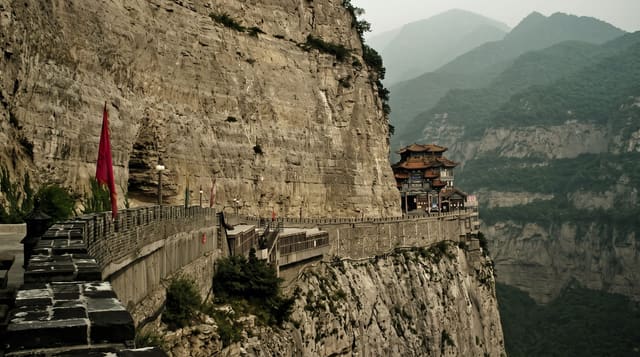
Nokogiriyama means saw mountain, for the profile left by two and a half centuries of quarrying - the Boshu stone taken from here went into buildings across Edo and Yokohama, and the extraction left vertical cut faces, square shafts and a plateau of sheer walls that look engineered because they are. Nihonji, a temple founded by tradition in 725, occupies the mountain, and the quarry work and the temple work overlap: between 1780 and 1798 a sculptor and his apprentices carved about 1,500 stone arhats into niches along the paths, each one different, many damaged in the nineteenth century and progressively restored. A Buddha of 31 metres, the largest carved stone image in Japan, was cut from the rock face in the same period and recut in the 1960s. Jigoku Nozoki, hell lookout, is a slab of quarried rock projecting over a hundred-metre drop.
The main sights
- Quarry faces - vertical cut walls left by two and a half centuries of stone extraction.
- 1,500 arhats - stone figures carved into niches between 1780 and 1798, each different.
- A 31-metre Buddha - the largest carved stone image in Japan, cut from the rock face.
- Jigoku Nozoki - a projecting slab over a drop of about a hundred metres.
When to go
All year; spring and autumn for comfort. Half a day.
What to expect
There are a great many steps even with the ropeway - the site is spread over a mountain. Entry and ropeway are charged separately. The hell lookout queues for photographs and the drop is real. Summer is hot with limited shade on the upper paths.
Nearby
Tokyo Bay ferries cross from Kurihama; Kamogawa is south on the coast.
Key facts
Source: Wikidata, item Q34882563, read on 18 October 2026.
What to pack for Nokogiriyama
Chosen from what this place is for. Tap a kit for the full checklist.
- Comfortable walking shoes - Sightseeing means kilometres of pavement and cobbles daily. Find on Amazon
- Modest clothing - Shoulders and knees covered - the single most common requirement. Find on Amazon
- A slim anti-theft daypack - Zips that close properly; keep it in front in crowds and on transit. Find on Amazon
- A scarf or shawl - To cover the head or shoulders on entry; women especially at mosques. Find on Amazon
Some links on this page are Amazon affiliate links - if you buy through them we may earn a small commission at no extra cost to you.
All packing kitsPlan your trip
Where to start if Nokogiriyama is going on the list.
Booking links on this page are affiliate links - if you book through them we may earn a small commission at no extra cost to you. It never changes what we write about a place.
Opening times, ticket prices and seasonal closures change - check the official source before you go: official site.