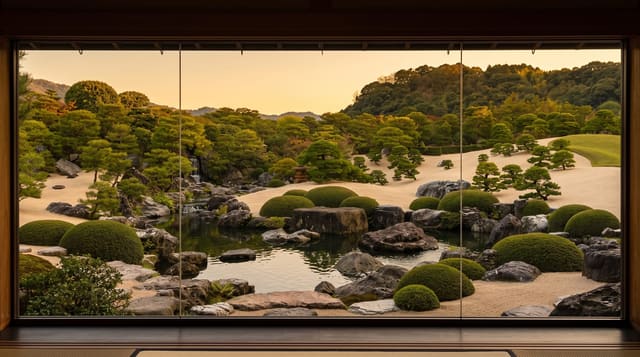
Iwami Ginzan
A silver mine at the heart of Japan's silver boom, listed by UNESCO partly for how little it damaged the land.
Updated 18 October 2026
UNESCO World Heritage
Iwami Ginzan was worked intensively from 1526, and at its peak in the early seventeenth century it is estimated to have produced about 38 tons of silver a year, at a time when Japan mined about a third of the world's silver - enough to appear on European maps of the period. The reason UNESCO inscribed it in 2007 is unusual: the citation emphasises that the mining was small-scale, done in hundreds of narrow hand-dug shafts rather than by open-cast extraction, that the surrounding forest was managed for fuel rather than stripped, and that the landscape recovered. About six hundred shafts are known; one, Ryugenji Mabu, is open to walk through, a narrow tunnel with chisel marks on the walls. Omori, the administrative town below, is a preserved street of houses and a magistrate's office. Cars are kept out of the valley, so the site is walked or cycled - about two kilometres from the town to the mine.
History
The Japanese merchant Kamiya Jutei found and opened the mine in 1526 and later brought in a Korean method of silver refining that became the haifukiho; at its peak in the early 1600s it produced about 38 tons of silver a year, at a time when Japan produced some 200 tons, a third of the world's output. Its silver was widely used for Japanese coins, warlords fought hard for it until the Tokugawa shogunate took control after the Battle of Sekigahara in 1600, and Yamabuki Castle stood at the centre of the workings, which were fenced and screened with pine trees. Production fell in the 19th century as the mine could not compete with others abroad, copper and other minerals took over, and mining ended in 1923, after almost four hundred years; in 2007 the mine and its cultural landscape became a World Heritage Site (Wikipedia, Iwami Ginzan Silver Mine).
What you'll find
- A hand-dug mine - hundreds of narrow shafts rather than open-cast working.
- Ryugenji Mabu - one tunnel open to walk, with chisel marks on the rock.
- Omori's street - a preserved administrative town below the mine.
- A recovered landscape - forest managed rather than stripped, which the UNESCO citation stresses.
When to go
April to November. A day. Bicycles are hired in Omori.
Things to know
Cars are excluded and the walk to the mine is a few kilometres each way. The open tunnel is short, low and wet. Much of the site is forest with markers rather than visible workings. Buses from Odashi are infrequent.
Nearby
Izumo Taisha is north-east; Matsue is beyond it.
Key facts
Source: Wikidata, item Q174139, read on 18 October 2026.
What to pack for Iwami Ginzan
Chosen from what this place is for. Tap a kit for the full checklist.
- Padded shorts - The one thing that makes a full day in the saddle bearable. Find on Amazon
- Comfortable walking shoes - Sightseeing means kilometres of pavement and cobbles daily. Find on Amazon
- Helmet - Bring your own if you have a good one; rentals vary wildly. Find on Amazon
- A slim anti-theft daypack - Zips that close properly; keep it in front in crowds and on transit. Find on Amazon
Some links on this page are Amazon affiliate links - if you buy through them we may earn a small commission at no extra cost to you.
All packing kitsPlan your trip
Where to start if Iwami Ginzan is going on the list.
Booking links on this page are affiliate links - if you book through them we may earn a small commission at no extra cost to you. It never changes what we write about a place.
Opening times, ticket prices and seasonal closures change - check the official source before you go: official site.