Vigevano
One of the earliest planned Renaissance squares, built as the forecourt of a castle and later a shoe town.
Updated 19 October 2026

AI illustration
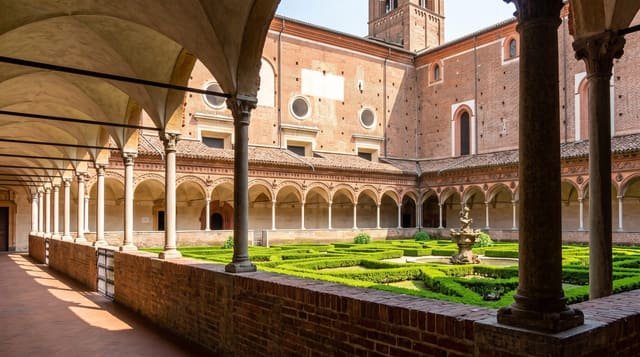
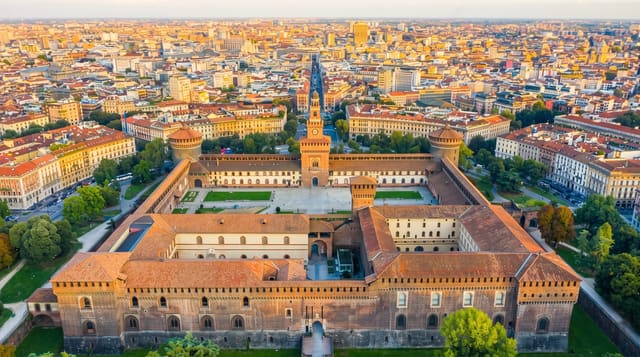
Ludovico il Moro cleared houses in 1492 to create Piazza Ducale as a monumental approach to his castle, a rectangle enclosed on three sides by uniform arcades on painted facades, with Bramante involved in the design; it is among the first squares in Europe conceived as a single architectural composition. The cathedral closes the fourth side with a curved baroque facade added later to correct the axis, since the church stands at an angle to the square. The castle behind is very large, with a covered elevated passage linking it to the older rocca. From the nineteenth century Vigevano became a centre of shoe manufacturing, recorded in a local museum.
History
The castle of Vigevano is first recorded in 963, and in 1154 Emperor Frederick Barbarossa gave the town to Pavia. In 1328 it passed to Azzone Visconti and thereafter followed the fortunes of Milan, and in 1445 Filippo Maria Visconti built the church of San Pietro Martire with its Dominican convent (Wikipedia, Vigevano).
What's there
- Piazza Ducale - a uniform arcaded square of 1492 with painted facades.
- The curved cathedral front - a baroque facade built to fix a crooked axis.
- The Sforza castle - a huge complex with a covered elevated passage.
- The shoe museum - the industry that shaped the modern town.
When to go
April to October; the square is at its best in evening light. The castle keeps limited hours and closes Mondays. Winter fog is heavy on the plain.
Good to know
Much of the castle is empty or closed. The rest of the town is ordinary. Fog in winter can obscure the square entirely.
Nearby
Pavia and the Certosa lie southeast; Milan is northeast.
Key facts
Source: Wikidata, item Q40832, read on 18 October 2026.
What to pack for Vigevano
Chosen from what this place is for. Tap a kit for the full checklist.
- Comfortable walking shoes - Sightseeing means kilometres of pavement and cobbles daily. Find on Amazon
- Modest clothing - Shoulders and knees covered - the single most common requirement. Find on Amazon
- A slim anti-theft daypack - Zips that close properly; keep it in front in crowds and on transit. Find on Amazon
- A scarf or shawl - To cover the head or shoulders on entry; women especially at mosques. Find on Amazon
Some links on this page are Amazon affiliate links - if you buy through them we may earn a small commission at no extra cost to you.
All packing kitsPlan your trip
Where to start if Vigevano is going on the list.
Booking links on this page are affiliate links - if you book through them we may earn a small commission at no extra cost to you. It never changes what we write about a place.
Opening times, ticket prices and seasonal closures change - check the official source before you go: official site.