The Last Supper
A mural Leonardo painted in a technique that failed almost immediately, kept alive by centuries of repair.
Updated 21 October 2026

AI illustration
UNESCO World Heritage
Leonardo painted this on the refectory wall of Santa Maria delle Grazie between about 1495 and 1498, using tempera and oil on dry plaster rather than true fresco so he could work slowly and revise; the paint began flaking within twenty years. It has been repainted, cleaned and restored repeatedly, most recently in a twenty-one-year campaign completed in 1999 that stripped earlier overpainting and left the surviving original, which is a fraction of the whole. A door was cut through the bottom in 1652, removing Christ's feet. Allied bombing in 1943 destroyed the refectory roof and one wall; the mural, sandbagged, survived.
History
Leonardo painted the Last Supper for his patron Ludovico Sforza, Duke of Milan, in the refectory of Santa Maria delle Grazie in about 1495-1498, finishing on 9 February 1498, but because the hastily rebuilt walls held moisture and his method did not bind to them, it began to decay almost at once: by 1517 it was flaking, and in 1556 Vasari called it a muddle of blots. Two early full-size copies by his assistants survive, one by Giampietrino in the Royal Academy in London and one by Cesare da Sesto at Ponte Capriasca in Switzerland. In 1652 a doorway was cut through the bottom centre, in 1726 Michelangelo Bellotti filled the gaps with oil paint and varnish, and in 1770 Giuseppe Mazza stripped that and repainted all but three faces before public outrage stopped him; in 1800, Goethe wrote, the room was flooded two feet deep after a storm (Wikipedia, The Last Supper - Leonardo).
What you'll find
- The surviving original - a fragment of Leonardo's paint after restoration.
- The cut doorway - the 1652 opening that removed the lower centre.
- The bombed refectory - a room rebuilt after 1943 around the wall.
- The composition - the moment of the announcement of betrayal.
When to go
Year-round; entry is in timed groups of limited size for fifteen minutes, and tickets are released in blocks that sell out months ahead. Booking is essential.
Things to know
Viewing is fifteen minutes in a controlled group, no more. Tickets must be booked far in advance and resellers charge heavily. Much of the original paint is gone.
Nearby
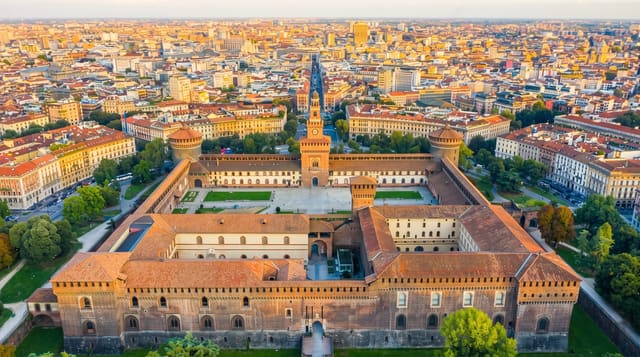
the Sforza Castle lies northeast; the Duomo is east.
Key facts
Source: Wikidata, item Q128910, read on 18 October 2026.
What to pack for The Last Supper
Chosen from what this place is for. Tap a kit for the full checklist.
- Comfortable walking shoes - Sightseeing means kilometres of pavement and cobbles daily. Find on Amazon
- A slim anti-theft daypack - Zips that close properly; keep it in front in crowds and on transit. Find on Amazon
- A refillable water bottle - Many cities have public fountains; save money and plastic. Find on Amazon
- A light layer + compact umbrella - For museum air-con and a sudden shower. Find on Amazon
Some links on this page are Amazon affiliate links - if you buy through them we may earn a small commission at no extra cost to you.
All packing kitsPlan your trip
Where to start if The Last Supper is going on the list.
Booking links on this page are affiliate links - if you book through them we may earn a small commission at no extra cost to you. It never changes what we write about a place.
Opening times, ticket prices and seasonal closures change - check the official source before you go: official site.