Piazza Navona
A baroque square in the shape of a Roman stadium, because that is exactly what lies beneath it.
Updated 19 October 2026
AI illustration
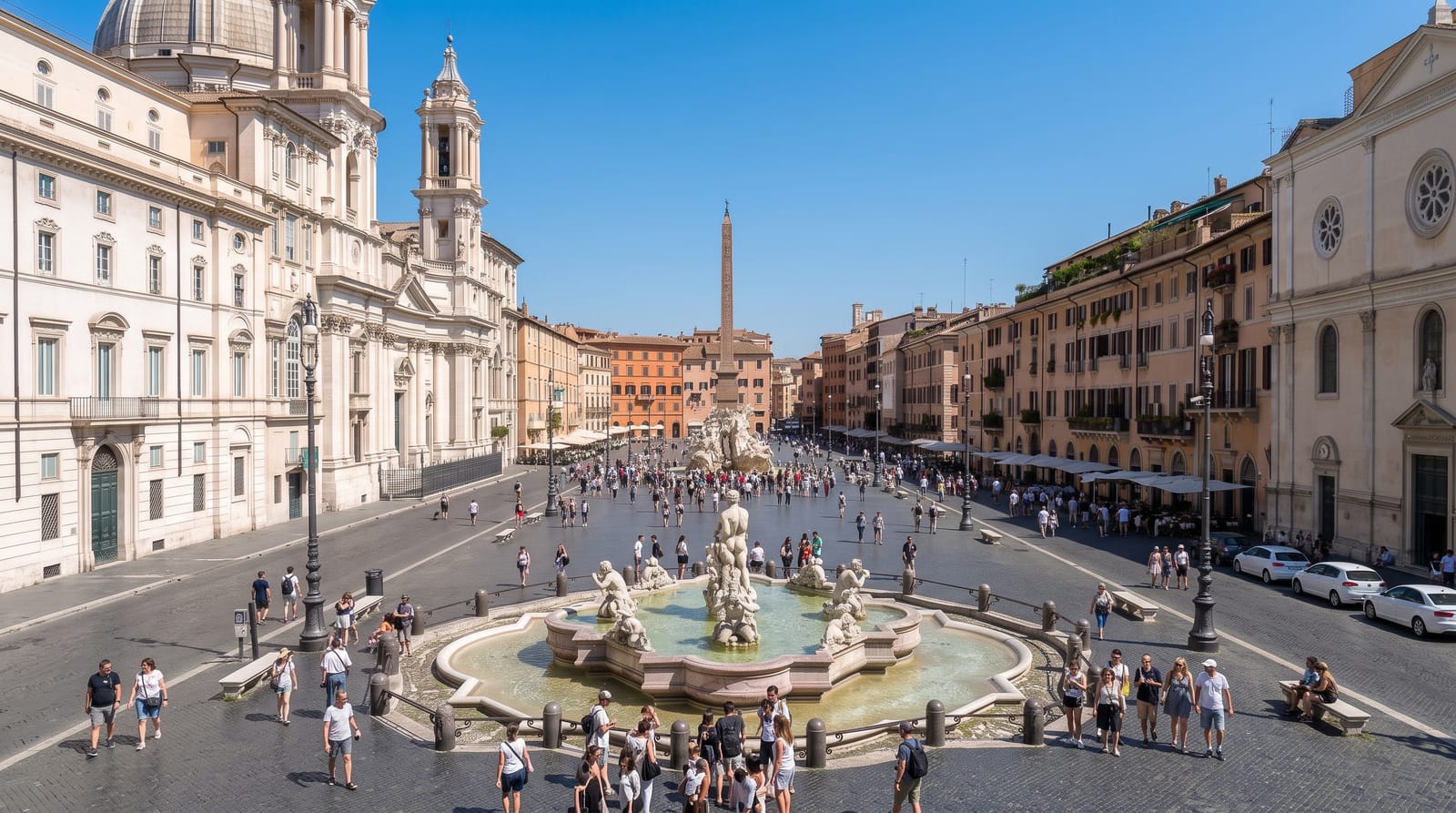
The square's long oval shape is not a design choice: Domitian built a stadium here in 86 for athletic contests, seating around thirty thousand, and the medieval city built on its foundations, so the buildings follow the line of the seating and the open space is the track. Sections of the stadium are visible underground beneath the northern end. Bernini's Fountain of the Four Rivers, finished in 1651, personifies the Nile, Ganges, Danube and Río de la Plata around an Egyptian obelisk; the Nile figure's veiled head refers to the river's then-unknown source, not, as the popular story has it, to distaste for Borromini's church opposite.
History
The square follows the shape of the Stadium of Domitian of the 1st century AD, where Romans came to watch the agones, the games, which is why it was known as the Circus Agonalis. It became a public space in the last years of the 15th century, when the city market moved here from the Campidoglio, and it was turned into a showpiece of Baroque Rome under Pope Innocent X, from 1644 to 1655, whose family palace, the Palazzo Pamphili, faces the square (Wikipedia, Piazza Navona).
What to look for
- The stadium outline - a square shaped by the seating of Domitian's arena.
- The Four Rivers fountain - Bernini's 1651 personifications around an obelisk.
- The underground stadium - excavated sections beneath the northern end.
- Sant'Agnese in Agone - Borromini's church on the western side.
When to go
April to June and September to October; the square is busy at all hours and calmest early morning. The Christmas market fills it in December. Cafe prices on the square are very high.
Before you go
The story that Bernini's Nile shields its eyes from Borromini's church is a later invention; the fountain predates the facade. Cafes on the square charge heavily for the position. Crowds are constant.
Nearby
The Pantheon lies east; Campo de' Fiori is south.
Key facts
Source: Wikidata, item Q463400, read on 18 October 2026.
What to pack for Piazza Navona
Chosen from what this place is for. Tap a kit for the full checklist.
- Head torch + spare batteries - Hands-free light is essential; caves are truly dark. Find on Amazon
- Comfortable walking shoes - Sightseeing means kilometres of pavement and cobbles daily. Find on Amazon
- Grippy closed shoes - Cave floors are wet, muddy and slick with formations. Find on Amazon
- A slim anti-theft daypack - Zips that close properly; keep it in front in crowds and on transit. Find on Amazon
Some links on this page are Amazon affiliate links - if you buy through them we may earn a small commission at no extra cost to you.
All packing kitsPlan your trip
Where to start if Piazza Navona is going on the list.
Booking links on this page are affiliate links - if you book through them we may earn a small commission at no extra cost to you. It never changes what we write about a place.
Opening times, ticket prices and seasonal closures change - check the official source before you go: official site.