Great St Bernard Pass
A pass crossed since the Bronze Age, with a hospice that has sheltered travellers continuously since 1050.
Updated 18 October 2026
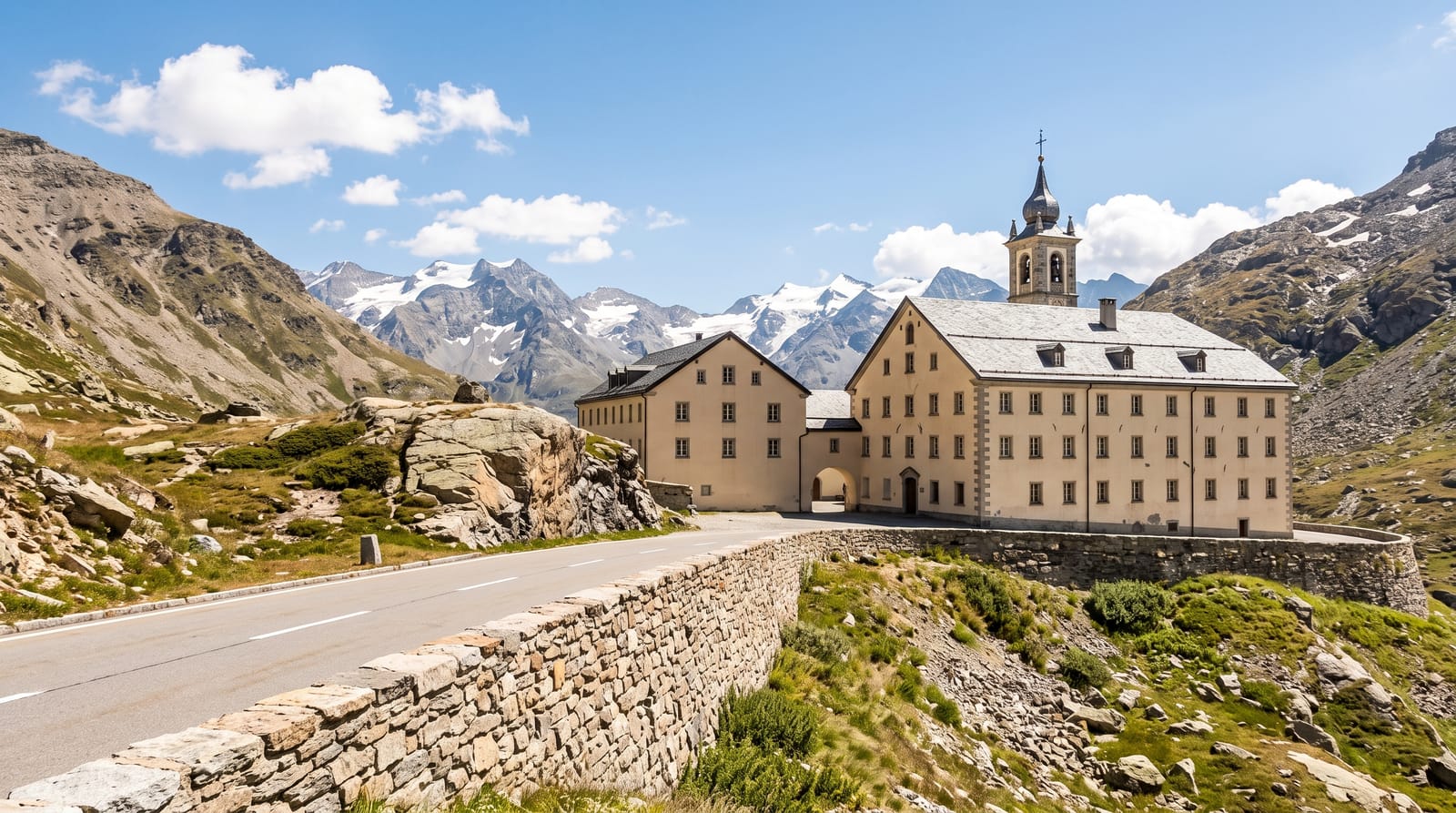
AI illustration
The pass sits at 2,469 metres on the Swiss border and has been used since prehistory, with a Roman road and a temple to Jupiter Poeninus at the summit, from which the Latin name Mons Iovis derives. Bernard of Menthon founded a hospice around 1050 to shelter travellers, and canons have kept it running ever since, one of the longest continuously operating institutions of its kind. The dogs bred there for rescue work took the pass's name; the barrel round the neck is a Victorian invention. Napoleon's army crossed here in May 1800. A tunnel below now carries year-round traffic.
History
The Roman road over the pass was completed by AD 43 under the emperor Claudius, with a staging post and the temple to Jupiter Poeninus at the summit, on the ground still called the Plan de Jupiter. In May 1800 Napoleon took about 40,000 men and a third of their heavy artillery over the top, while another 20,000 crossed three other passes as a diversion. The hospice's dogs were sold in 2004; the Fondation Barry du Grand Saint Bernard bought them and keeps breeding them. The road tunnel beneath the pass opened in 1964 and took most of the commercial traffic (Wikipedia, Great St Bernard Pass).
Highlights
- The hospice - a refuge run continuously by canons since about 1050.
- The summit lake - a cold tarn on the border beside the buildings.
- The Roman traces - the temple site and road on the pass.
- The dogs - the St Bernard breed kept in kennels at the hospice.
When to go
June to September; the high road over the pass closes from roughly October to May and traffic uses the tunnel below. Snow can lie at the summit in any month.
Practical notes
The pass road is shut for more than half the year. Weather at 2,469 metres is cold and changeable. The hospice is a religious house, not a hotel attraction.
Nearby
Aosta lies south; the Swiss Valais is over the border.
What to pack for Great St Bernard Pass
Chosen from what this place is for. Tap a kit for the full checklist.
- Warm base layers - Merino or synthetic against the skin - never cotton, which chills when damp. Find on Amazon
- Comfortable walking shoes - Sightseeing means kilometres of pavement and cobbles daily. Find on Amazon
- Modest clothing - Shoulders and knees covered - the single most common requirement. Find on Amazon
- An insulated + windproof jacket - A down or synthetic layer under a hard shell handles most cold. Find on Amazon
Some links on this page are Amazon affiliate links - if you buy through them we may earn a small commission at no extra cost to you.
All packing kitsPlan your trip
Where to start if Great St Bernard Pass is going on the list.
Booking links on this page are affiliate links - if you book through them we may earn a small commission at no extra cost to you. It never changes what we write about a place.
Opening times, ticket prices and seasonal closures change - check the official source before you go: official site.