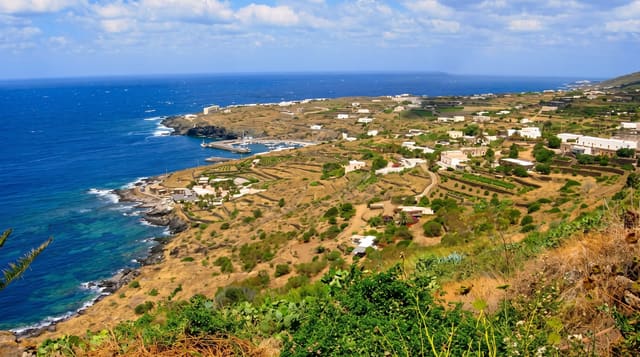
The Aeolian Islands
Seven volcanic islands off Sicily's north coast - Stromboli's nightly fireworks, Vulcano's mud and Salina's green terraces, UNESCO-listed as living volcanology.
Updated 18 October 2026
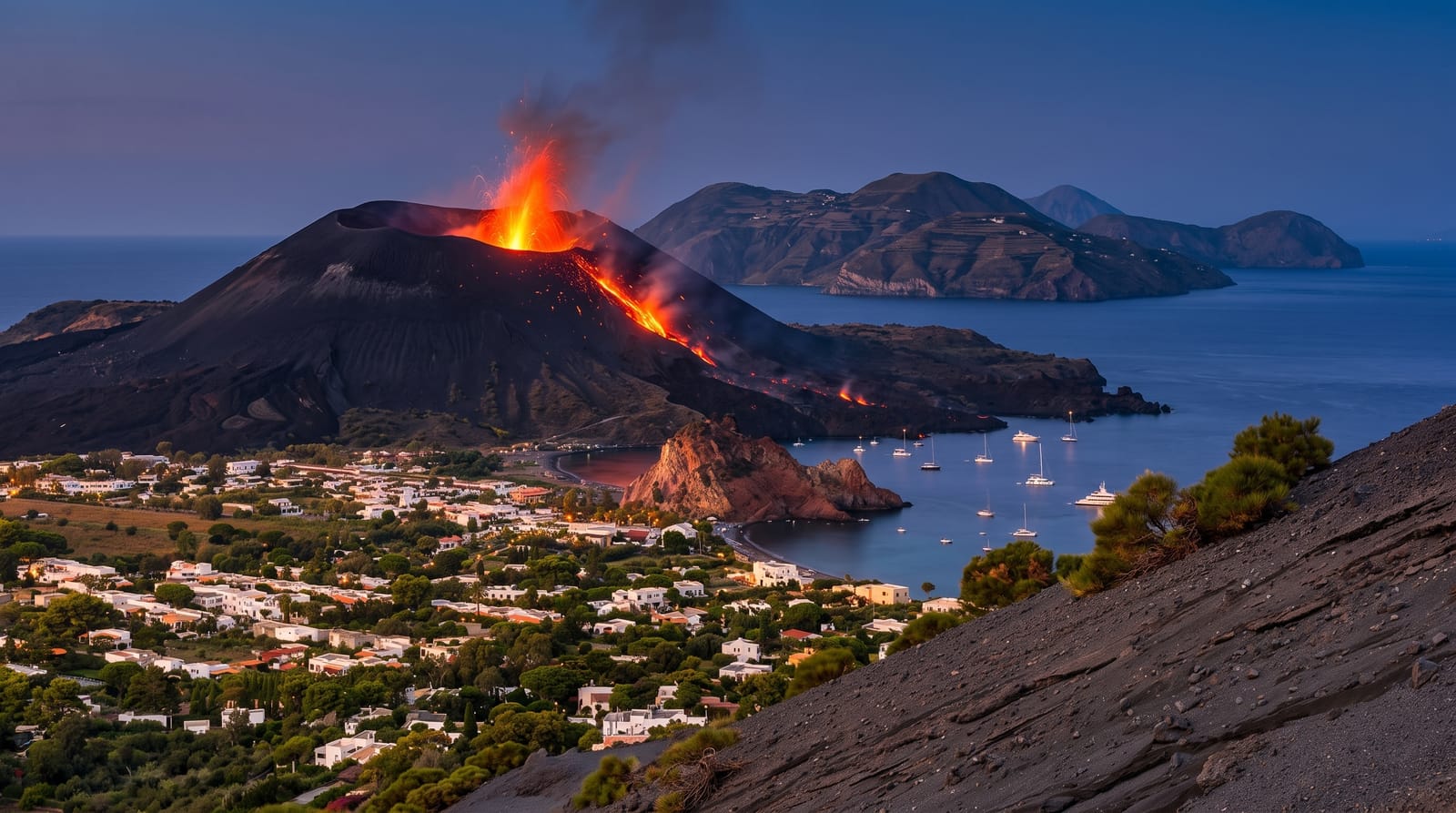
AI illustration
UNESCO World Heritage
The Aeolians are seven volcanic islands scattered across the Tyrrhenian off Sicily's north coast, inscribed by UNESCO because two of volcanology's textbook eruption styles - Strombolian and Vulcanian - are named from here, and the textbook is still being written nightly. Stromboli is the showpiece: a black cone rising sheer from the sea that has been erupting more or less continuously for millennia, flinging incandescent rock skyward on a schedule reliable enough that evening boats gather below the Sciara del Fuoco fire-slope to watch. Vulcano counters with sulphurous fumaroles, warm seas and its famous mud; Lipari runs the archipelago as its pumice-and-obsidian capital; green Salina grows the capers and sweet Malvasia wine; Panarea does whitewashed chic; and Alicudi and Filicudi hold the far end in near-roadless quiet, donkeys still meeting the hydrofoil. Island-hopping between them is the whole art.
History
Settlers from Sicily reached Lipari between 4000 and 2500 BC and grew rich on obsidian, and in the Bronze Age the islanders traded from Mycenae to the British Isles, until their villages were wrecked by new Italic invaders around 1250 BC. Greeks from Rhodes and Knidos settled Lipari in 580 BC, the islands sided with Carthage in the Punic Wars and were sacked by Rome, and in 836 the Aghlabids sacked Lipari and annexed the islands to the Emirate of Sicily. After the Norman conquest of 1061 Roger II sent Benedictine monks to Lipari, and a cathedral was built to Saint Bartholomew, the islands' patron since, as legend has it, his body washed ashore here in 264. On 30 June 1544 the corsair Hayreddin Barbarossa took Lipari with 180 ships and carried off much of its population, traditionally 9,000 of 10,000 people, though recent scholars suggest fewer, after which Spain resettled and rebuilt the town; the islands had not a single victim in the earthquake of 1693 that killed some 60,000 people in eastern Sicily, and malvasia grapes and capers brought new prosperity (Wikipedia, Aeolian Islands).
What you'll find
- Stromboli by night - incandescent bursts over the Sciara del Fuoco from a boat.
- Vulcano's fumaroles - steaming yellow vents and warm volcanic seas.
- Salina's green terraces - capers, Malvasia vineyards and twin peaks.
- Lipari's citadel - the pumice-white capital and its archaeology museum.
When to go
May, June and September give warm seas, running boats and rooms at sane prices; July and August double the crowds and rates. Off-season the archipelago half-closes and winter swells cancel hydrofoils - build slack into any shoulder-season plan.
Things to know
Everything moves by boat, and boats obey the sea - departure boards are suggestions in rough weather. Stromboli summit access runs guided-only and the permitted altitude shifts with activity; the boat view of the eruptions asks nothing and delivers plenty. Panarea prices are Capri-adjacent in August.
Nearby
Milazzo is the mainland gateway; Cefalu and Taormina bracket the Sicilian coast within day-trip logic of the ferry ports.
Key facts
Source: Wikidata, item Q179883, read on 18 October 2026.
What to pack for The Aeolian Islands
Chosen from what this place is for. Tap a kit for the full checklist.
- Reef-safe sunscreen - High SPF that will not bleach the coral you are swimming over. Find on Amazon
- Modest clothing - Shoulders and knees covered - the single most common requirement. Find on Amazon
- Quick-dry towel - A microfibre towel packs small and dries in minutes. Find on Amazon
- A scarf or shawl - To cover the head or shoulders on entry; women especially at mosques. Find on Amazon
Some links on this page are Amazon affiliate links - if you buy through them we may earn a small commission at no extra cost to you.
All packing kitsPlan your trip
Where to start if The Aeolian Islands is going on the list.
Booking links on this page are affiliate links - if you book through them we may earn a small commission at no extra cost to you. It never changes what we write about a place.
Opening times, ticket prices and seasonal closures change - check the official source before you go: official site.