The Burren
A vast limestone pavement in County Clare - a lunar landscape of bare grey rock where Arctic and Mediterranean flowers grow side by side.
Updated 18 October 2026

AI illustration
Real photos (1)
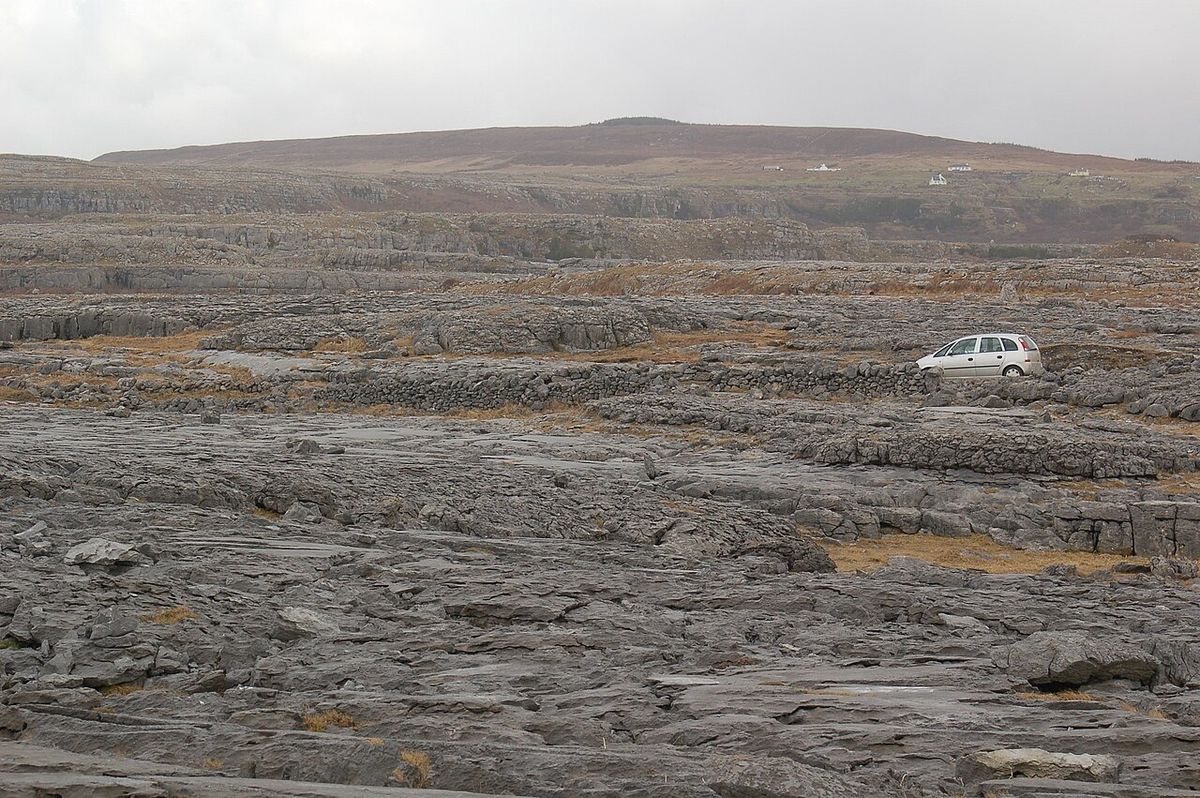
The Burren is a strange, beautiful landscape in County Clare, a vast expanse of bare grey limestone pavement cracked into blocks, seemingly barren yet home to an extraordinary mix of Arctic, alpine and Mediterranean wildflowers growing in its crevices. Scattered with ancient tombs and forts, it is a place unlike anywhere else in Ireland.
History
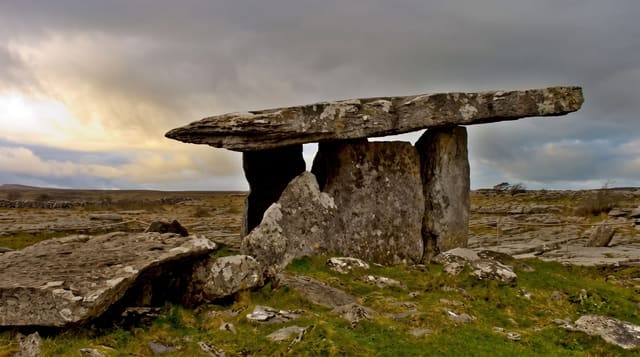
People have used this rock for a very long time: butchered bones found in caves have been radiocarbon dated to about 33,000 years ago, from Ice Age hunters. Settlers had clearly arrived by around 4000 BC, clearing the woods and building stone walls and tombs such as Poulnabrone dolmen; there are around 70 megalithic tombs in the Burren, most of them wedge tombs from about 2500 to 2000 BC, and more than 300 Bronze Age fulachtaí fia, probably places where water was heated by fire. One old habit survives: cattle are moved up to the uplands in winter, the reverse of the usual pattern, so they can graze all year (Wikipedia, The Burren).
Background
The name comes from the Irish Boirinn, meaning rocky district. The area measures around 530 square kilometres, inside a ring traced by Lisdoonvarna, Corofin, Gort and Kinvara. Approximately 325 million years ago, in the Visean stage of the early Carboniferous, the limestone settled as sediment in a tropical sea, and the bed is up to 800 metres thick. Roughly 60% of the uplands are bare limestone pavement, and the surface karst dates from approximately 10,000 years ago. More than 50 kilometres of cave passages have been mapped. Because the soil rarely cools below 6 °C, the growing season is among the longest in Ireland or Britain.
Source: Wikipedia, "The Burren"
The landscape
- The limestone pavement - the vast cracked grey rock, seemingly lunar.
- The wildflowers - the rare mix of Arctic and Mediterranean flowers in spring.
- Poulnabrone dolmen - the ancient portal tomb on the rock.
- Caves and forts - the Aillwee Cave and the stone ring forts.
When to go
Late spring, especially May and June, for the astonishing wildflower display; the rock landscape is striking year-round. The bare stone can be bleak and slippery in wet weather.
Things to know
It is a subtle landscape whose wonder is the flowers and the strange rock rather than a single dramatic view, so a little knowledge deepens it. The pavement is uneven and slippery when wet, so tread carefully. It is spread out, so a car helps.
Nearby
The Cliffs of Moher are on the same coast; Galway is an hour to the north.
Key facts
Source: Wikidata, item Q917858, read on 18 October 2026.
What to pack for The Burren
Chosen from what this place is for. Tap a kit for the full checklist.
- Broken-in walking shoes or boots - Grip and ankle support matter more than looks; never hike in brand-new boots. Find on Amazon
- Head torch + spare batteries - Hands-free light is essential; caves are truly dark. Find on Amazon
- Spare batteries + cards - Cold and long shoots drain power; never run out at the good light. Find on Amazon
- Warm base layers - Merino or synthetic against the skin - never cotton, which chills when damp. Find on Amazon
Some links on this page are Amazon affiliate links - if you buy through them we may earn a small commission at no extra cost to you.
All packing kitsPlan your trip
Where to start if The Burren is going on the list.
Booking links on this page are affiliate links - if you book through them we may earn a small commission at no extra cost to you. It never changes what we write about a place.
Opening times, ticket prices and seasonal closures change - check the official source before you go: official site.