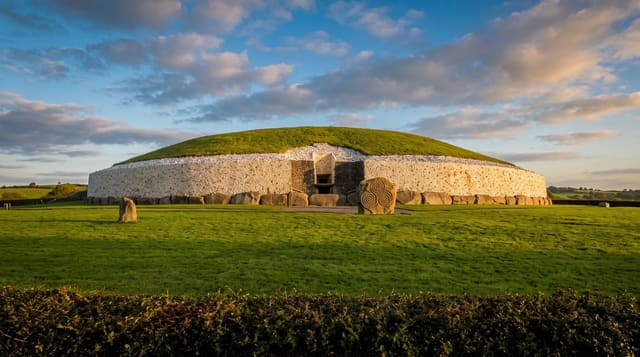
Knowth
A great Neolithic mound in the Boyne Valley carrying about a third of all known megalithic art in Western Europe.
Updated 21 October 2026
UNESCO World Heritage
Knowth is the largest of the three great Boyne Valley mounds, built around 3200 BC, and it differs from Newgrange in two ways that matter. It has two passages rather than one, entering from east and west and nearly meeting in the middle, and it is ringed by around 127 kerbstones, most of them carved - together with the art inside, that amounts to roughly a third of all known megalithic art in Western Europe, including the celebrated stone sometimes read as a lunar calendar. Seventeen smaller satellite tombs surround the main mound. The site was reused repeatedly: Iron Age burials, an early medieval settlement with souterrains, and a Norman motte on top. The passages are not open to visitors - unlike Newgrange, you cannot go inside - but you can walk on the mound and around the full kerb, which is where the carving is.
History
Knowth was built around 3200 BC, a great passage tomb ringed by 17 smaller tombs, and holds the largest assemblage of megalithic art in Europe. After the mound fell out of use, a timber circle of the late Neolithic stood near its eastern entrance, the cairn slipped and covered both passages, and for some two thousand years the site was hardly used, apart from about 35 cist graves. In the late Iron Age and early Christian period it became a fortified settlement with ditches and souterrains, people found their way into the passages again and carved four names in ogham in the eastern chamber, and Knowth became the seat of the kings of Northern Brega. The Normans used it as a motte in the 12th century, the Cistercians of Mellifont then farmed it, the state took over most of the site in 1939, and George Eogan led excavations from the 1960s to the 1980s (Wikipedia, Knowth).
The main sights
- The kerbstones - around 127, most carved, ringing the mound.
- The two passages - east and west, unusual among Irish tombs.
- The satellite tombs - seventeen smaller mounds around the main one.
- The later layers - Iron Age burials, early medieval souterrains, a Norman motte.
When to go
April to October for the fullest tour schedule. Access is only by shuttle from the visitor centre and slots must be booked - turning up without a booking often means being turned away.
Before you go
You cannot enter the passages at Knowth, which disappoints people expecting the Newgrange experience. Access is by timed shuttle only; walking or driving to the site is not permitted. Tours are cancelled in bad weather at times.
Nearby
Newgrange and Dowth are the other Boyne mounds; the visitor centre serves all three.
Key facts
Source: Wikidata, item Q1482124, read on 18 October 2026.
What to pack for Knowth
Chosen from what this place is for. Tap a kit for the full checklist.
- Comfortable walking shoes - Sightseeing means kilometres of pavement and cobbles daily. Find on Amazon
- A slim anti-theft daypack - Zips that close properly; keep it in front in crowds and on transit. Find on Amazon
- A refillable water bottle - Many cities have public fountains; save money and plastic. Find on Amazon
- A light layer + compact umbrella - For museum air-con and a sudden shower. Find on Amazon
Some links on this page are Amazon affiliate links - if you buy through them we may earn a small commission at no extra cost to you.
All packing kitsPlan your trip
Where to start if Knowth is going on the list.
Booking links on this page are affiliate links - if you book through them we may earn a small commission at no extra cost to you. It never changes what we write about a place.
Opening times, ticket prices and seasonal closures change - check the official source before you go: official site.