Bective Abbey
A Cistercian abbey on the Boyne, unfenced and unstaffed, with a cloister you can walk into at any hour.
Updated 19 October 2026
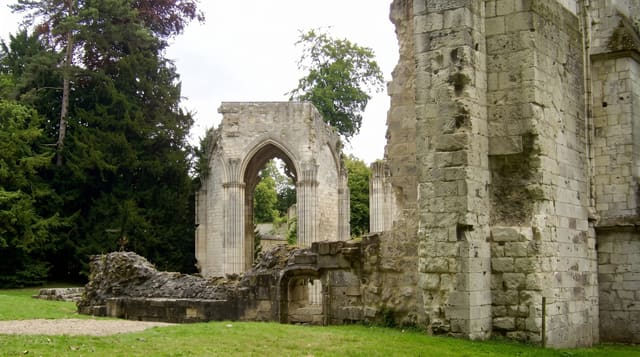
Bective was founded in 1147 as a daughter house of Mellifont, the second Cistercian abbey in Ireland, and it was important enough that its abbot sat in the Irish parliament. After the dissolution in 1536 it was converted into a fortified house, which is why the ruin reads oddly - monastic cloister arcades and a tower and mullioned windows from a later domestic conversion, all in the same walls. The cloister is the best surviving part, with an arcade on two sides. The body of Hugh de Lacy, the Norman lord of Meath killed in 1186, was reportedly buried here while his head went to Saint Thomas's Abbey in Dublin, prompting a long dispute between the two houses. Braveheart filmed here in 1994. The site is open ground beside the road, with no gate, no staff and no ticket, and it is usually deserted.
History
The abbey was founded in 1147 by Murchad O'Maeil-Sheachlainn as a daughter house of Mellifont, and most of what remains dates from the 15th century. Its lands were confiscated in the Dissolution of the Monasteries in the 1530s, rented to Thomas Asgarde and bought by Andrew Wyse in 1552, and the state bought the site in 2012 (Wikipedia, Bective Abbey).
What you'll find
- The cloister - arcades surviving on two sides, walkable.
- The mixed fabric - monastic work and the later fortified house in one ruin.
- The tower - added in the post-dissolution conversion.
- The setting - the Boyne alongside, with no fence or gate.
When to go
April to October. The ruins are open at any hour with no gate, though the ground is uneven and unlit. Grass and stone are slippery after rain.
What to expect
Unstaffed, unlit and only lightly stabilised - loose stone, uneven ground and open drops in places. No facilities, no interpretation beyond a panel, and roadside parking only.
Nearby
Trim Castle is south; the Hill of Tara and Navan are north-east.
Key facts
Source: Wikidata, item Q813773, read on 18 October 2026.
What to pack for Bective Abbey
Chosen from what this place is for. Tap a kit for the full checklist.
- Comfortable walking shoes - Sightseeing means kilometres of pavement and cobbles daily. Find on Amazon
- Modest clothing - Shoulders and knees covered - the single most common requirement. Find on Amazon
- A slim anti-theft daypack - Zips that close properly; keep it in front in crowds and on transit. Find on Amazon
- A scarf or shawl - To cover the head or shoulders on entry; women especially at mosques. Find on Amazon
Some links on this page are Amazon affiliate links - if you buy through them we may earn a small commission at no extra cost to you.
All packing kitsPlan your trip
Where to start if Bective Abbey is going on the list.
Booking links on this page are affiliate links - if you book through them we may earn a small commission at no extra cost to you. It never changes what we write about a place.
Opening times, ticket prices and seasonal closures change - check the official source before you go: official site.