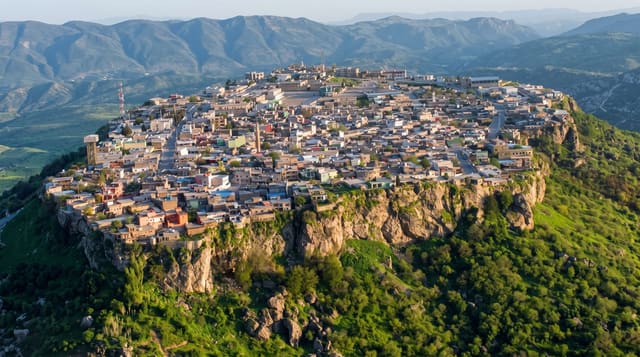
Kirkuk Citadel
An ancient mound above the Khasa river in Kirkuk, occupied for thousands of years and now largely emptied.
Updated 21 October 2026
The citadel of Kirkuk stands on a tell rising above the Khasa river in the middle of the city, a settlement mound built up by continuous occupation reaching back thousands of years to the Assyrian city of Arrapha and earlier. On top were streets of houses, mosques, churches and a synagogue, and the tomb traditionally identified as that of the prophet Daniel, which is venerated by Muslims, Christians and Jews alike. The mound's population was moved off in the 1990s and most of the houses were demolished, leaving the tell largely bare with a few restored buildings, sections of wall and the tomb complex. Restoration has proceeded in phases. The city below is mixed Kurdish, Turkmen, Arab and Christian, and its market is worth the walk.
History
In 1923 archaeologists found 51 clay tablets near the citadel showing that the site goes back at least to the 2nd millennium BC. Seleucus I Nicator built a rampart with 72 towers around its 72 streets and two entrances, the so-called Red Church keeps traces of mosaics from before the 7th century, and Timur is believed to have visited the citadel in 1393 (Wikipedia, Kirkuk Citadel).
Highlights
- The tell - the occupation mound rising above the river and city.
- Daniel's tomb - the shrine venerated across several faiths.
- Restored fragments - the few buildings and wall sections rebuilt.
- The city below - the mixed quarters and market around the mound.
When to go
November to March; Kirkuk summers are severe. Mornings are best on the exposed mound. Access to parts of the citadel varies with the state of works and should be checked locally.
Practical notes
Most of the historic quarter on the mound was demolished and what remains is fragmentary, with restoration incomplete. Areas may be fenced. Interpretation is minimal.
Nearby
Sherwana castle lies south-east; Sulaymaniyah is east.
Key facts
Source: Wikidata, item Q1144137, read on 18 October 2026.
What to pack for Kirkuk Citadel
Chosen from what this place is for. Tap a kit for the full checklist.
- Comfortable walking shoes - Sightseeing means kilometres of pavement and cobbles daily. Find on Amazon
- Modest clothing - Shoulders and knees covered - the single most common requirement. Find on Amazon
- A slim anti-theft daypack - Zips that close properly; keep it in front in crowds and on transit. Find on Amazon
- A scarf or shawl - To cover the head or shoulders on entry; women especially at mosques. Find on Amazon
Some links on this page are Amazon affiliate links - if you buy through them we may earn a small commission at no extra cost to you.
All packing kitsPlan your trip
Where to start if Kirkuk Citadel is going on the list.
Booking links on this page are affiliate links - if you book through them we may earn a small commission at no extra cost to you. It never changes what we write about a place.
Opening times, ticket prices and seasonal closures change - check the official source before you go: official site.