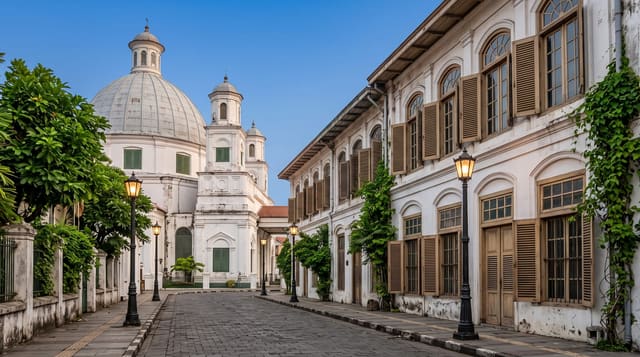
Lawang Sewu
The 1907 Dutch railway headquarters in Semarang, named for its thousand doors, with a basement famous for ghost stories.
Updated 21 October 2026
Lawang Sewu was built between 1904 and 1907 as the headquarters of the Nederlandsch-Indische Spoorweg Maatschappij, the first railway company in the Indies, and it is one of the better pieces of colonial architecture in Java - a large L-shaped building designed for the tropics with tall louvred doors and windows in long ranks to move air, a stained-glass stair hall made in Amsterdam, and a monumental brick front. The Javanese name means thousand doors, from the number of openings. The basement, used as a prison during the Japanese occupation, has generated a large ghost-story industry.
History
The name means "a thousand doors". The building was designed by Cosman Citroen of the firm of J. F. Klinkhamer and B. J. Quendag in the New Indies Style, a Dutch rationalism adapted to the Indies; building A was begun in 1904 and completed in 1907, the rest of the complex was finished in 1919, and it served first as the head office of the Nederlandsch-Indische Spoorweg Maatschappij, the first railway company in the Dutch East Indies (Wikipedia, Lawang Sewu).
What to look for
- Ranks of louvred doors - the tropical ventilation that gave the building its name.
- An Amsterdam stained-glass hall - the stair window imported for the headquarters.
- The wartime basement - used as a Japanese prison during the occupation.
- The New Indies Style - Dutch rationalism adapted to the tropics, designed by Cosman Citroen.
When to go
All year. Two hours.
Practical notes
The ghost-tour framing around the basement sits uncomfortably with what happened there. Restoration has been extensive. It is hot inside despite the ventilation, and crowded at weekends.
Nearby
Tugu Muda monument is opposite; the Kota Lama old town is north.
Key facts
Source: Wikidata, item Q1704755, read on 18 October 2026.
What to pack for Lawang Sewu
Chosen from what this place is for. Tap a kit for the full checklist.
- Comfortable walking shoes - Sightseeing means kilometres of pavement and cobbles daily. Find on Amazon
- A slim anti-theft daypack - Zips that close properly; keep it in front in crowds and on transit. Find on Amazon
- A refillable water bottle - Many cities have public fountains; save money and plastic. Find on Amazon
- A light layer + compact umbrella - For museum air-con and a sudden shower. Find on Amazon
Some links on this page are Amazon affiliate links - if you buy through them we may earn a small commission at no extra cost to you.
All packing kitsPlan your trip
Where to start if Lawang Sewu is going on the list.
Booking links on this page are affiliate links - if you book through them we may earn a small commission at no extra cost to you. It never changes what we write about a place.
Opening times, ticket prices and seasonal closures change - check the official source before you go: official site.