Borobudur
The largest Buddhist temple in the world - a colossal ninth-century stone mandala of terraces, reliefs and bell-shaped stupas rising from the jungle of Java, magical at sunrise, a UNESCO site.
Updated 18 October 2026

AI illustration
UNESCO World Heritage
Borobudur is the largest Buddhist temple in the world, a colossal ninth-century monument in central Java built as a giant stone mandala. Its nine stacked terraces, carved with kilometres of exquisite relief panels telling Buddhist teachings, rise to a summit crowned with dozens of bell-shaped stupas and a central dome, ringed by jungle and volcanoes. A UNESCO masterpiece, it is at its most magical at sunrise, emerging from the morning mist.
History
No records survive of who built Borobudur or why; by comparing its reliefs with royal inscriptions, Jacques Dumarçay dated the construction in five stages, begun under the Sailendra dynasty around 780 and completed around 833, in the same period as the Hindu temples of Prambanan nearby. When it fell out of use is unknown: sometime between 928 and 1006 King Mpu Sindok moved the Mataram capital to East Java after a series of volcanic eruptions, and the monument lay for centuries under volcanic ash and jungle, though the Nagarakretagama still mentions a vihara at Budur around 1365. In 1814 Thomas Stamford Raffles, then British administrator of Java, heard of it and sent the Dutch engineer Hermann Cornelius, whose 200 men spent two months clearing the trees and earth, and the whole complex was uncovered by 1835. Theodoor van Erp restored it from 1907, rebuilding the upper three circular platforms and their stupas, and the largest restoration, by the Indonesian government and UNESCO, was completed in 1983; in 1991 it became a World Heritage Site (Wikipedia, Borobudur).
What you'll find
- The stone mandala - the vast stacked temple of nine terraces.
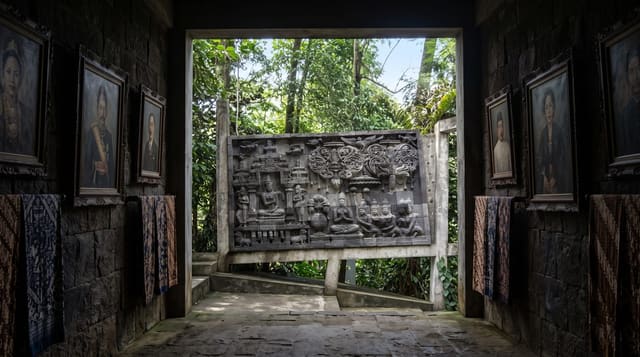
- The relief panels - the kilometres of carved Buddhist reliefs.
- The bell-shaped stupas - the summit terraces of latticed stupas.
- The sunrise - the temple emerging from the mist at dawn.
When to go
May to September, the dry season, for the clearest weather; sunrise is the classic and most atmospheric time, though it costs extra and books out. Note that visitor numbers and access to climb the upper terraces are now limited to protect the stone, so book ahead.
Practical notes
To protect the fragile stone, visitor numbers and access to climb to the upper terraces are now capped and require booking, often with a guide, so plan ahead. The famous sunrise experience is a premium ticket and popular. It is hot and can be crowded. It pairs naturally with the Hindu temples of Prambanan nearby.
Nearby
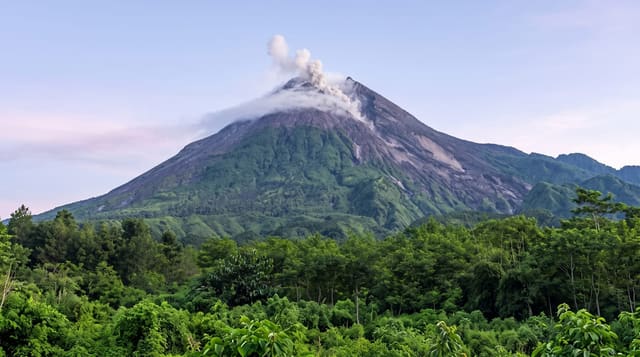
The Prambanan temples and the city of Yogyakarta are close; Mount Merapi looms nearby.
Key facts
Source: Wikidata, item Q42798, read on 18 October 2026.
What to pack for Borobudur
Chosen from what this place is for. Tap a kit for the full checklist.
- Strong insect repellent - DEET or picaridin; the jungle is where bites and disease risk are highest. Find on Amazon
- Comfortable walking shoes - Sightseeing means kilometres of pavement and cobbles daily. Find on Amazon
- Modest clothing - Shoulders and knees covered - the single most common requirement. Find on Amazon
- Long, light, quick-dry clothing - Covers skin from insects and sun without cooking you in the humidity. Find on Amazon
Some links on this page are Amazon affiliate links - if you buy through them we may earn a small commission at no extra cost to you.
All packing kitsPlan your trip
Where to start if Borobudur is going on the list.
Booking links on this page are affiliate links - if you book through them we may earn a small commission at no extra cost to you. It never changes what we write about a place.
Opening times, ticket prices and seasonal closures change - check the official source before you go: official site.