Vaishno Devi
A cave shrine reached by a twelve-kilometre climb, drawing around ten million pilgrims a year.
Updated 19 October 2026
AI illustration
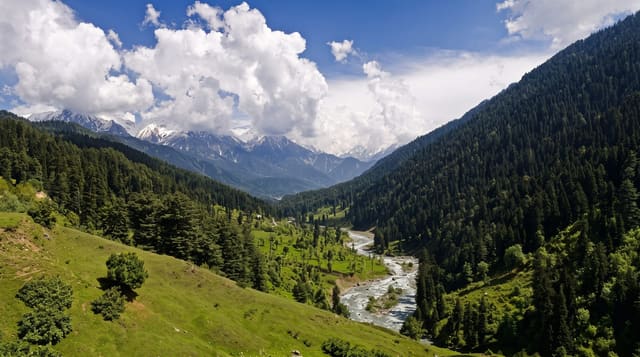
The shrine lies in a cave at about 1,585 metres in the Trikuta hills, where three natural rock formations called the pindies are venerated as the goddess. Pilgrims register at Katra and climb roughly twelve kilometres on a paved path, on foot, by pony, in a palanquin or by helicopter to a point near the top, walking through the night in large numbers. Around ten million people make the journey each year, which makes it one of the most visited religious sites in India. The old cave, narrow and low, is opened only when numbers permit; most enter through wider tunnels cut later.
History
The shrine began as a sacred site of local tribes who revered the mountain's three peaks as the goddess Trikuta Devi, and after migrations into the Jammu region around the 12th century the local deity gradually came to be identified with Vaishno Devi. A royal chronicle of 1847 says Raja Jas Dev of Jammu visited the shrine in 996 CE, in the 18th century Maharaja Ranjit Dev of Jammu set up the first formal facilities for pilgrims, water stations and shelters, by 1846 the temple was part of the Dharmarth Trust founded by Maharaja Gulab Singh, and in 2023 the shrine board reported 9.52 million pilgrims (Wikipedia, Vaishno Devi Temple).
What you'll find
- The cave shrine - three rock formations venerated as the goddess.
- The twelve-kilometre climb - a paved path with pilgrims day and night.
- Bhairon temple - the shrine higher up that pilgrims visit after.
- The scale - around ten million visitors annually on one path.
When to go
March to October; Navratri in spring and autumn brings the largest crowds. Summer is hot on the lower path, and winter can bring snow at the top. Nights are common for the climb, being cooler.
Things to know
Registration is compulsory and numbers are capped at busy times. The climb is long and crowded, with ponies on the same path. Bags, phones and cameras are restricted near the shrine, and queues for darshan run for hours.
Nearby
Katra is the base town; Jammu lies south.
Key facts
Source: Wikidata, item Q611371, read on 18 October 2026.
What to pack for Vaishno Devi
Chosen from what this place is for. Tap a kit for the full checklist.
- Head torch + spare batteries - Hands-free light is essential; caves are truly dark. Find on Amazon
- Warm base layers - Merino or synthetic against the skin - never cotton, which chills when damp. Find on Amazon
- Comfortable walking shoes - Sightseeing means kilometres of pavement and cobbles daily. Find on Amazon
- Modest clothing - Shoulders and knees covered - the single most common requirement. Find on Amazon
Some links on this page are Amazon affiliate links - if you buy through them we may earn a small commission at no extra cost to you.
All packing kitsPlan your trip
Where to start if Vaishno Devi is going on the list.
Booking links on this page are affiliate links - if you book through them we may earn a small commission at no extra cost to you. It never changes what we write about a place.
Opening times, ticket prices and seasonal closures change - check the official source before you go: official site.