Mount Abu
Rajasthan's only hill station, and the site of Jain temples whose marble carving is the finest in India.
Updated 19 October 2026
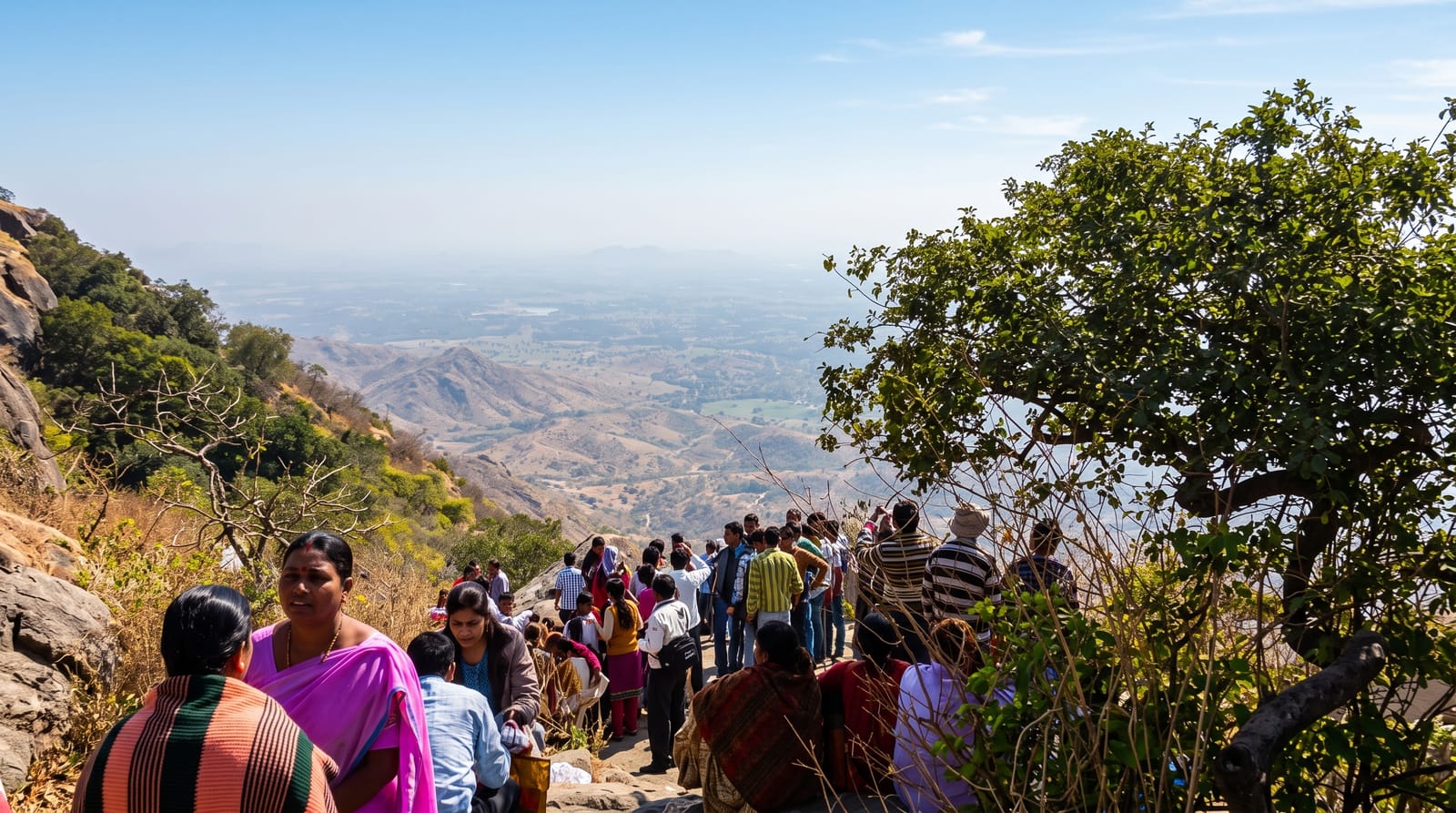
AI illustration
Mount Abu sits at about 1,220 metres on an isolated Aravalli plateau, cool enough to have served as a hill retreat for the Rajput states and the British, with Nakki Lake at its centre and viewpoints on the rim. Its real distinction is the Dilwara temples, five Jain temples built between the eleventh and thirteenth centuries in white marble hauled up the hill, whose interiors carry carving of a delicacy that is hard to credit in stone: lotus ceilings cut so thin the light passes through, pendants hanging free, and figured brackets across every surface. Guru Shikhar, the highest point in Rajasthan, lies nearby.
History
The ancient name of Mount Abu is Arbuda, and the Puranas call the region Arbudaranya, "forest of Arbuda"; legend says the sage Vasishtha performed a sacrifice on its peak, from whose fire-altar rose the first of the Agnivansha. The Paramara kings built Achalgarh Fort, Rao Lumba of the Deora-Chauhan dynasty took Mount Abu in 1311 and moved his capital to Chandravati in the plains, and after Chandravati was wrecked in 1405 Sirohi became the capital; the British later leased Abu from the Maharaja of Sirohi, and a municipality was set up here in 1864 (Wikipedia, Abu Raj).
What you'll find
- The Dilwara temples - marble carving of exceptional fineness, especially the ceilings.
- Nakki Lake - the small lake at the centre of the town.
- Guru Shikhar - the highest point in Rajasthan, a short drive away.
- The sunset points - rim viewpoints over the plain below.
When to go
October to March; Mount Abu is busiest in the summer months when Gujaratis and Rajasthanis escape the plains heat. Dilwara admits non-Jains only in the afternoon hours.
Things to know
Photography is entirely prohibited inside Dilwara and phones are collected at the gate. Leather is not allowed. The town itself is crowded and commercialised, with the temples the reason to come.
Nearby
Abu Road lies below; Udaipur is northeast.
Key facts
Source: Wikidata, item Q695221, read on 18 October 2026.
What to pack for Mount Abu
Chosen from what this place is for. Tap a kit for the full checklist.
- Comfortable walking shoes - Sightseeing means kilometres of pavement and cobbles daily. Find on Amazon
- Modest clothing - Shoulders and knees covered - the single most common requirement. Find on Amazon
- A slim anti-theft daypack - Zips that close properly; keep it in front in crowds and on transit. Find on Amazon
- A scarf or shawl - To cover the head or shoulders on entry; women especially at mosques. Find on Amazon
Some links on this page are Amazon affiliate links - if you buy through them we may earn a small commission at no extra cost to you.
All packing kitsPlan your trip
Where to start if Mount Abu is going on the list.
Booking links on this page are affiliate links - if you book through them we may earn a small commission at no extra cost to you. It never changes what we write about a place.
Opening times, ticket prices and seasonal closures change - check the official source before you go: official site.


