Kumbhalgarh Fort
A fifteenth-century hill fort in the Aravallis wrapped in a wall running some thirty-six kilometres over the ridges around it.
Updated 18 October 2026
AI illustration
UNESCO World Heritage
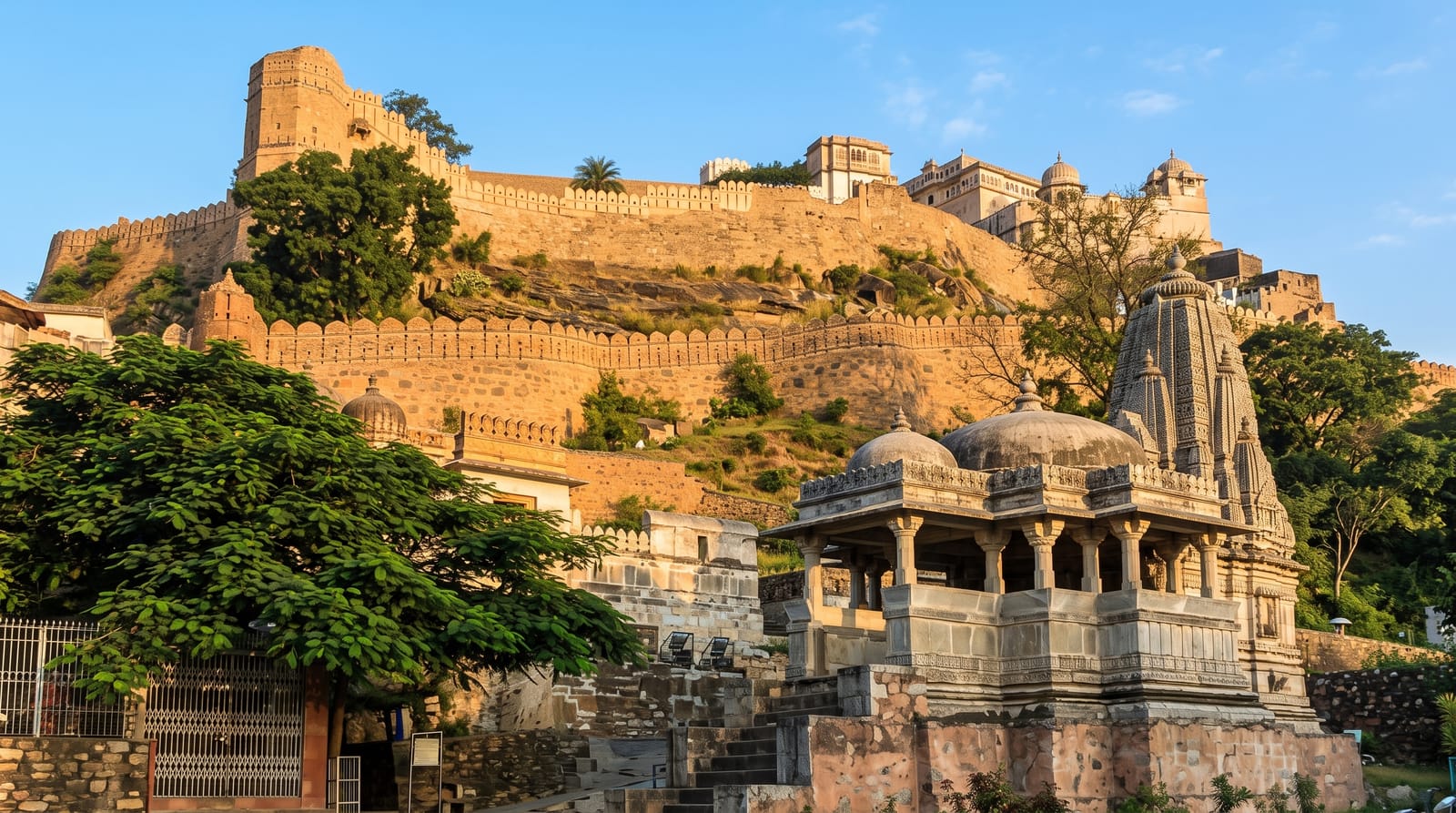
Kumbhalgarh is a fifteenth-century hill fort in the Aravalli range, built under Rana Kumbha, and its reputation rests on the wall. It runs for around thirty-six kilometres over the ridges, wide enough in places to walk along, dipping and climbing out of sight in both directions. Inside the enclosure are more than three hundred temples of various dates and, at the highest point, the Badal Mahal palace, from which the view is ridge after ridge of dry forest with almost no settlement in it. The fort adjoins a wildlife sanctuary, which is why the surroundings stay so empty. It is about two hours by road from Udaipur, and the winding approach is a good part of the trip.
History
Rana Lakha won this area and the plains of Godwar from the Chauhan Rajputs of Nadol in the late 14th century, and in 1448, according to the Kumbhalgarh inscription, Rana Kumbha ordered the fort, which was built by Mandan, chief architect of Mewar; of the 32 forts Kumbha is said to have built, it is the largest and most elaborate, and its name means Kumbha's fort. Ahmad Shah II of Gujarat failed to take it in 1457, as did Mahmud Khalji in 1458-59 and 1467, but Akbar's general Shahbaz Khan captured it in April 1578 after a six-month siege, and Maharana Pratap, who was born in the fort, recaptured it in 1583. In 1818 the British took it over and later returned it to Udaipur State; its wall runs for 36 kilometres, and since 2013 it has been part of the Hill Forts of Rajasthan World Heritage Site (Wikipedia, Kumbhalgarh).
The main sights
- The perimeter wall - the long rampart following the ridgeline, walkable for stretches from the gates.
- Badal Mahal - the palace at the summit, with painted rooms and a view over empty hills.
- The temple cluster - hundreds of shrines of different periods inside the walls, mostly unattended.
- The gateways - a sequence of stepped gates on the climb from the car park to the top.
When to go
October to March is dry and cool, and clear mornings give the longest views along the wall. The monsoon greens the hills and can be striking but brings mist that hides exactly what you came for. There is an evening sound and light show; check whether it is running before you plan around it. Allow travel time from Udaipur both ways.
What to expect
It is a long steep climb from the entrance to Badal Mahal, mostly on stone ramps in full sun, and there is no transport up. The famous wall cannot be walked end to end, only in short accessible sections, which surprises people. Interpretation on site is minimal. The two-hour drive each way makes it a full day for one fort.
Nearby
The Jain temple complex at Ranakpur is about an hour away and is usually combined with this in one trip.
Key facts
Source: Wikidata, item Q1246283, read on 18 October 2026.
What to pack for Kumbhalgarh Fort
Chosen from what this place is for. Tap a kit for the full checklist.
- Broken-in walking shoes or boots - Grip and ankle support matter more than looks; never hike in brand-new boots. Find on Amazon
- Binoculars - The single best wildlife tool - even a compact pair transforms a sighting. Find on Amazon
- Strong insect repellent - DEET or picaridin; the jungle is where bites and disease risk are highest. Find on Amazon
- Comfortable walking shoes - Sightseeing means kilometres of pavement and cobbles daily. Find on Amazon
Some links on this page are Amazon affiliate links - if you buy through them we may earn a small commission at no extra cost to you.
All packing kitsPlan your trip
Where to start if Kumbhalgarh Fort is going on the list.
Booking links on this page are affiliate links - if you book through them we may earn a small commission at no extra cost to you. It never changes what we write about a place.
Opening times, ticket prices and seasonal closures change - check the official source before you go: official site.