Chitradurga Fort
A fort of seven concentric walls built among giant granite boulders, using the rock itself as fortification.
Updated 19 October 2026
AI illustration
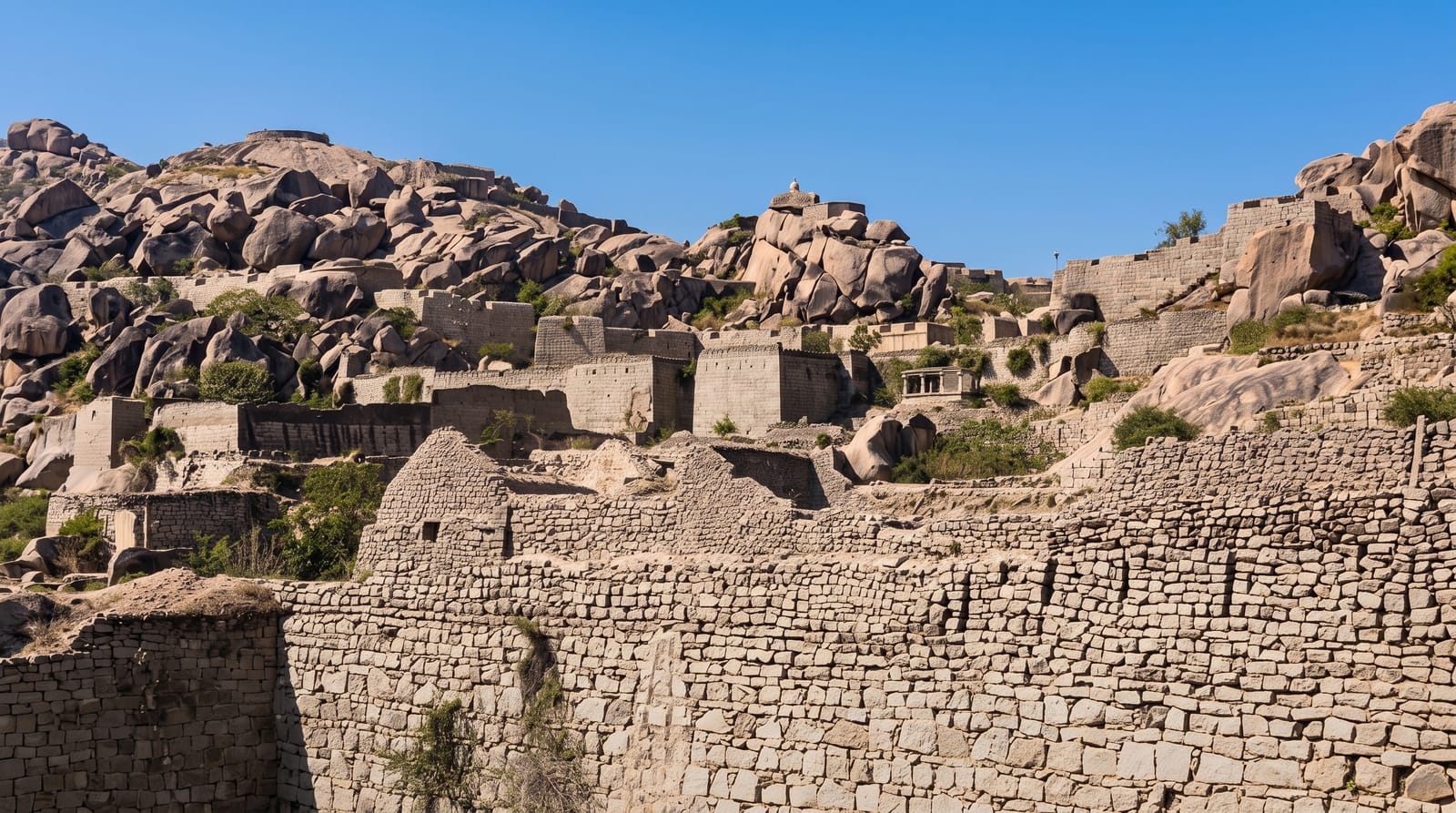
Chitradurga is built across a group of granite hills strewn with enormous rounded boulders, and its builders, mostly the Nayakas from the fifteenth century onward, used those boulders as part of the defence, running walls between them so that natural rock forms much of the circuit. Seven concentric enclosure walls, nineteen gateways, temples, granaries, oil pits and a rainwater system that collected and stored water across the hill make up the interior. It is known locally as Elusuttina Kote, the fort of seven circles. The story of Onake Obavva, who is said to have held a breach single-handed with a pestle, is attached to a narrow gap in the rock.
History
The fort was built in stages between the 11th and 13th centuries by the dynasties of the region, among them the Chalukyas and Hoysalas, and was greatly enlarged between the 15th and 18th centuries by the Nayakas of Chitradurga, who served the Vijayanagara Empire until it fell in 1565 and then ruled independently. Their first ruler, Timmanna Nayaka, was a chieftain from Matti raised to governor of Chitradurga for his services, and the last, Madakari Nayaka V, held the fort against Hyder Ali of Mysore in three battles before Hyder Ali took it in 1779 (Wikipedia, Chitradurga Fort).
What's there
- The boulder walls - fortifications run between giant granite rocks.
- The seven circuits - concentric enclosure walls with angled gates.
- The water system - tanks and channels collecting rain across the hill.
- Obavva's gap - the narrow rock breach of the local story.
When to go
October to March; central Karnataka is severely hot from March to June and the granite radiates heat. Mornings are best. The fort is quiet on weekdays.
Before you go
The fort is large and the climb long with uneven granite underfoot and no shade. Interpretation is limited. Guides at the gate vary in quality.
Nearby
Hampi lies north; Bengaluru is southeast.
Key facts
Source: Wikidata, item Q5102308, read on 18 October 2026.
What to pack for Chitradurga Fort
Chosen from what this place is for. Tap a kit for the full checklist.
- Comfortable walking shoes - Sightseeing means kilometres of pavement and cobbles daily. Find on Amazon
- Modest clothing - Shoulders and knees covered - the single most common requirement. Find on Amazon
- A slim anti-theft daypack - Zips that close properly; keep it in front in crowds and on transit. Find on Amazon
- A scarf or shawl - To cover the head or shoulders on entry; women especially at mosques. Find on Amazon
Some links on this page are Amazon affiliate links - if you buy through them we may earn a small commission at no extra cost to you.
All packing kitsPlan your trip
Where to start if Chitradurga Fort is going on the list.
Booking links on this page are affiliate links - if you book through them we may earn a small commission at no extra cost to you. It never changes what we write about a place.
Opening times, ticket prices and seasonal closures change - check the official source before you go: official site.