Temple of Olympian Zeus
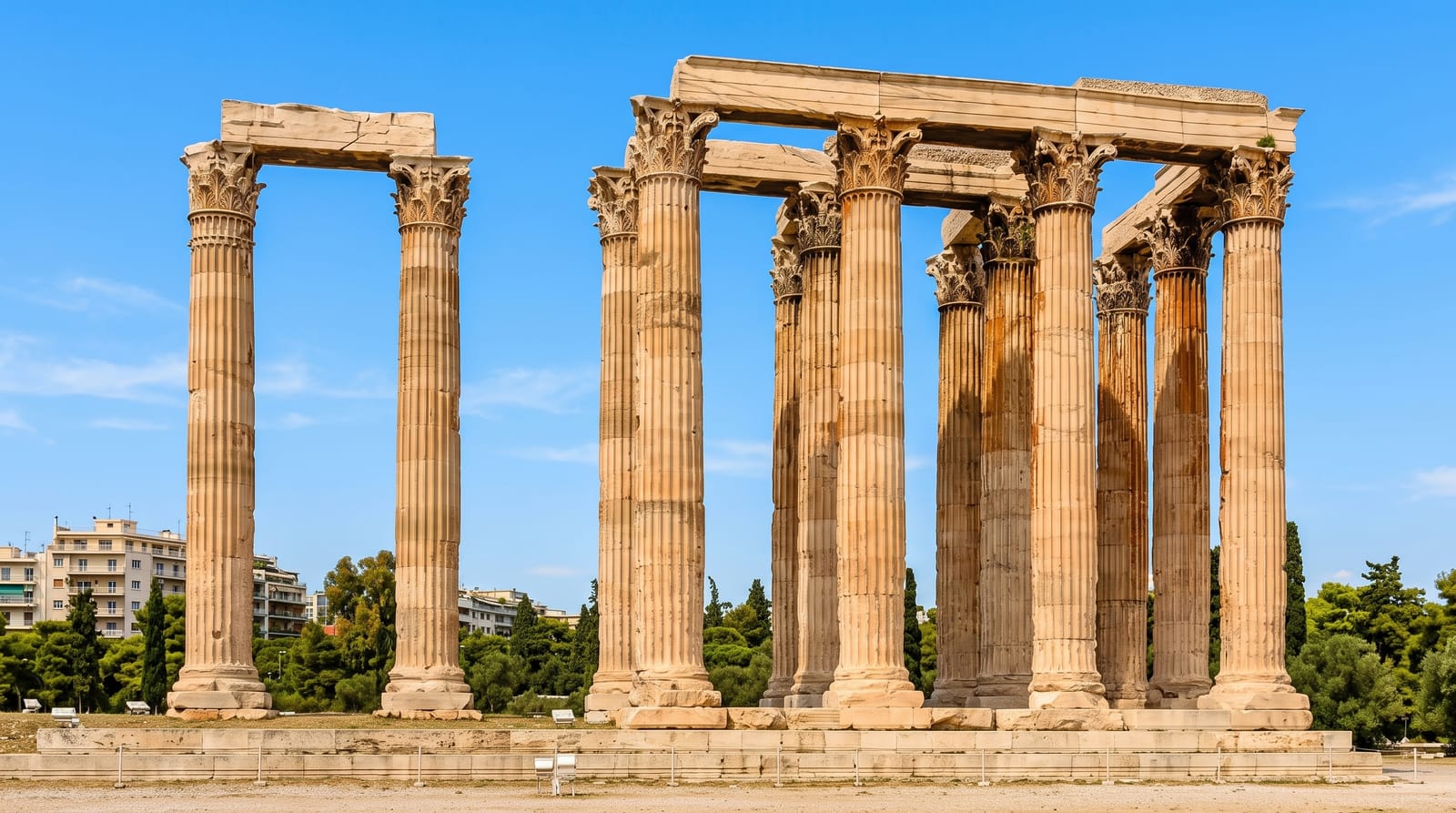
Fifteen colossal columns left of a temple that took nearly seven centuries to build and was finished by a Roman emperor.
Updated 19 October 2026
AI illustration
The Olympieion was begun around 520 BC by Hippias and Hipparchos, sons of the tyrant Peisistratos, abandoned when the family fell, restarted under a Hellenistic king, and finally completed in AD 131 by the emperor Hadrian, who filled it with a giant gold and ivory statue of Zeus and another of himself. That gives the building a construction history of roughly 638 years. It was the largest temple in Greece, 104 columns of Corinthian order standing over seventeen metres high; fifteen remain upright today and a sixteenth lies where a storm dropped it in 1852, its drums scattered like coins so you can see exactly how such a column was assembled. Beside the site stands Hadrian's Arch, inscribed on one face as the city of Theseus and on the other as the city of Hadrian.
History
An earlier temple to Zeus on the site was built by the tyrant Peisistratus around 550 BC, and after his death his sons Hippias and Hipparchos began a colossal new one around 520 BC; the work stopped when Hippias was expelled in 510 BC, with only the platform and parts of the columns done. In 174 BC the Seleucid king Antiochus IV Epiphanes revived the project under the Roman architect Decimus Cossutius, with 104 columns 17 m high, but in 86 BC Sulla sacked Athens and carried some of the unfinished columns to Rome for the Temple of Jupiter on the Capitoline; the temple was finally completed under Hadrian in the 2nd century AD, some 638 years after it was begun, and was pillaged in a Germanic invasion in 267 AD and probably never repaired (Wikipedia, Temple of Olympian Zeus, Athens).
What to look for
- The fifteen standing columns - the surviving core of the largest temple in Greece.
- The fallen column - drums lying in a row since an 1852 storm.
- Hadrian's Arch - the marble gateway at the site's edge, with its two inscriptions.
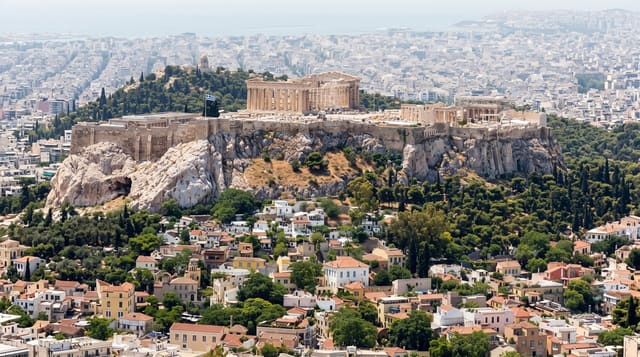
- The Acropolis view - the temple framed against the rock behind it.
When to go
Morning or late afternoon; the site is open and treeless, and midsummer midday is punishing. Winter light on the columns is excellent and the site is almost empty.
What to expect
The enclosure is essentially a large field with a group of columns, seen in half an hour. There is little shade, few explanatory signs, and the marble takes some imagination to rebuild. It is included in the combined Acropolis ticket, which makes it worth the detour.
Nearby
The Acropolis and the Plaka lie north; the National Garden begins across the road.
Key facts
Source: Wikidata, item Q1123019, read on 18 October 2026.
What to pack for Temple of Olympian Zeus
Chosen from what this place is for. Tap a kit for the full checklist.
- Comfortable walking shoes - Sightseeing means kilometres of pavement and cobbles daily. Find on Amazon
- Modest clothing - Shoulders and knees covered - the single most common requirement. Find on Amazon
- A slim anti-theft daypack - Zips that close properly; keep it in front in crowds and on transit. Find on Amazon
- A scarf or shawl - To cover the head or shoulders on entry; women especially at mosques. Find on Amazon
Some links on this page are Amazon affiliate links - if you buy through them we may earn a small commission at no extra cost to you.
All packing kitsPlan your trip
Where to start if Temple of Olympian Zeus is going on the list.
Booking links on this page are affiliate links - if you book through them we may earn a small commission at no extra cost to you. It never changes what we write about a place.
Opening times, ticket prices and seasonal closures change - check the official source before you go: official site.