Pella
The capital of ancient Macedon and birthplace of Alexander, with pebble mosaics of a lion hunt and a deer hunt still in place.
Updated 19 October 2026
AI illustration
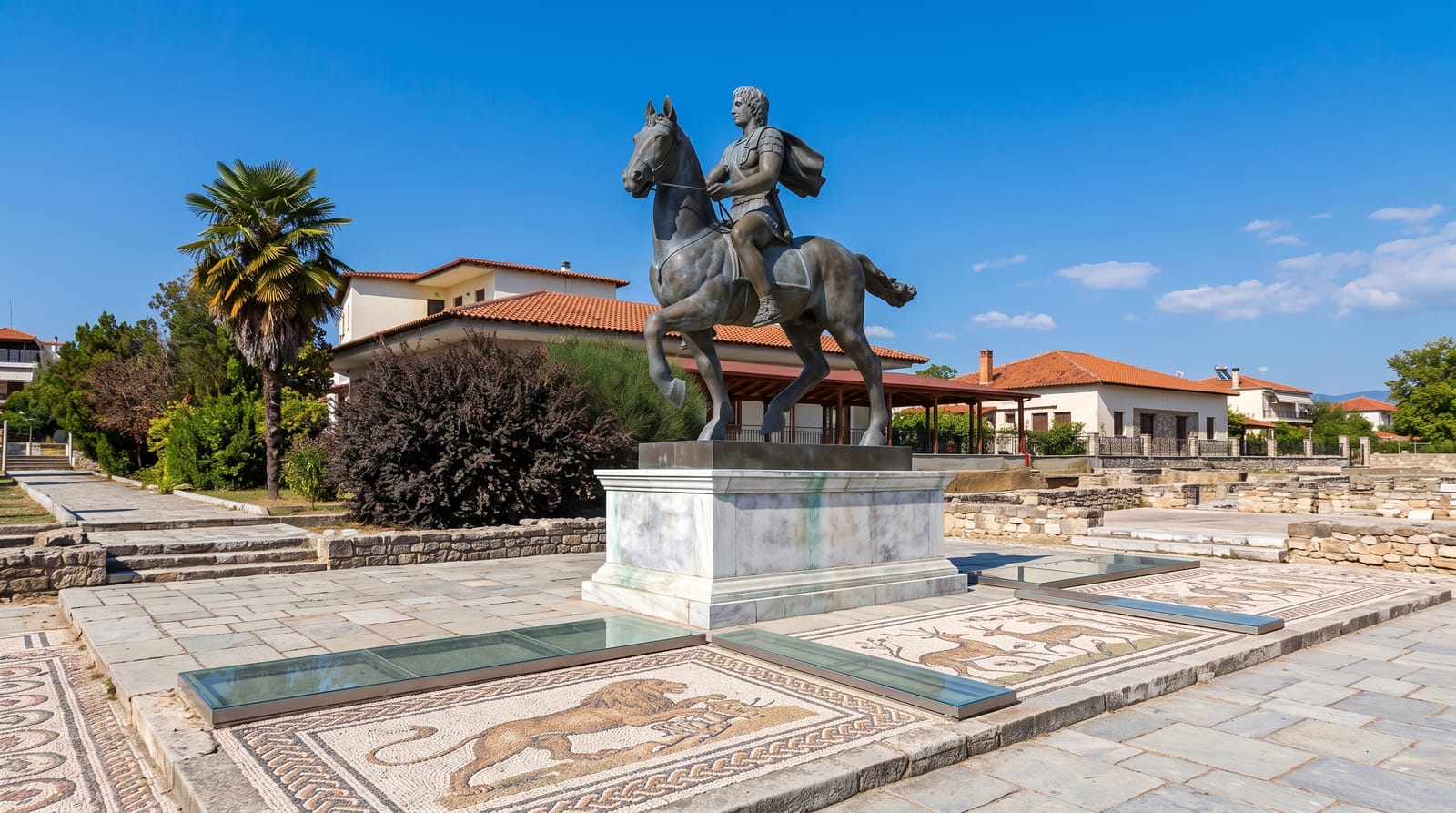
Pella became the Macedonian capital around 400 BC, when the court moved down from Aigai to the plain, and here Philip II ruled and Alexander was born in 356 BC. The city was laid out on a grid with wide streets, a vast agora and mansions whose floors carry the finest pebble mosaics ever found: made from natural river stones set on edge, with lead strips outlining the figures, they show a lion hunt, a stag hunt signed by the artist Gnosis, Dionysos riding a panther and the abduction of Helen. Some remain in situ under shelters at the site, while others are displayed in the museum opened in 2009, which also holds the palace finds, the sanctuary material and a reconstructed house interior. The palace itself sits on the low hill above; after years of excavation and restoration it opened to visitors on 28 December 2025, at first on Sundays only.
History
Pella was probably founded at the beginning of the 4th century BC by Archelaus I as the new capital of Macedon in place of Aigai, which remained the royal burial place, and it quickly became the largest and richest city in Macedonia, flourishing especially under Cassander. In antiquity it was a port, linked to the Thermaic Gulf by a navigable inlet that has since silted up, and its name probably comes from pella, "stone"; in 168 BC the Romans sacked it in the Third Macedonian War, and it declined as Thessalonica became the capital of the Roman province (Wikipedia, Pella).
Highlights
- The pebble mosaics - lion hunt, stag hunt and Dionysos floors, some in situ.
- The house plans - large peristyle mansions on the excavated grid.
- The museum - mosaics, sculpture, and finds from the palace and sanctuaries.
- The palace hill - the royal complex above the city, open to visitors since December 2025, at first on Sundays only.
When to go
Spring and autumn; the plain is very hot in July and August and the site has little shade, though the museum is air-conditioned. Mornings suit the mosaics best.
Practical notes
Much of the city remains unexcavated and what is visible is foundations plus mosaics under cover. Site and museum are a short walk apart and both need time. Public transport works but is slow; a car is easier.
Nearby
Vergina and the royal tombs lie south; Thessaloniki is forty minutes east.
Key facts
Source: Wikidata, item Q213679, read on 18 October 2026.
What to pack for Pella
Chosen from what this place is for. Tap a kit for the full checklist.
- Comfortable walking shoes - Sightseeing means kilometres of pavement and cobbles daily. Find on Amazon
- A slim anti-theft daypack - Zips that close properly; keep it in front in crowds and on transit. Find on Amazon
- A refillable water bottle - Many cities have public fountains; save money and plastic. Find on Amazon
- A light layer + compact umbrella - For museum air-con and a sudden shower. Find on Amazon
Some links on this page are Amazon affiliate links - if you buy through them we may earn a small commission at no extra cost to you.
All packing kitsPlan your trip
Where to start if Pella is going on the list.
Booking links on this page are affiliate links - if you book through them we may earn a small commission at no extra cost to you. It never changes what we write about a place.
Opening times, ticket prices and seasonal closures change - check the official source before you go: official site.