Bridge of Arta
A four-arched stone bridge over the Arachthos, subject of the most famous folk ballad in the Greek language.
Updated 19 October 2026
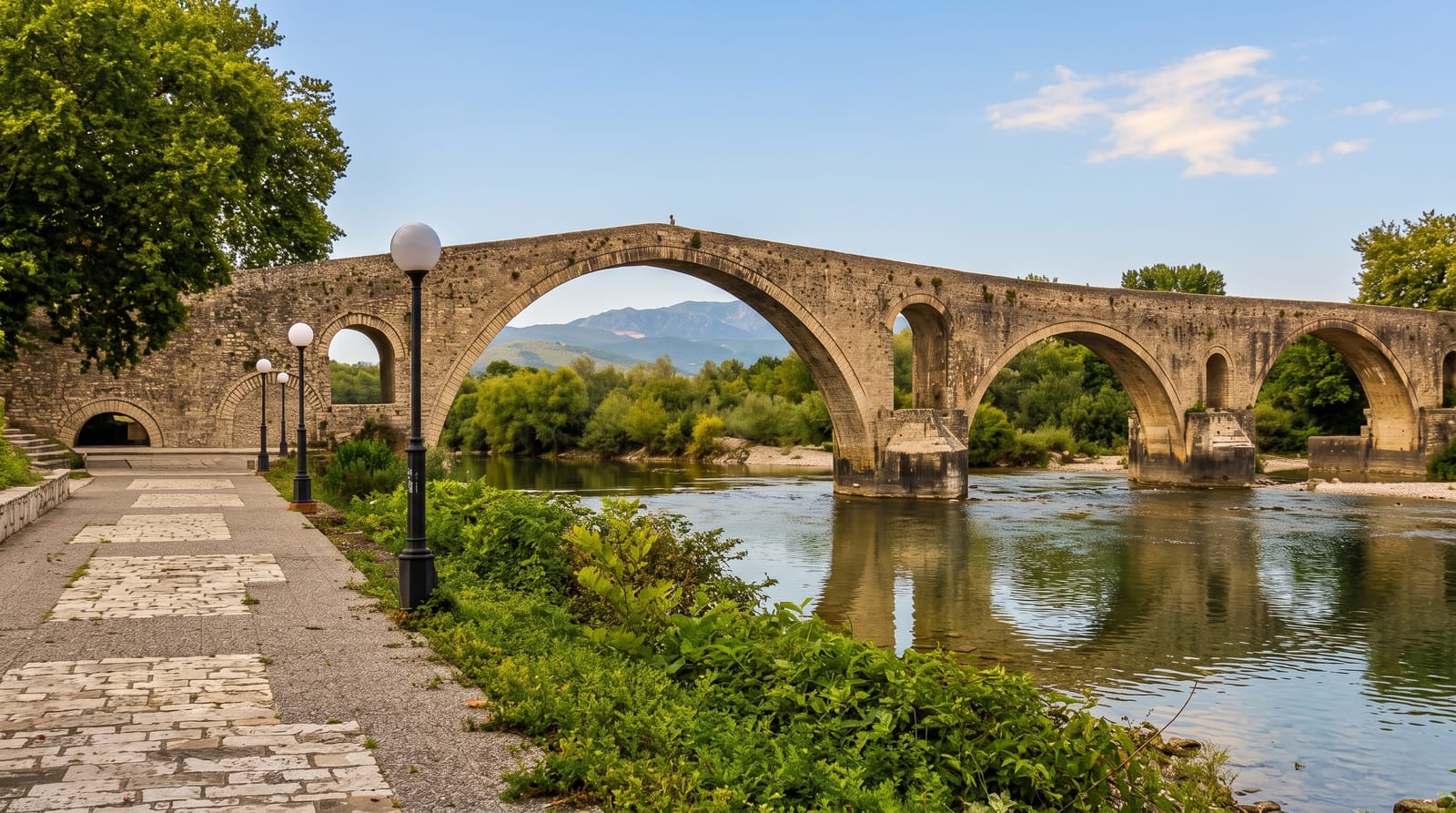
AI illustration
The bridge carries four main arches of unequal size across the Arachthos at the edge of Arta, its present form an Ottoman rebuilding, probably of 1602-06 or perhaps 1613, over earlier, probably Roman and Byzantine, foundations. Its fame comes from the ballad of the Bridge of Arta, known across the Balkans in different versions: the master builder's work collapses every night until a bird speaks and tells him he must wall his wife into the foundations, and her curse and her final blessing on travellers end the song. Generations of Greek children learn it at school, which is why the bridge is a national landmark rather than merely a fine piece of masonry. It is closed to traffic and can be walked, with cafes on the bank and the Arachthos running broad and shallow below.
History
According to the Epirote chronicler Panayiotis Aravantinos, the bridge was first built under the Roman Empire, and some traditions say it was rebuilt when Arta was capital of the Despotate of Epirus, perhaps under Michael II Doukas, r. 1230-1268; the present bridge is Ottoman, probably from 1602-06 or perhaps 1613. From the annexation of Arta in 1881 its highest point marked the border between the Ottoman Empire and Greece (Wikipedia, Bridge of Arta).
What's there
- The four arches - the uneven spans of the Ottoman rebuilding.
- The cobbled deck - the steep pedestrian crossing over the river.
- The riverbank - cafes and paths along the Arachthos.
- The ballad's setting - the bridge of the best-known Greek folk song.
When to go
Any time; late afternoon light suits the stone. Spring gives the fullest river. The bridge is lit at night, which makes an evening walk worthwhile.
What to expect
The surroundings are the outskirts of a working town rather than a scenic gorge, with a main road nearby. The visit is short. Arta itself has Byzantine churches worth adding to the trip.
Nearby
The Paregoretissa church stands in Arta; the Plaka bridge and Tzoumerka lie upstream.
Key facts
Source: Wikidata, item Q996126, read on 18 October 2026.
What to pack for Bridge of Arta
Chosen from what this place is for. Tap a kit for the full checklist.
- Comfortable walking shoes - Sightseeing means kilometres of pavement and cobbles daily. Find on Amazon
- A slim anti-theft daypack - Zips that close properly; keep it in front in crowds and on transit. Find on Amazon
- A refillable water bottle - Many cities have public fountains; save money and plastic. Find on Amazon
- A light layer + compact umbrella - For museum air-con and a sudden shower. Find on Amazon
Some links on this page are Amazon affiliate links - if you buy through them we may earn a small commission at no extra cost to you.
All packing kitsPlan your trip
Where to start if Bridge of Arta is going on the list.
Booking links on this page are affiliate links - if you book through them we may earn a small commission at no extra cost to you. It never changes what we write about a place.
Opening times, ticket prices and seasonal closures change - check the official source before you go: official site.