Ancient Olympia
The birthplace of the Olympic Games - the ruined sanctuary where athletes competed for over a thousand years, with the original stadium, a UNESCO site.
Updated 18 October 2026
AI illustration
UNESCO World Heritage
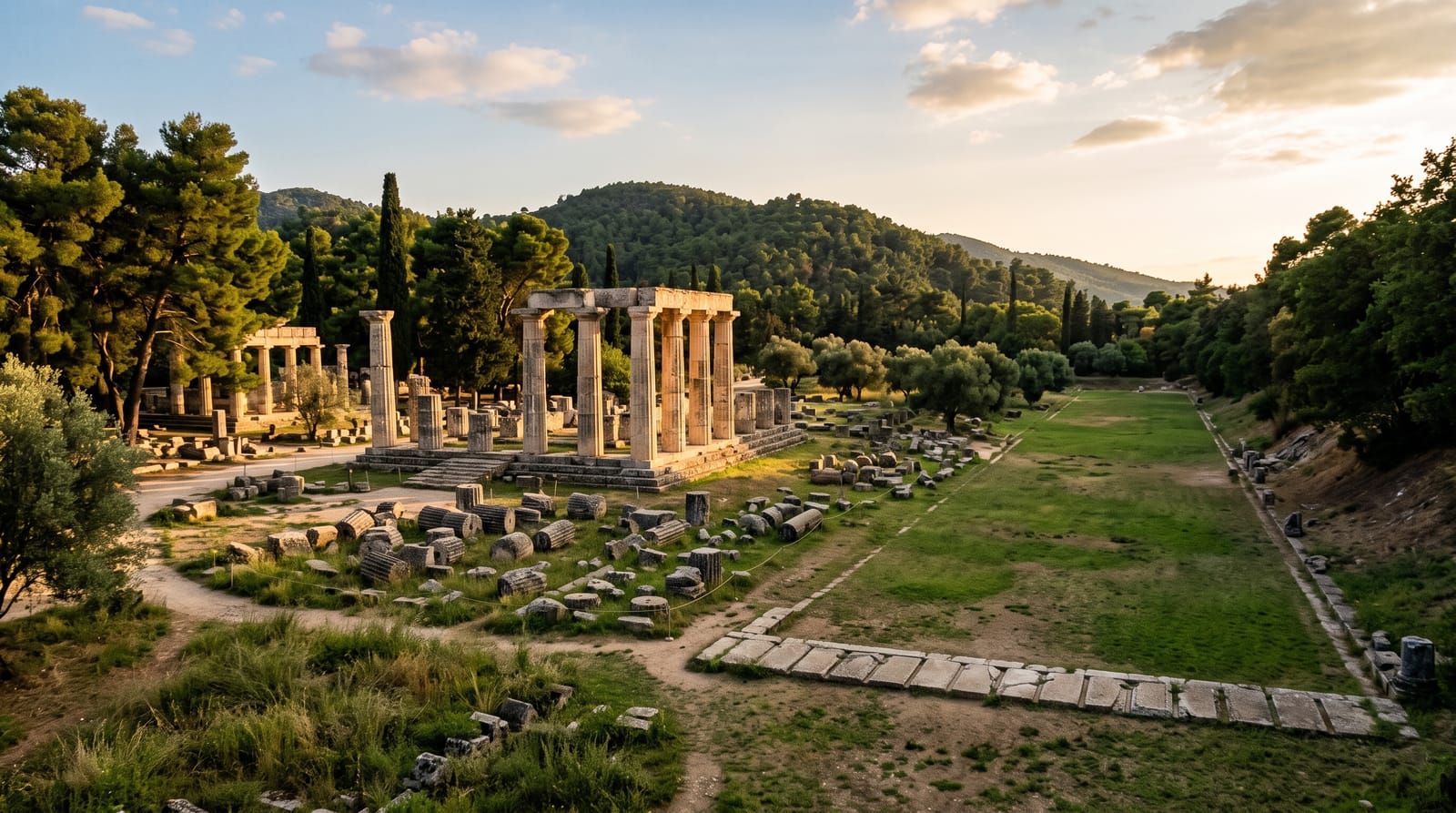
Ancient Olympia was the birthplace of the Olympic Games, the sacred sanctuary in the green western Peloponnese where athletes from across the Greek world competed every four years for over a millennium. Its ruins, shaded by pines, include the great temple of Zeus that held a wonder of the world, the workshop of Phidias, and the original stadium where visitors still line up on the ancient start.
History
The authorities of Elis organised the first Olympic festival here in the 8th century BC, traditionally in 776 BC, and the games were held every four years until the 4th century AD; the Temple of Hera of around 600 BC is the earliest building on the site, the first stadium of about 560 BC was a simple track, and the Temple of Zeus followed in the mid-5th century BC, the start of the sanctuary's golden age. Over time the site was buried under deposits up to 8 metres deep, perhaps left by repeated tsunamis rather than river floods, and the English antiquarian Richard Chandler identified it in 1766; French archaeologists of the Expédition scientifique de Morée dug here for six weeks in 1829 and located the Temple of Zeus. From 1875 the German government funded the great excavation under Ernst Curtius, which uncovered the centre of the sanctuary and some 14,000 objects, among them the Hermes of Praxiteles and the Nike of Paeonius (Wikipedia, Olympia, Greece).
What to look for
- The original stadium - the ancient running track with its stone start line.
- The Temple of Zeus - the ruins of the temple that held a Wonder of the World.
- The sanctuary ruins - the treasuries, palaestra and workshop of Phidias.
- The museum - the sculptures, including the Hermes of Praxiteles.
When to go
Spring and autumn for mild weather and green surroundings; summer is hot, though the site has more shade than most. It is far from Athens, best combined with a Peloponnese trip or a cruise stop.
Practical notes
It is far in the western Peloponnese, a long way from Athens, best on a wider tour or cruise. The ruins are tumbled and low, so the stadium and museum bring it alive more than the foundations. It can be busy with cruise groups.
Nearby
The green hills of the western Peloponnese surround it; the coast and Patras are within reach.
Key facts
Source: Wikidata, item Q38888, read on 18 October 2026.
What to pack for Ancient Olympia
Chosen from what this place is for. Tap a kit for the full checklist.
- Comfortable walking shoes - Sightseeing means kilometres of pavement and cobbles daily. Find on Amazon
- Modest clothing - Shoulders and knees covered - the single most common requirement. Find on Amazon
- A slim anti-theft daypack - Zips that close properly; keep it in front in crowds and on transit. Find on Amazon
- A scarf or shawl - To cover the head or shoulders on entry; women especially at mosques. Find on Amazon
Some links on this page are Amazon affiliate links - if you buy through them we may earn a small commission at no extra cost to you.
All packing kitsPlan your trip
Where to start if Ancient Olympia is going on the list.
Booking links on this page are affiliate links - if you book through them we may earn a small commission at no extra cost to you. It never changes what we write about a place.
Opening times, ticket prices and seasonal closures change - check the official source before you go: official site.