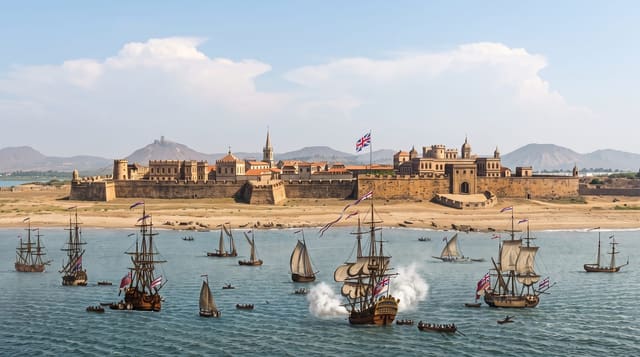
Fort Prinzenstein
A Danish fort at Keta, half taken by the sea, marking the eastern end of the chain of Ghanaian coastal forts.
Updated 18 October 2026
UNESCO World Heritage
Prinzenstein was built by the Danes at Keta in 1784, the easternmost of the forts on this coast and one of the last built, and it was used in the trade in enslaved people until Denmark abolished its participation and then in the suppression of the traffic afterwards. The sea has taken a large part of it: coastal erosion along this shore has been severe, and the western half of the fort has gone into the water, leaving standing walls, cells and a bastion behind a sea defence built to stop further loss. What survives includes underground holding rooms shown to visitors. Keta itself has lost streets to the same erosion. The fort is part of the World Heritage inscription on the Ghanaian forts and castles.
History
The Dutch West India Company built Fort Singelenburgh on this site in 1734 but abandoned it in 1737; after the Anlo pillaged the Danish agent at Keta in 1783, the Danish governor of Christiansborg raised an army from the Ada, Akwapim, Ga and Krobo, defeated the Anlo and in 1784 imposed a treaty that let the Danes build Fort Prinzenstein, of stone brought mostly from Accra, and bound the Anlo to trade only with them. Until 1803 the fort held enslaved people awaiting shipment to the Caribbean; in 1850 it was sold to Britain with the rest of the Danish Gold Coast and later served as a prison, and in 1980 the sea wrecked part of it, an erosion that efforts to protect the remains since 1991 have not stopped (Wikipedia, Fort Prinzenstein).
Highlights
- The surviving walls - the standing half of the Danish fort.
- Holding cells - the underground rooms shown on the guided route.
- The sea defence - the wall built to stop further erosion.
- The Keta shore - the eroding coast the fort stands on.
When to go
November to March for the dry season and easier travel in the Volta Region. Mornings are cooler. The fort keeps daytime hours with a caretaker guide.
Good to know
Much of the fort has been lost to the sea and what remains is fragile. Interpretation is limited to the guide. The subject is the transatlantic slave trade and is addressed directly. Keta is a long drive east of Accra.
Nearby
The Keta lagoon lies inland; Ada Foah is west along the coast.
Key facts
Source: Wikidata, item Q1438675, read on 18 October 2026.
What to pack for Fort Prinzenstein
Chosen from what this place is for. Tap a kit for the full checklist.
- Reef-safe sunscreen - High SPF that will not bleach the coral you are swimming over. Find on Amazon
- Head torch + spare batteries - Hands-free light is essential; caves are truly dark. Find on Amazon
- Comfortable walking shoes - Sightseeing means kilometres of pavement and cobbles daily. Find on Amazon
- Quick-dry towel - A microfibre towel packs small and dries in minutes. Find on Amazon
Some links on this page are Amazon affiliate links - if you buy through them we may earn a small commission at no extra cost to you.
All packing kitsPlan your trip
Where to start if Fort Prinzenstein is going on the list.
Booking links on this page are affiliate links - if you book through them we may earn a small commission at no extra cost to you. It never changes what we write about a place.
Opening times, ticket prices and seasonal closures change - check the official source before you go: official site.