Wuppertal Suspension Railway
A monorail hanging under its track since 1901, running mostly above a river because there was no room elsewhere.
Updated 19 October 2026
AI illustration
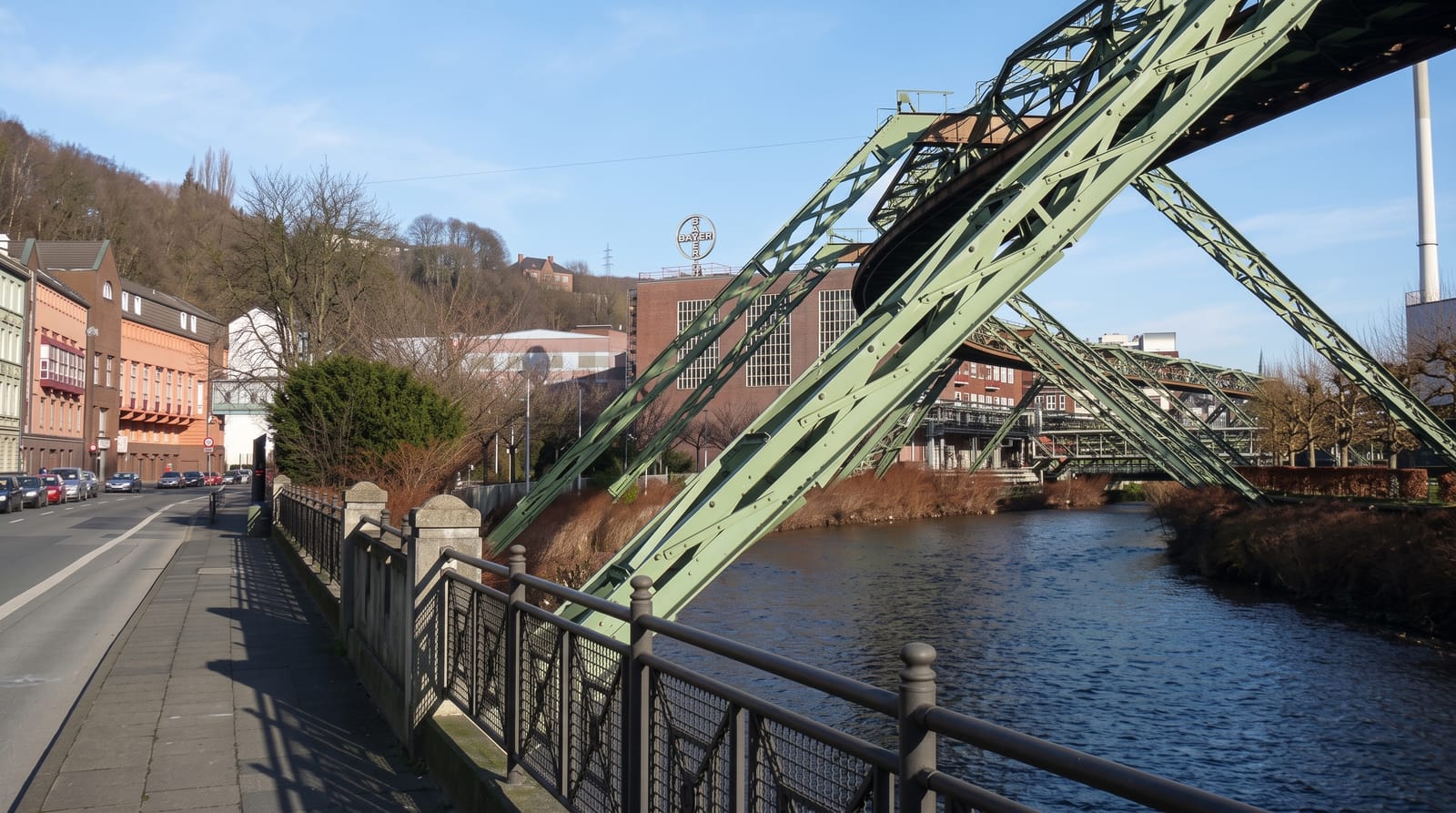
The Schwebebahn opened in 1901 and still runs, carrying about eighty thousand passengers a day on thirteen and a half kilometres of route, of which roughly ten kilometres hang over the Wupper river; the valley was too narrow and built up for a conventional line, so the track was hung above the water on a steel framework. Cars are suspended below the rail and swing on curves. In 1950 a circus elephant named Tuffi was put aboard as a publicity stunt, panicked, went through the side and fell into the river, surviving with minor injuries; the incident is still local shorthand for a bad idea.
History
In 1824 the Briton Henry Robinson Palmer presented a horse-drawn single-rail suspension railway, which the industrialist Friedrich Harkort championed for carrying coal, and on 9 September 1826 Elberfeld's councillors discussed it, but the plan fell to opposition from carters and mill owners. In 1887 Elberfeld and Barmen set up a commission for an elevated railway, in 1894 they chose the system of the Cologne engineer Eugen Langen, and construction began in 1898; Emperor Wilhelm II rode a trial run on 24 October 1900, and the line opened in sections, from 1 March and 24 May 1901 to the eastern terminus at Oberbarmen on 27 June 1903, using some 19,200 tonnes of steel at a cost of 16 million gold marks (Wikipedia, Wuppertal Schwebebahn).
What you'll find
- The hanging cars - carriages suspended below the rail, swinging on curves.
- The river route - ten kilometres of track above the Wupper itself.
- The 1901 stations - original steel and glass structures on the line.
- The Tuffi story - the 1950 elephant incident, marked in the city.
When to go
Year-round; it is a working commuter line, so peak hours are crowded. The full route takes about half an hour end to end and costs a normal transit fare.
What to expect
It is public transport, not an attraction, and runs to a timetable with maintenance closures. The valley it crosses is industrial. Seats fill at rush hour.
Nearby
The Neanderthal museum lies west; Solingen is south.
Key facts
Source: Wikidata, item Q256964, read on 18 October 2026.
What to pack for Wuppertal Suspension Railway
Chosen from what this place is for. Tap a kit for the full checklist.
- Comfortable walking shoes - Sightseeing means kilometres of pavement and cobbles daily. Find on Amazon
- A slim anti-theft daypack - Zips that close properly; keep it in front in crowds and on transit. Find on Amazon
- A refillable water bottle - Many cities have public fountains; save money and plastic. Find on Amazon
- A light layer + compact umbrella - For museum air-con and a sudden shower. Find on Amazon
Some links on this page are Amazon affiliate links - if you buy through them we may earn a small commission at no extra cost to you.
All packing kitsPlan your trip
Where to start if Wuppertal Suspension Railway is going on the list.
Booking links on this page are affiliate links - if you book through them we may earn a small commission at no extra cost to you. It never changes what we write about a place.
Opening times, ticket prices and seasonal closures change - check the official source before you go: official site.