Wiesbaden
A spa city of twenty-six hot springs, with a nickelodeon-era funicular still driven by water ballast.
Updated 19 October 2026
AI illustration
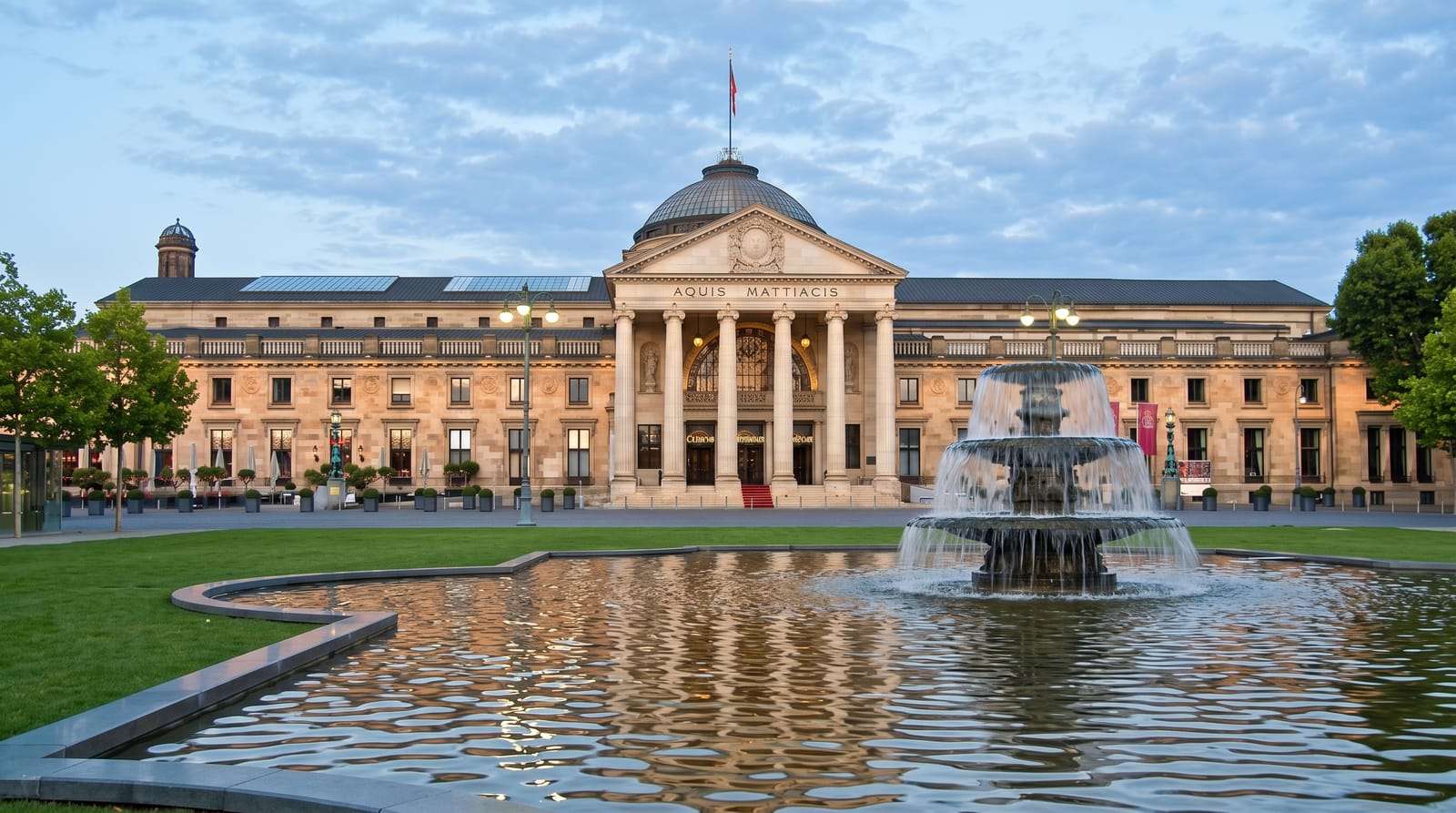
Twenty-six hot springs rise in Wiesbaden, the Kochbrunnen reaching about sixty-six degrees, and the Romans used them; the city grew into one of Europe's leading spa resorts in the nineteenth century, when it had more millionaires per head than anywhere in Germany. The Kurhaus of 1907 holds a casino and concert hall. The Nerobergbahn, opened in 1888, climbs the Neroberg hill on a water-ballast system: the upper car takes on water to become heavier, descends and hauls the lower car up, then dumps the water at the bottom, using no motor at all. A Russian Orthodox church with five gilded domes stands on the hill.
History
There was settlement here in the Neolithic, and continuous occupation from a Roman fort of 6 AD with a cavalry unit; Pliny the Elder mentions the hot springs, famous for bathing the army's horses, and the town appears as Aquae Mattiacorum in 121, after the Germanic Mattiaci, just across the Rhine from Mogontiacum, today's Mainz. The Alamanni captured the fort around 260, and in the 370s, as Roman allies, they took charge of the area's defence (Wikipedia, Wiesbaden).
Highlights
- The Nerobergbahn - an 1888 funicular driven entirely by water ballast.
- The Kochbrunnen - a hot spring at about sixty-six degrees in the centre.
- The Kurhaus - a 1907 spa building with casino and concert hall.
- The Russian church - five gilded domes on the Neroberg.
When to go
April to October; the Nerobergbahn runs from spring to autumn only. The Kurhaus and baths operate year-round. Wine festivals fill the streets in August.
What to expect
The funicular is seasonal and closed in winter. The casino has dress and identification requirements. The spa water tastes strongly of minerals.
Nearby
Kloster Eberbach lies west; Mainz is across the Rhine.
Key facts
Source: Wikidata, item Q1721, read on 18 October 2026.
What to pack for Wiesbaden
Chosen from what this place is for. Tap a kit for the full checklist.
- Comfortable walking shoes - Sightseeing means kilometres of pavement and cobbles daily. Find on Amazon
- Swimwear - Needed at most public thermal pools; some traditional baths are nude and single-sex. Find on Amazon
- A slim anti-theft daypack - Zips that close properly; keep it in front in crowds and on transit. Find on Amazon
- Quick-dry towel + flip-flops - For wet changing areas and hot poolside stone. Find on Amazon
Some links on this page are Amazon affiliate links - if you buy through them we may earn a small commission at no extra cost to you.
All packing kitsPlan your trip
Where to start if Wiesbaden is going on the list.
Booking links on this page are affiliate links - if you book through them we may earn a small commission at no extra cost to you. It never changes what we write about a place.
Opening times, ticket prices and seasonal closures change - check the official source before you go: official site.