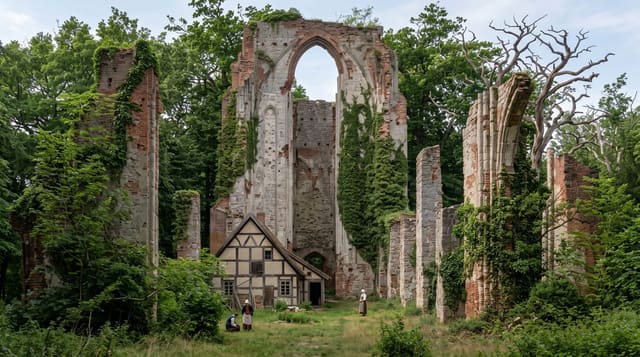
Rostock Old Town
A Hanseatic city with the oldest university on the Baltic, founded in 1419, and a surviving brick gate.
Updated 4 September 2026

AI illustration
Rostock was among the leading Hanseatic ports and founded its university in 1419, the oldest in the Baltic region and among the oldest in northern Europe. The Marienkirche holds an astronomical clock of 1472 whose original movement still runs, one of very few medieval astronomical clocks working with original mechanism; its calendar disc runs to 2017 and was replaced with a new one to continue. The Kröpeliner Tor and Steintor survive from the walls, and Kröpeliner Strasse runs between them as the main street. Bombing in 1942 destroyed much of the centre and the reconstruction mixes restored gables with 1950s and 1960s building.
Highlights
- The astronomical clock - a 1472 movement in the Marienkirche, still running.
- The city gates - the Kröpeliner Tor and Steintor from the medieval walls.
- The university - the oldest in the Baltic region, founded in 1419.
- The mixed rebuilding - restored gables beside postwar architecture.
When to go
May to September; the Hanse Sail brings tall ships to the harbour in August. Churches close during services. Winter is cold and quiet.
Good to know
Much of the centre is postwar rebuilding of varying quality. The clock is behind the altar with limited viewing. Hanse Sail week fills the city.
Nearby
Warnemünde lies at the port mouth; Bad Doberan is west.
What to pack for Rostock Old Town
Chosen from what this place is for. Tap a kit for the full checklist.
- Comfortable walking shoes - Sightseeing means kilometres of pavement and cobbles daily. Find on Amazon
- A slim anti-theft daypack - Zips that close properly; keep it in front in crowds and on transit. Find on Amazon
- A refillable water bottle - Many cities have public fountains; save money and plastic. Find on Amazon
- A light layer + compact umbrella - For museum air-con and a sudden shower. Find on Amazon
Some links on this page are Amazon affiliate links - if you buy through them we may earn a small commission at no extra cost to you.
All packing kitsPlan your trip
Where to start if Rostock Old Town is going on the list.
Booking links on this page are affiliate links - if you book through them we may earn a small commission at no extra cost to you. It never changes what we write about a place.
Opening times, ticket prices and seasonal closures change - check the official source before you go: official site.