Pillnitz Palace
A riverside palace built in a Chinese-influenced style, with a camellia from Japan that has flowered since 1801.
Updated 19 October 2026
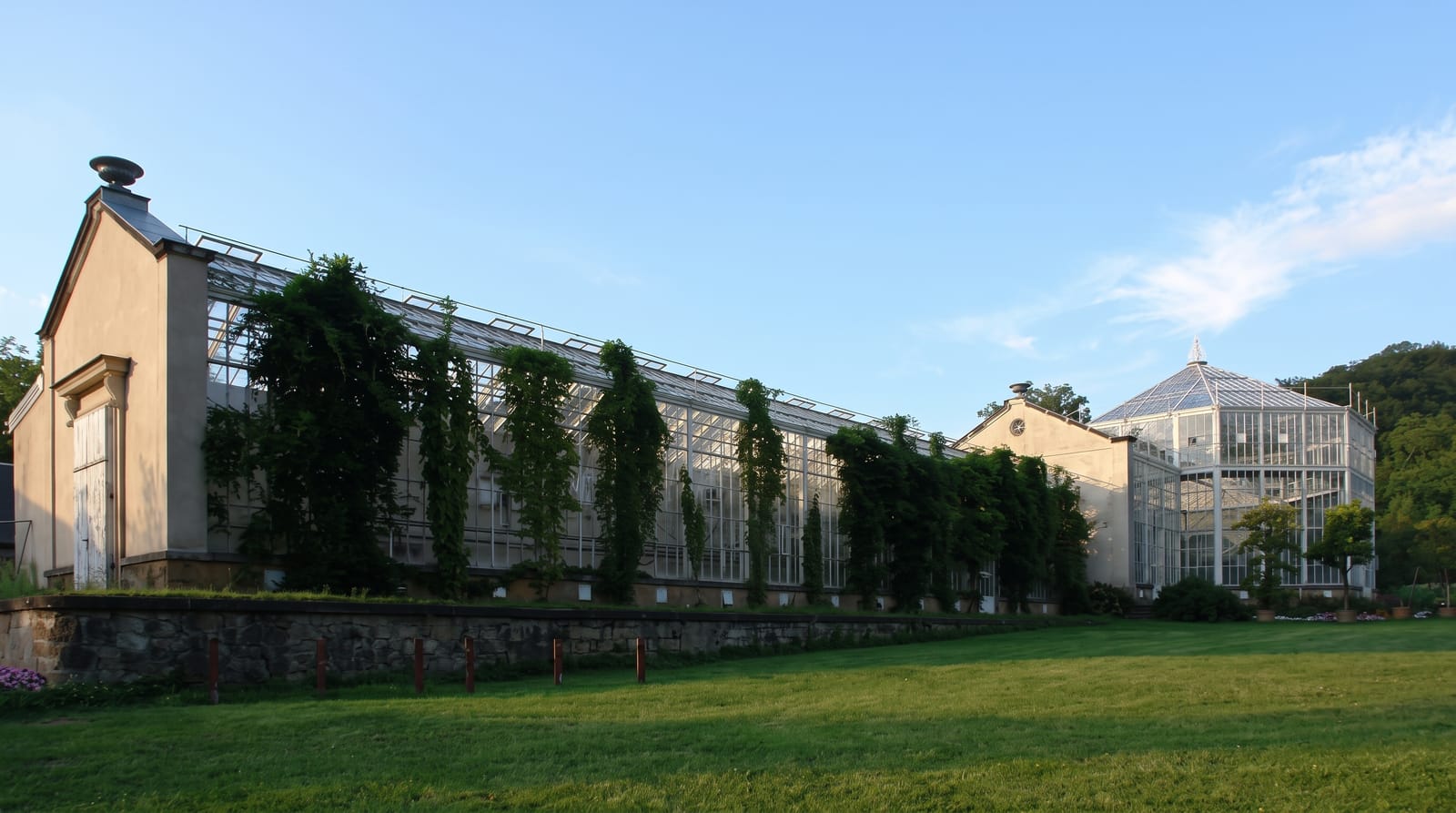
AI illustration
Augustus the Strong rebuilt Pillnitz from 1720 in a style mixing baroque with Chinese and Japanese elements as then understood in Europe, with curved roofs and painted decoration; the Water Palace faces the Elbe with a broad flight of steps down to the river, where the court arrived by gondola. A camellia planted in the garden in 1801, brought from Japan by way of Kew, has grown to about eight and a half metres and is thought to be the oldest camellia in Europe north of the Alps; a mobile glasshouse on rails is moved over it each winter and removed in spring, when it carries tens of thousands of red flowers.
History
A modest fortified house stood here by the 14th century and was enlarged into a four-winged building in the 16th and 17th centuries; Elector John George IV bought it in 1694 as a present for his mistress Magdalena Sibylla of Neidschutz, and in 1706 Augustus the Strong gave it to his mistress Anna Constantia of Brockdorff. From 1720 Matthäus Daniel Pöppelmann and Zacharias Longuelune replaced the old buildings with Baroque palaces, the Riverside Palace in 1720/21, the water stairs for gondolas in 1725 and the matching Upper Palace in 1723/24. Elector Frederick Augustus I made Pillnitz his summer residence in 1765 and added English and Chinese gardens with pavilions and an artificial ruin, and after the old palace burned in 1818 Christian Friedrich Schuricht built the Neoclassical New Palace, finished in 1826; it remained the Wettins' summer residence until 1918 (Wikipedia, Pillnitz Palace).
What to look for
- The camellia - a Japanese plant of 1801, moved under glass each winter.
- The Water Palace - river steps where the court arrived by gondola.
- The chinoiserie - curved roofs and painted decoration on the wings.
- The park - baroque, English and Chinese garden sections along the Elbe.
When to go
Late February to April for the camellia flowering, which lasts several weeks. April to October for the park generally; the palace museums close Mondays.
Before you go
The camellia flowers for a limited window and is enclosed the rest of the year. Palace museums close in winter. The paddle steamer from Dresden is seasonal.
Nearby
Dresden lies downstream; Moritzburg is northwest.
Key facts
Source: Wikidata, item Q462239, read on 18 October 2026.
What to pack for Pillnitz Palace
Chosen from what this place is for. Tap a kit for the full checklist.
- Quick-dry clothing - Board shorts or synthetics that shrug off spray and dry fast. Find on Amazon
- Comfortable walking shoes - Sightseeing means kilometres of pavement and cobbles daily. Find on Amazon
- Secure water shoes or reef boots - Grip on slippery launches and protection on rocky shores. Find on Amazon
- A slim anti-theft daypack - Zips that close properly; keep it in front in crowds and on transit. Find on Amazon
Some links on this page are Amazon affiliate links - if you buy through them we may earn a small commission at no extra cost to you.
All packing kitsPlan your trip
Where to start if Pillnitz Palace is going on the list.
Booking links on this page are affiliate links - if you book through them we may earn a small commission at no extra cost to you. It never changes what we write about a place.
Opening times, ticket prices and seasonal closures change - check the official source before you go: official site.