Lüneburg
A brick Gothic salt town whose buildings lean and sink because the ground beneath them was mined out.
Updated 16 October 2026
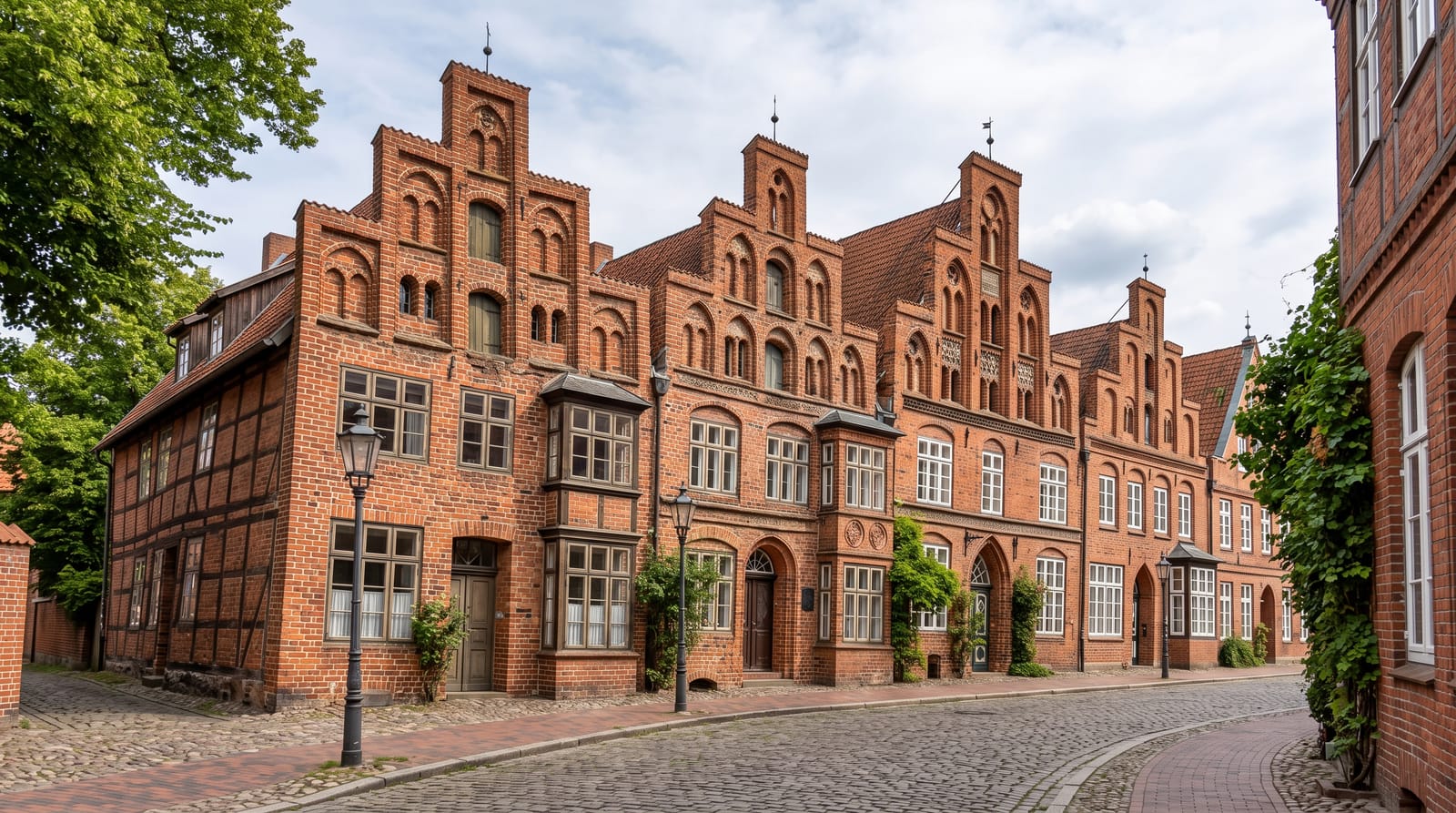
AI illustration
Lüneburg's wealth came from a salt dome under the town, worked from the tenth century and supplying the Hanseatic herring trade through Lübeck; the salt made it one of the richest towns in northern Germany, and the money went into brick Gothic houses and a town hall with a Gothic court room. Extracting the brine dissolved the ground and caused subsidence, so streets and buildings in the older quarters visibly lean, sag and have been repeatedly propped and rebuilt. The saltworks closed in 1980. The Water Quarter around the old crane keeps warehouses, a brewery and the mill buildings on the Ilmenau.
Background
The first written record is a deed of 13 August 956, by which the Holy Roman Emperor Otto I granted the Lüneburg tax to a monastery raised there for Saint Michael. Far older traces exist: 56 axes with an estimated age of 150,000 years turned up in the 1990s during work on the autobahn between Ochtmissen and Bardowick. The ancient town may be the Leufana or Leuphana listed by Ptolemy. Since 2007 Lüneburg may officially call itself a Hansestadt, recognising its place in the Hanseatic League, and it is home to Leuphana University. It lies about 50 kilometres southeast of Hamburg and has roughly 77,000 residents, with around 103,000 in the wider urban area.
Source: Wikipedia, "Lüneburg"
The main sights
- The leaning buildings - subsidence from centuries of brine extraction.
- The brick Gothic - stepped gables and the town hall's medieval court room.
- The Water Quarter - the old crane, warehouses and mills on the Ilmenau.
- The salt museum - the industry that made and undermined the town.
When to go
April to October; the town is lively in term time with its university. Museums close Mondays. Christmas markets fill the squares in December.
Before you go
Some leaning buildings are propped and fenced. The salt museum is modest. The town is compact and seen in a day.
Nearby
Lüneburg Heath lies south-west; Hamburg is northwest.
Key facts
Source: Wikidata, item Q3920, read on 18 October 2026.
What to pack for Lüneburg
Chosen from what this place is for. Tap a kit for the full checklist.
- Comfortable walking shoes - Sightseeing means kilometres of pavement and cobbles daily. Find on Amazon
- Modest clothing - Shoulders and knees covered - the single most common requirement. Find on Amazon
- A slim anti-theft daypack - Zips that close properly; keep it in front in crowds and on transit. Find on Amazon
- A scarf or shawl - To cover the head or shoulders on entry; women especially at mosques. Find on Amazon
Some links on this page are Amazon affiliate links - if you buy through them we may earn a small commission at no extra cost to you.
All packing kitsPlan your trip
Where to start if Lüneburg is going on the list.
Booking links on this page are affiliate links - if you book through them we may earn a small commission at no extra cost to you. It never changes what we write about a place.
Opening times, ticket prices and seasonal closures change - check the official source before you go: official site.


