Königstein Fortress
A fortress on a sandstone tableland, never taken, with a well cut a hundred and fifty-two metres into the rock.
Updated 19 October 2026
AI illustration
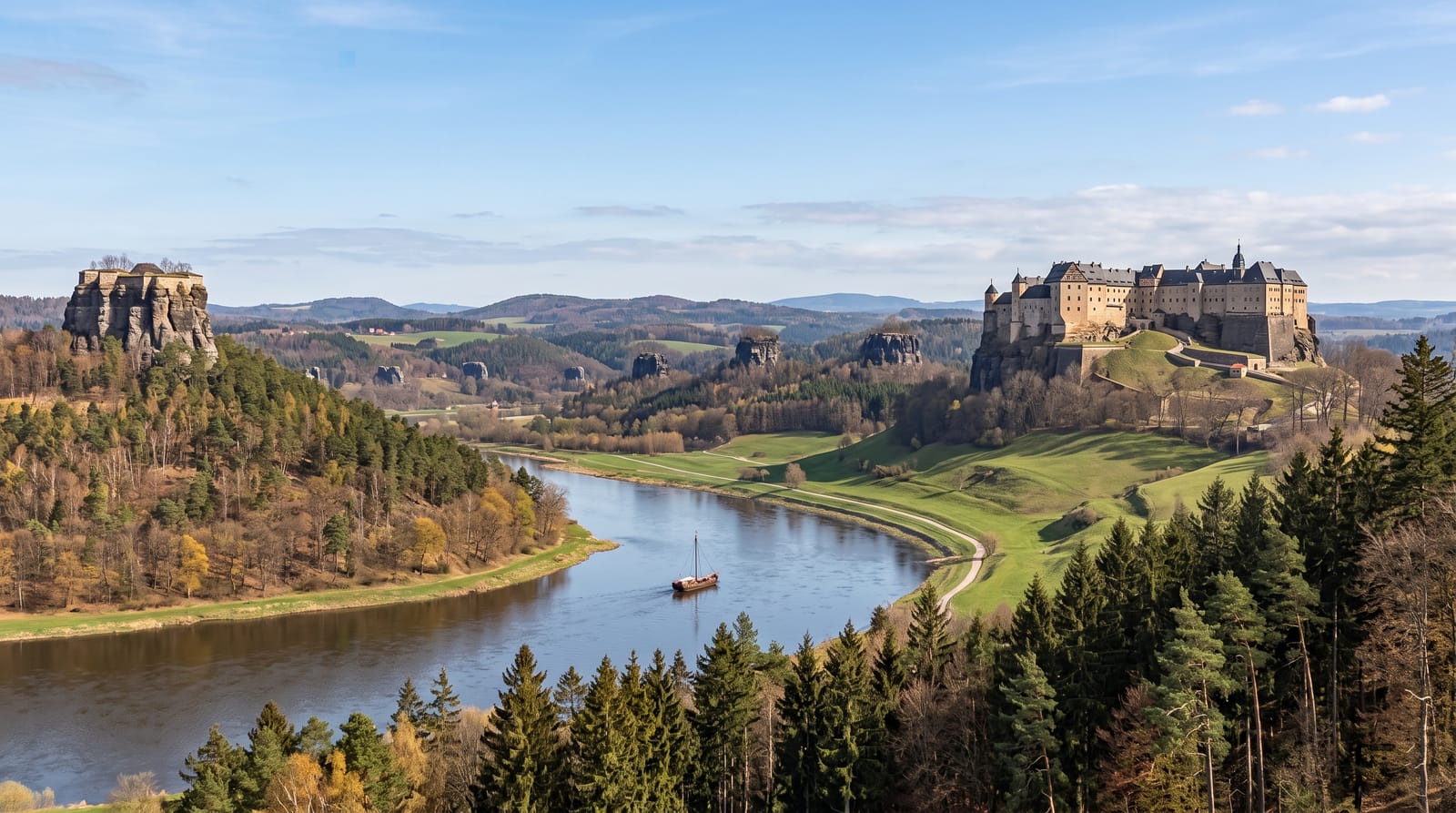
The fortress occupies a flat sandstone tableland two hundred and forty metres above the Elbe with vertical cliffs on all sides, and its defences were never breached in its history. Its well, sunk between 1563 and 1569, is a hundred and fifty-two and a half metres deep through solid rock, the deepest in Saxony, worked by a treadwheel; a demonstration pours water down it. The site covers about nine and a half hectares with more than fifty buildings from four centuries, including barracks, a garrison church and cisterns. It served as a state prison for long periods. The plateau walk round the ramparts gives views over the Elbe Sandstone Mountains.
History
The oldest written record of a castle on the Königstein is a deed of King Wenceslas I of Bohemia of 1233 naming a Burgrave Gebhard of Stein, and the name Königstein, "king's rock", first appears in the Upper Lusatian border charter of 1241; the Bohemian kings enlarged it into a stronghold controlling the Elbe above Pirna, and Charles IV stayed here from 5 to 19 August 1359. Pledged several times, it was taken in 1408 by the margraves of Meissen during the Dohna feud, and passed finally to Meissen on 25 April 1459 by the Treaty of Eger. The oldest surviving building is the chapel of the turn of the 13th century; the 152.5 metre well was bored through the rock from 1563 to 1569, about 8 cubic metres of water having to be removed from the shaft each day, and between 1589 and 1591/97 Elector Christian I of Saxony and his successor made it the strongest fortress in Saxony (Wikipedia, Königstein Fortress).
What's there
- The 152-metre well - a shaft through solid rock with a treadwheel.
- The tableland site - nine and a half hectares on a cliff-edged plateau.
- The rampart walk - a circuit with views over the Elbe and the sandstone hills.
- The fifty buildings - barracks, church and stores from four centuries.
When to go
April to October; the fortress opens year-round with shorter winter hours. The climb from the town is steep, with a shuttle bus and a lift as alternatives.
Before you go
The approach is a steep climb unless you use the paid shuttle and lift. The site is large and exposed. Winter closes some buildings.
Nearby
The Bastei lies downstream; the Czech border is south.
Key facts
Source: Wikidata, item Q700562, read on 18 October 2026.
What to pack for Königstein Fortress
Chosen from what this place is for. Tap a kit for the full checklist.
- Broken-in walking shoes or boots - Grip and ankle support matter more than looks; never hike in brand-new boots. Find on Amazon
- Comfortable walking shoes - Sightseeing means kilometres of pavement and cobbles daily. Find on Amazon
- Layers + a waterproof shell - Mountain weather turns fast; a packable rain jacket saves the day. Find on Amazon
- A slim anti-theft daypack - Zips that close properly; keep it in front in crowds and on transit. Find on Amazon
Some links on this page are Amazon affiliate links - if you buy through them we may earn a small commission at no extra cost to you.
All packing kitsPlan your trip
Where to start if Königstein Fortress is going on the list.
Booking links on this page are affiliate links - if you book through them we may earn a small commission at no extra cost to you. It never changes what we write about a place.
Opening times, ticket prices and seasonal closures change - check the official source before you go: official site.