Hohenzollern Castle
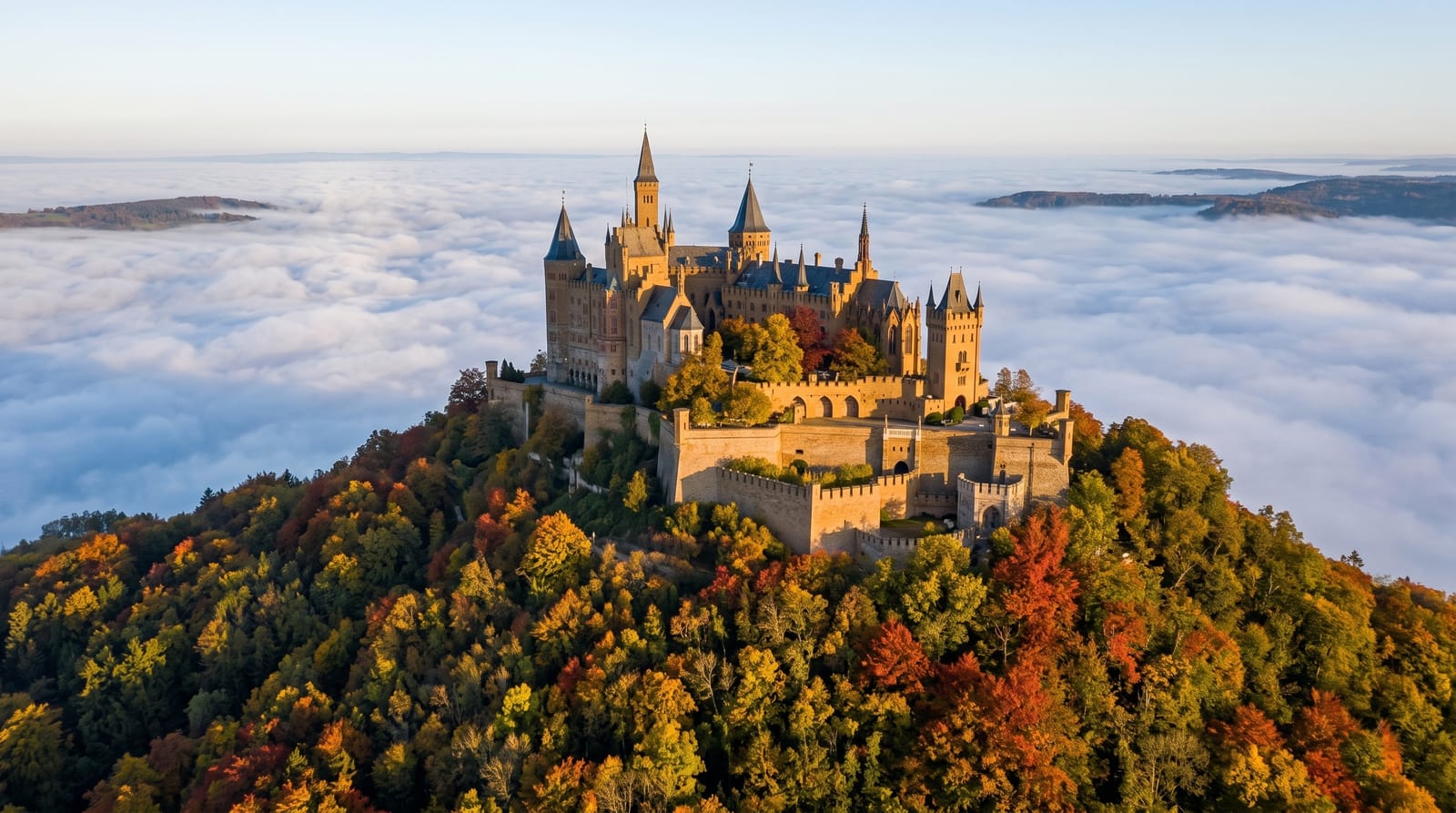
A neo-Gothic castle on an isolated cone of the Swabian Jura, visible for kilometres and sometimes standing above cloud.
Updated 19 October 2026
AI illustration
The castle on Mount Hohenzollern is the third on the site and by far the youngest, built between 1850 and 1867 in a romantic Gothic Revival style for the family whose name it carries. Historically it is a nineteenth century idea of the Middle Ages rather than the thing itself, and it is best taken on those terms: turrets, battlements and a spiralling walled ramp that wraps the hill several times before letting you through the gate. The setting does the rest. The cone rises alone off the Swabian Jura escarpment, and on autumn mornings the valleys below fill with fog while the towers stay in sun.
History
The first castle on the mountain was built around 1040 by the Counts of Zollern; the family is first mentioned in 1061 and the castle, praised as the "crown of all castles in Swabia", appears as Castro Zolre in 1267, and in 1423 it was totally destroyed after a long siege by the Swabian League of Cities. A second, stronger castle was begun in 1454; Württemberg troops took it in 1634 in the Thirty Years' War, French soldiers occupied it in the winter of 1744/45, and after the last Austrian owner left in 1798 it fell into ruin until only the Chapel of St Michael was usable. Crown Prince Frederick William IV of Prussia climbed the hill in 1819 to learn about his family's roots and later resolved to rebuild it; Friedrich August Stüler began the design in 1846, construction started in 1850, and it was completed on 3 October 1867 under King William I (Wikipedia, Hohenzollern Castle).
What's there
- The approach ramp - a spiralling walled road that circles the hill before reaching the gate.
- The bastion walk - a full circuit of the outer terrace with the Jura escarpment on every side.
- The treasury - court silver, regalia and porcelain shown in a vaulted strongroom.
- St Michael's chapel - the oldest surviving part of the complex, with old stained glass panels.
When to go
Late spring to early autumn for reliable opening and warm terraces. October and November bring the inversions that put the castle above a sea of fog, but they are a matter of luck and an early start. Interiors are seen by guided tour, and tours sell out on summer weekends, so book a slot before travelling.
Before you go
It is a nineteenth century reconstruction, and visitors expecting an authentic medieval fortress leave disappointed. The shuttle costs extra on top of the ticket, or you walk up a steep gravel road. Cloud can swallow the whole hill for days and take the views with it. Interior tours move fast through fewer rooms than the exterior suggests.
Nearby
The Danube gorge above Beuron, Sigmaringen's palace on the river, and the caves of the Ach valley.
Key facts
Source: Wikidata, item Q156457, read on 18 October 2026.
What to pack for Hohenzollern Castle
Chosen from what this place is for. Tap a kit for the full checklist.
- Head torch + spare batteries - Hands-free light is essential; caves are truly dark. Find on Amazon
- Comfortable walking shoes - Sightseeing means kilometres of pavement and cobbles daily. Find on Amazon
- Grippy closed shoes - Cave floors are wet, muddy and slick with formations. Find on Amazon
- A slim anti-theft daypack - Zips that close properly; keep it in front in crowds and on transit. Find on Amazon
Some links on this page are Amazon affiliate links - if you buy through them we may earn a small commission at no extra cost to you.
All packing kitsPlan your trip
Where to start if Hohenzollern Castle is going on the list.
Booking links on this page are affiliate links - if you book through them we may earn a small commission at no extra cost to you. It never changes what we write about a place.
Opening times, ticket prices and seasonal closures change - check the official source before you go: official site.