Cloppenburg Museum Village
A rebuilt Lower Saxon village of thatched hall houses, mills and a school, moved building by building onto open ground outside Cloppenburg.
Updated 19 October 2026
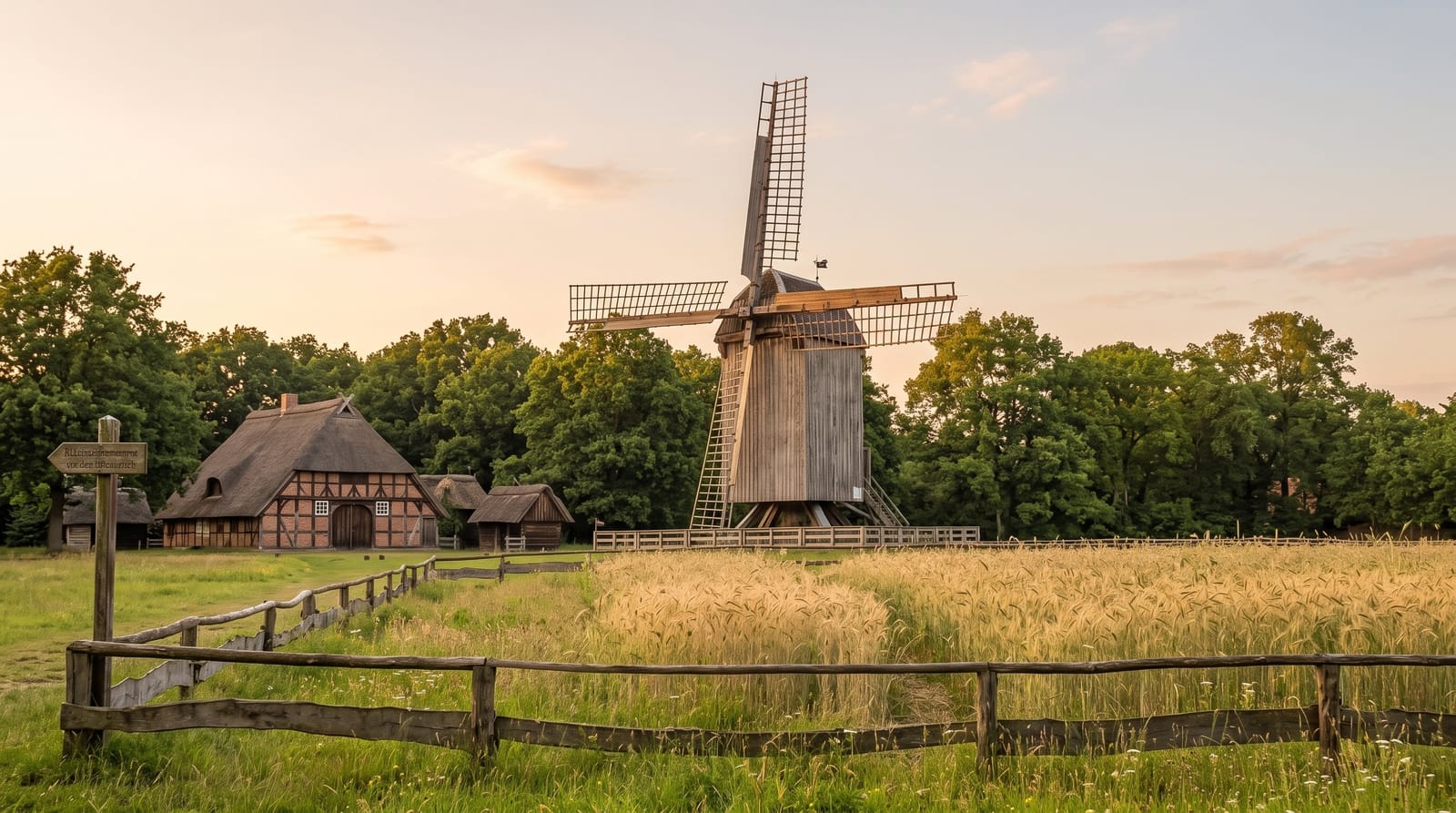
AI illustration
Museumsdorf Cloppenburg opened in the 1930s and is one of Germany's oldest open-air museums. Farm buildings from across Lower Saxony and the Oldenburg country were dismantled where they stood, carted here and rebuilt on heathland. The centrepiece is the Low German hall house, in which family, harvest and cattle shared one great thatched roof and the threshing floor ran straight through the middle. Around it stand windmills, a watermill, a village school, a small church, craft workshops and bee sheds, with rye fields, orchards and old livestock breeds worked in between. Interpreters demonstrate baking, smithing and flax work on set days, and the layout is meant to be walked rather than toured room by room.
History
The museum village was laid out in 1934 by Heinrich Ottenjann, senior schoolmaster at Cloppenburg, and ceremonially opened on Ascension Day in 1936. On 13 April 1945 six of its houses were destroyed, among them the Quatmannshof farm, which had been rebuilt faithfully in every detail by 1962; Ottenjann's son Helmut directed the museum from 1961 to 1996, followed by Uwe Meiners from 1996 to 2018 (Wikipedia, Cloppenburg Museum Village).
What's there
- The hall houses - thatched Low German farmsteads with the threshing floor running down the middle.
- The windmills - several types dismantled elsewhere and rebuilt on open ground.
- The village school - a single classroom with its benches, slates and stove.
- The worked fields - rye, flax and orchard plots farmed by old methods through the season.
When to go
April to October is when the buildings are open, the fields are worked and craft demonstrations run; several houses close entirely in winter. Weekdays in term time are quiet, while weekends bring families and themed days. Rain matters here because almost all of the visit is outdoors on grass and sand paths, so it is worth waiting for a settled day.
What to expect
It is a long walk on soft ground with little shelter between houses. Interpretation is almost entirely in German and the demonstrations are timetabled, so an unplanned visit can miss all of them. Interiors are dim by design and the same beams and hearths begin to repeat. Cloppenburg is a small town with limited reasons to stay the night.
Nearby
The heath and moor tracks of the Oldenburger Munsterland, and Oldenburg's old town to the north.
Key facts
Source: Wikidata, item Q605210, read on 18 October 2026.
What to pack for Cloppenburg Museum Village
Chosen from what this place is for. Tap a kit for the full checklist.
- Comfortable walking shoes - Sightseeing means kilometres of pavement and cobbles daily. Find on Amazon
- A slim anti-theft daypack - Zips that close properly; keep it in front in crowds and on transit. Find on Amazon
- A refillable water bottle - Many cities have public fountains; save money and plastic. Find on Amazon
- A light layer + compact umbrella - For museum air-con and a sudden shower. Find on Amazon
Some links on this page are Amazon affiliate links - if you buy through them we may earn a small commission at no extra cost to you.
All packing kitsPlan your trip
Where to start if Cloppenburg Museum Village is going on the list.
Booking links on this page are affiliate links - if you book through them we may earn a small commission at no extra cost to you. It never changes what we write about a place.
Opening times, ticket prices and seasonal closures change - check the official source before you go: official site.