Bad Karlshafen
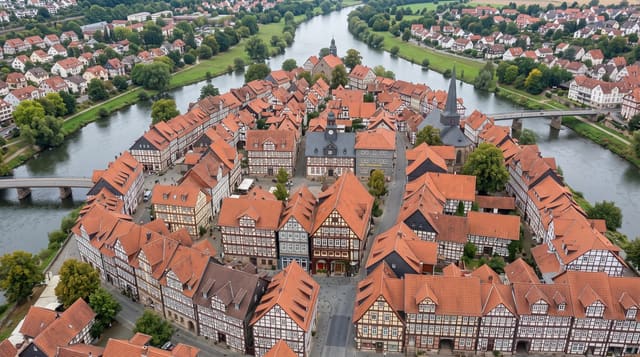
A white baroque town built to a single plan for Huguenot refugees, around a harbour that never got its canal.
Updated 19 October 2026

AI illustration
Landgrave Karl of Hesse-Kassel founded the town in 1699 for Huguenots who had fled France after the revocation of the Edict of Nantes, and had it laid out on a strict baroque plan with white plastered buildings of uniform height around a rectangular harbour basin. The harbour was to be the end of a canal linking the Weser to the Diemel and bypassing tolls; the canal was never completed after Karl's death, so the basin remained a harbour without its purpose. The town is unusually uniform and white for the region. Huguenot history is covered in a museum and archive.
History
The town was founded in 1699 for French Huguenots fleeing persecution, first named Sieburg and later after Charles I, Landgrave of Hesse-Kassel, who gave them refuge. Charles and his engineer and architect Friedrich Conradi planned a Landgrave-Carl Canal and a harbour at Karlshafen to bypass customs duties on the Weser, and between 1685 and 1750 hundreds of Waldensians expelled from Piedmont also lived here; the German Huguenot Museum keeps an archive, library and family histories, and the town has held spa status, and the title Bad, since 1977 (Wikipedia, Bad Karlshafen).
What to look for
- The white baroque plan - uniform plastered buildings to one design.
- The harbour basin - a rectangular dock built for a canal never finished.
- The Huguenot museum - the refugee history that founded the town.
- The Weser setting - the river running below the planned centre.
When to go
April to October; boat trips run on the Weser in season and the cycle path passes through. The town is small and quiet. Winter is very quiet.
What to expect
The town is tiny and seen in an hour or two. The spa function has declined. Services are limited outside the season.
Nearby
Hann. Münden lies upriver; the Reinhardswald is south.
Key facts
Source: Wikidata, item Q506295, read on 18 October 2026.
What to pack for Bad Karlshafen
Chosen from what this place is for. Tap a kit for the full checklist.
- Comfortable walking shoes - Sightseeing means kilometres of pavement and cobbles daily. Find on Amazon
- A slim anti-theft daypack - Zips that close properly; keep it in front in crowds and on transit. Find on Amazon
- A refillable water bottle - Many cities have public fountains; save money and plastic. Find on Amazon
- A light layer + compact umbrella - For museum air-con and a sudden shower. Find on Amazon
Some links on this page are Amazon affiliate links - if you buy through them we may earn a small commission at no extra cost to you.
All packing kitsPlan your trip
Where to start if Bad Karlshafen is going on the list.
Booking links on this page are affiliate links - if you book through them we may earn a small commission at no extra cost to you. It never changes what we write about a place.
Opening times, ticket prices and seasonal closures change - check the official source before you go: official site.