Shio-Mgvime Monastery
A sixth-century monastery in a limestone gorge near Mtskheta, with cells cut into the rock.
Updated 18 October 2026
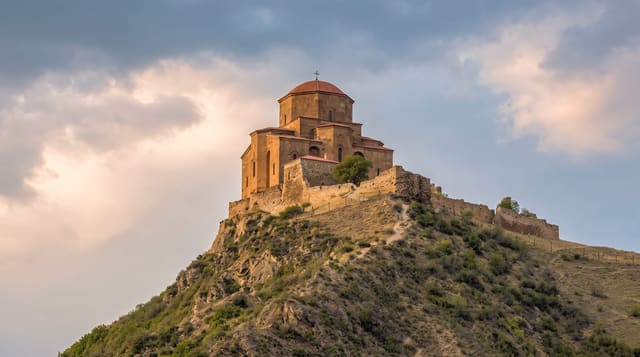
Shio-Mgvime was founded in the sixth century by Shio, one of the Assyrian fathers who established monasticism in Georgia, who is said to have lived in a cave here, and the monastery that grew around him became one of the largest in the country during the medieval period. It occupies a narrow limestone gorge west of Mtskheta, with the Church of Saint John the Baptist, the oldest building, standing above cells and chambers cut into the rock, and a domed church of the twelfth century beside it. Shio's own cave and grave are below the church. The road in follows the gorge through bare hills, which makes the arrival at the green cluster of buildings abrupt.
History
The community grew quickly into the largest in Georgia, with as many as 2,000 monks by the end of the 6th century, under the personal patronage of the Catholicos. David IV the Builder made it a royal domain and gave it its rule, the typicon, in 1123. It declined with the fall of the medieval Georgian kingdom and repeated invasions, revived when King George VIII (r. 1446-1465) granted it to the Zevdginidze-Amilakhvari family, who used it as their burial ground until the 1810s, and was ravaged by the troops of the Persian Shah Abbas I in 1614-1616. Rebuilt by Prince Givi Amilakhvari in 1678, it was devastated again during the Ottoman occupation of the 1720s, restored in 1733 and raided by Persian forces less than two years later. It was restored and its interior renovated in the 19th century, though it never regained its old importance; it was shut under Soviet rule and is an active monastery again today (Wikipedia, Shio-Mgvime Monastery).
What to look for
- Cells cut into the rock - the cave dwellings of the early community.
- The Church of Saint John the Baptist - the sixth-century core.
- Shio's cave and grave - the shrine below the church.
- The bare limestone gorge - the approach from Mtskheta.
When to go
April to October. Two hours from Mtskheta. The road is narrow and rough in places. Modest dress is expected and coverings are available at the entrance.
Things to know
The road in is narrow with passing difficulties and taxis charge accordingly. It is a working monastery with photography restrictions. Interiors are dark. There are no facilities on site.
Nearby
Mtskheta is east; Tbilisi lies beyond it.
Key facts
Source: Wikidata, item Q2236298, read on 18 October 2026.
What to pack for Shio-Mgvime Monastery
Chosen from what this place is for. Tap a kit for the full checklist.
- Head torch + spare batteries - Hands-free light is essential; caves are truly dark. Find on Amazon
- Comfortable walking shoes - Sightseeing means kilometres of pavement and cobbles daily. Find on Amazon
- Modest clothing - Shoulders and knees covered - the single most common requirement. Find on Amazon
- Grippy closed shoes - Cave floors are wet, muddy and slick with formations. Find on Amazon
Some links on this page are Amazon affiliate links - if you buy through them we may earn a small commission at no extra cost to you.
All packing kitsPlan your trip
Where to start if Shio-Mgvime Monastery is going on the list.
Booking links on this page are affiliate links - if you book through them we may earn a small commission at no extra cost to you. It never changes what we write about a place.
Opening times, ticket prices and seasonal closures change - check the official source before you go: official site.