Tarascon Castle
A castle rising sheer from the Rhone, later a prison whose inmates carved graffiti into its walls.
Updated 21 October 2026
AI illustration
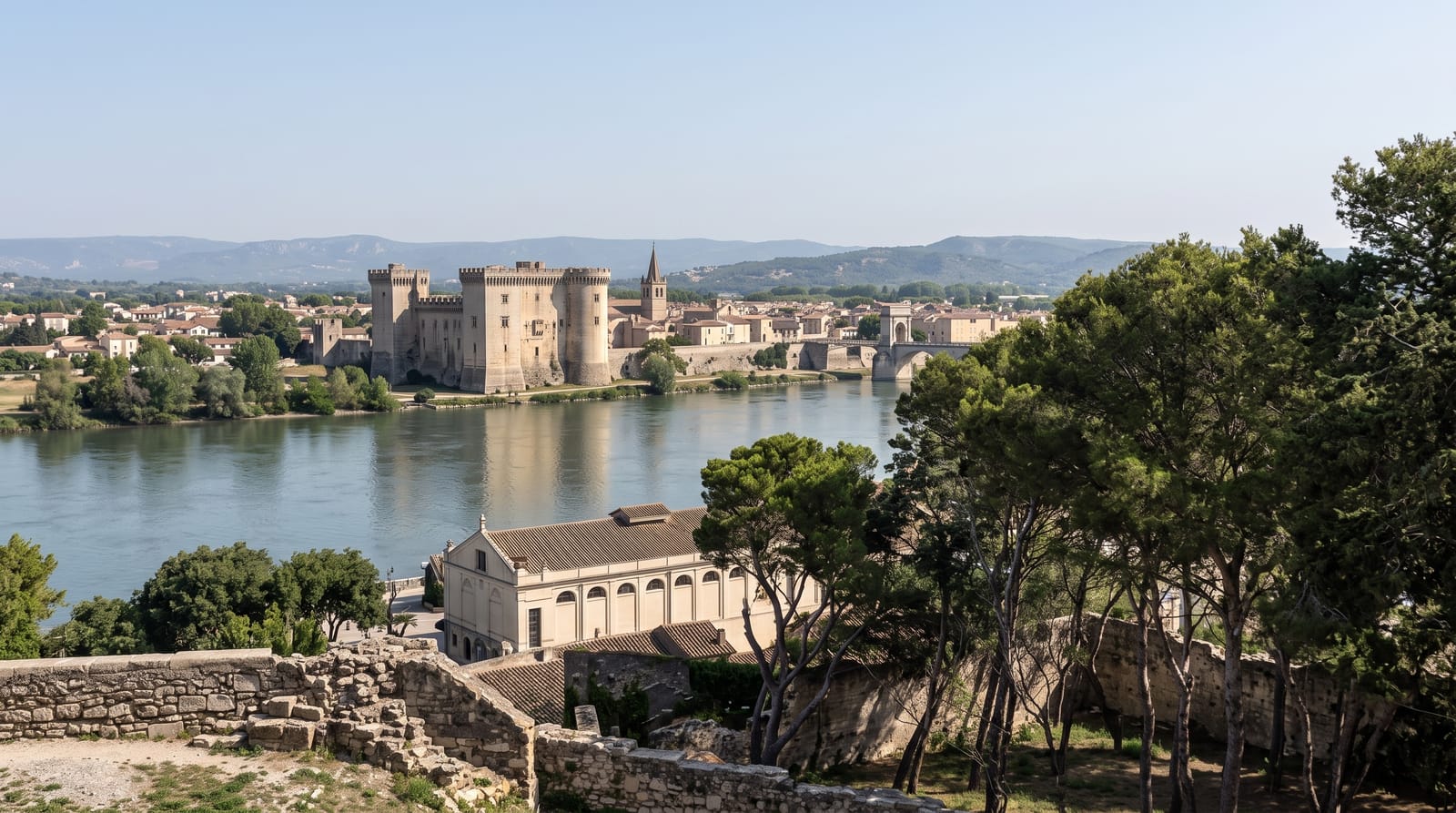
The castle of Tarascon rises straight out of the Rhone with almost no batter, a smooth wall of pale stone about forty-eight metres high, built between 1400 and 1435 largely for Louis II of Anjou and completed under King Rene, who held court here in the fifteenth century. Because it was used as a prison from the seventeenth century until 1926 rather than being rebuilt, the medieval fabric survived unusually intact, and the walls carry graffiti cut by prisoners, including medieval ships and war galleys cut by Catalan sailors held prisoner in a cell in the fifteenth century. The town also keeps the legend of the Tarasque, a river monster tamed by Saint Martha and paraded in a June festival.
History
The first castle was built between 994 and 1010 by Roubaud II, Marquis of Provence, on the ruins of a Roman castrum to control the Rhône; badly damaged in a rising of townspeople siding with the Counts of Toulouse in 1232, it was rebuilt by Charles of Anjou and given its layout by his son Charles II. Bertrand Du Guesclin, freed in December 1367, besieged Tarascon with 2,000 men from 4 March 1368 and took it within the month, but it was recaptured in 1370, and after 1386 a civil war left the castle and town in ruins. The Anjou family began the present fortress in 1401, modelled on the Bastille in Paris and built of stone from the Beaucaire quarries, and René of Anjou completed it in 1449; after a failed siege in 1427 it was armed with twenty bombards. Once Provence passed to Louis XI, the castle lost its military and royal role, survived sieges in 1586 and 1652 and became a military prison; it was listed as a historic monument in 1840 while still a prison, and after the prison closed in 1926 the state bought it in 1932, restored it and opened it as a museum (Wikipedia, Château de Tarascon).
What to look for
- The river wall - a sheer forty-eight-metre facade rising from the Rhone.
- The prisoners' graffiti - carved ships and marks in the interior stone.
- The royal apartments - fifteenth-century rooms of King Rene's court.
- The roof terrace - a view over the Rhone to Beaucaire opposite.
When to go
April to October; the castle opens year-round with shorter winter hours. The Tarasque festival falls in late June. The roof terrace is exposed to the mistral.
Practical notes
The interior is largely bare stone rooms with little furnishing, the prison years having stripped it. There are many stairs. The town outside is modest.
Nearby
Arles lies south; Avignon is northeast.
Key facts
Source: Wikidata, item Q740250, read on 18 October 2026.
What to pack for Tarascon Castle
Chosen from what this place is for. Tap a kit for the full checklist.
- Comfortable walking shoes - Sightseeing means kilometres of pavement and cobbles daily. Find on Amazon
- A slim anti-theft daypack - Zips that close properly; keep it in front in crowds and on transit. Find on Amazon
- A refillable water bottle - Many cities have public fountains; save money and plastic. Find on Amazon
- A light layer + compact umbrella - For museum air-con and a sudden shower. Find on Amazon
Some links on this page are Amazon affiliate links - if you buy through them we may earn a small commission at no extra cost to you.
All packing kitsPlan your trip
Where to start if Tarascon Castle is going on the list.
Booking links on this page are affiliate links - if you book through them we may earn a small commission at no extra cost to you. It never changes what we write about a place.
Opening times, ticket prices and seasonal closures change - check the official source before you go: official site.