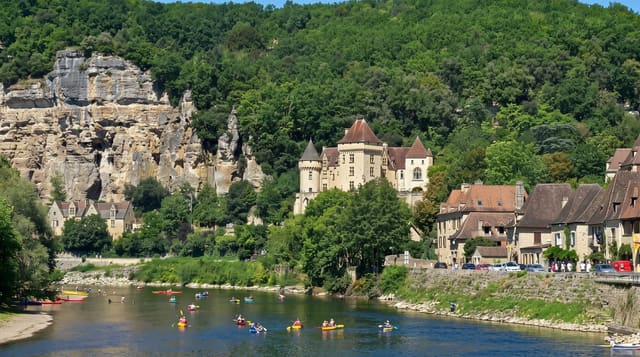
Sarlat-la-Caneda
A dense medieval and Renaissance town of golden limestone in the Perigord, restored as France's pilot conservation project in the 1960s.
Updated 19 October 2026
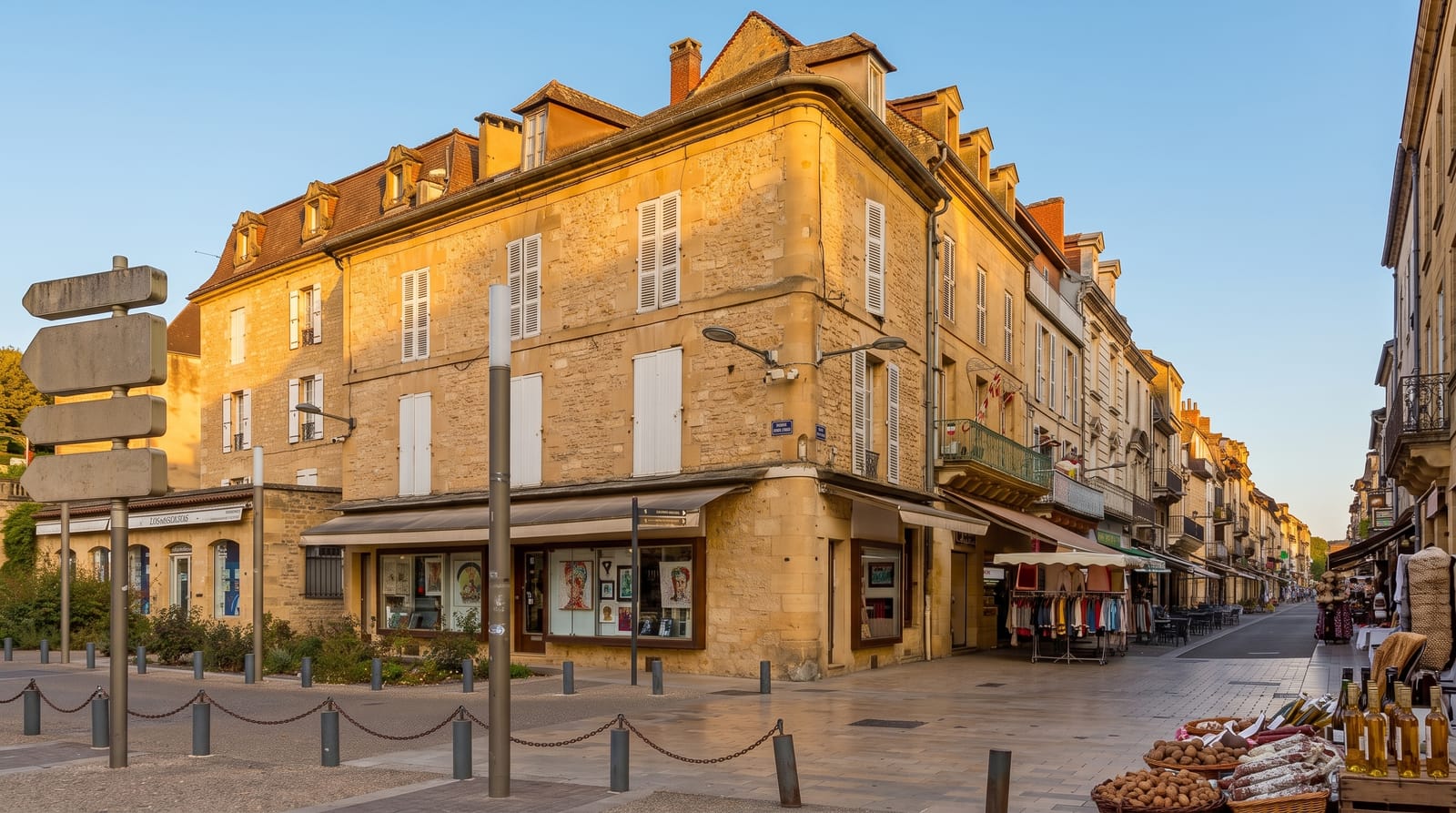
AI illustration
Sarlat holds one of the highest concentrations of protected buildings in France, packed into a few hundred metres of lanes cut from the same honey-coloured limestone. Almost none of it was demolished in the nineteenth century because the town was poor and off the main routes, and in 1962 it became the test case for a new French law on conserving whole historic quarters rather than single monuments. The result reads as one piece: steep roofs of heavy lauze slabs, Renaissance windows, a twelfth-century conical tower built as a lantern for the dead, and a deconsecrated church that Jean Nouvel converted into a covered market behind giant steel doors.
History
Sarlat grew up around a large Benedictine abbey of Carolingian origin, recorded as early as 1081 and one of the few in the region never raided by the Vikings; its church was dedicated to Saint Sacerdos by 1318 and became a cathedral in the 20th century. The town was besieged in 1370 during the Hundred Years' War, and because later history largely passed it by, it remains one of the towns most representative of 14th-century France, its preservation owed in part to André Malraux, who as Minister of Culture from 1960 to 1969 restored it and many other sites. Its historic centre, with 77 protected monuments, was placed on France's Tentative List for UNESCO in 2002, and Sarlat and La Canéda, separate towns until then, were merged into one commune in March 1965 (Wikipedia, Sarlat-la-Canéda).
Highlights
- The lauze roofs - heavy limestone slabs, the traditional roofing of the Perigord.
- The Lanterne des Morts - a conical twelfth-century tower behind the cathedral.
- The Sainte-Marie market hall - a stripped church with steel doors by Jean Nouvel.
- Saturday market - the whole centre given over to Perigord produce.
When to go
Late spring and September are the honest windows. In July and August the lanes move at shuffling pace and the heat sits in the stone until late evening. Saturday is the best day to come and the worst day to park, so arrive before nine. Winter shuts many shops but leaves the architecture and the light.
Practical notes
Sarlat lives entirely on visitors, and the ground floors are wall to wall foie gras, walnut and souvenir shops, which wears thin fast. Prices run higher than the surrounding villages for the same produce. Parking sits outside the centre and fills early. The town is small enough that half a day covers it unless you time the visit with the market.
Nearby
The Dordogne valley castles at Beynac and Castelnaud, the cliff village of La Roque-Gageac and the painted caves upriver.
Key facts
Source: Wikidata, item Q6381, read on 18 October 2026.
What to pack for Sarlat-la-Caneda
Chosen from what this place is for. Tap a kit for the full checklist.
- Head torch + spare batteries - Hands-free light is essential; caves are truly dark. Find on Amazon
- Comfortable walking shoes - Sightseeing means kilometres of pavement and cobbles daily. Find on Amazon
- Modest clothing - Shoulders and knees covered - the single most common requirement. Find on Amazon
- Grippy closed shoes - Cave floors are wet, muddy and slick with formations. Find on Amazon
Some links on this page are Amazon affiliate links - if you buy through them we may earn a small commission at no extra cost to you.
All packing kitsPlan your trip
Where to start if Sarlat-la-Caneda is going on the list.
Booking links on this page are affiliate links - if you book through them we may earn a small commission at no extra cost to you. It never changes what we write about a place.
Opening times, ticket prices and seasonal closures change - check the official source before you go: official site.