Palais Garnier
An opera house with a lake beneath it, a Chagall ceiling above, and a phantom legend built on both.
Updated 19 October 2026
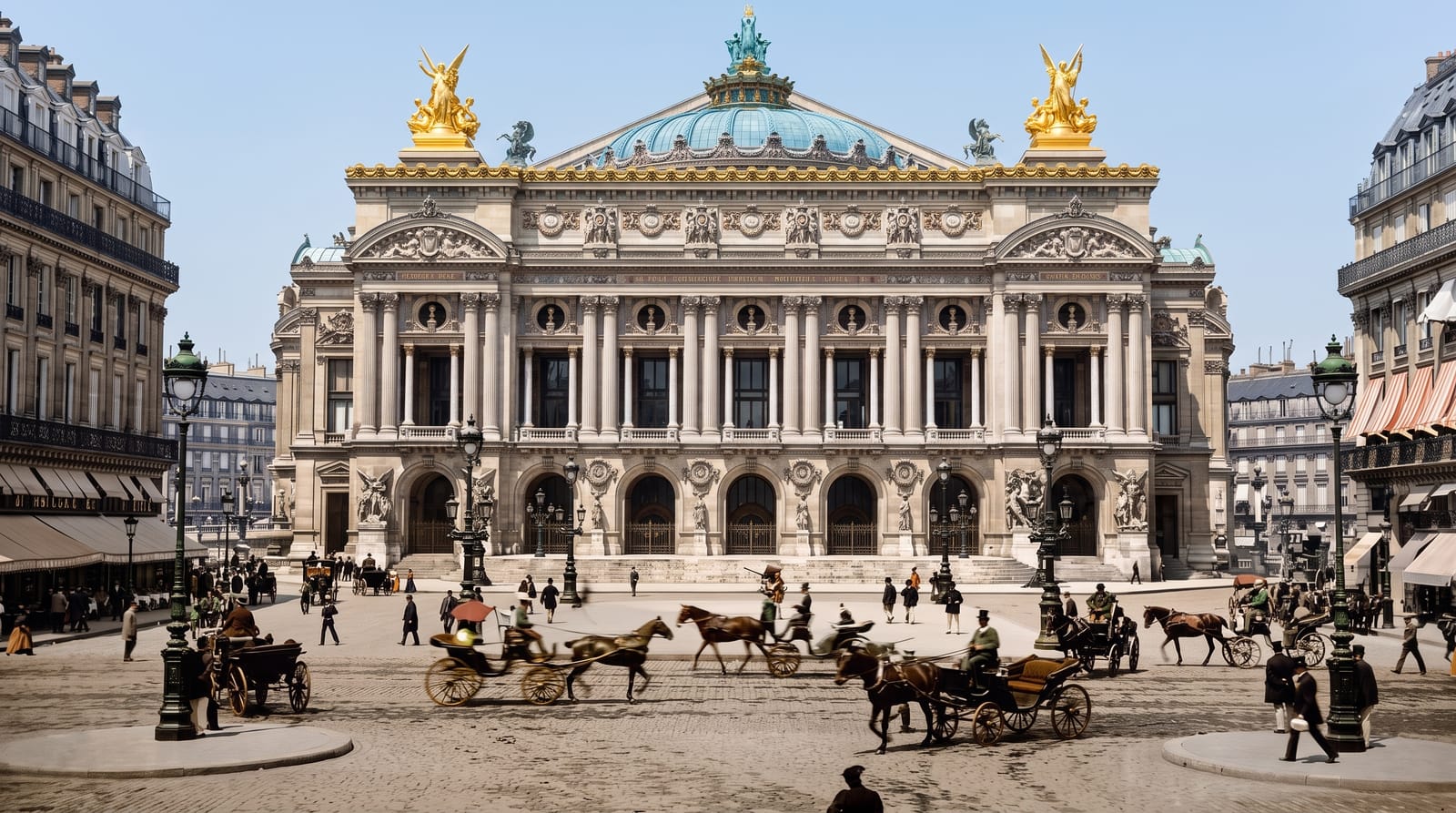
AI illustration
Charles Garnier won the competition in 1861 and the building opened in 1875, an exercise in Second Empire display: a grand staircase of coloured marble designed so that arriving audiences could watch each other, a foyer of gilt and mirrors modelled on a palace gallery, and an auditorium in red and gold. Groundwater under the site forced the engineers to build a water tank in the substructure, which became the underground lake of Leroux's Phantom of the Opera; it is real, and the fire brigade trains in it. The auditorium ceiling was repainted by Chagall in 1964, over the original, which survives beneath.
History
In 1821 the Paris Opera moved into the temporary Salle Le Peletier, and the search for a permanent home began; a site by the Palais-Royal chosen in 1847 was dropped after the revolution of 1848, but with the Second Empire and Haussmann's appointment in 1853 the plan revived, made more urgent when an attempt on Napoleon III's life was made at the old opera's cramped entrance on 14 January 1858. An imperial decree of 29 September 1860 fixed the site off the Boulevard des Capucines, and the competition announced on 30 December 1860 drew about 170 entries, won by the young Charles Garnier. Built from 1861 to 1875, the 1,979-seat house was the main theatre of the Paris Opera and its ballet until the Opéra Bastille opened in 1989, and it has been a monument historique since 1923 (Wikipedia, Palais Garnier).
What's there
- The grand staircase - coloured marble built for audiences to be seen on.
- The Chagall ceiling - the 1964 painting over the original, above the chandelier.
- The grand foyer - a mirrored gilt gallery the length of the facade.
- The water tank - the substructure reservoir behind the phantom's lake.
When to go
Year-round; daytime visits are possible when no rehearsal is running, which is not always predictable, so checking on the day helps. Performances are a separate and better way to see the auditorium.
What to expect
The auditorium is closed to daytime visitors during rehearsals, which happens often and without much warning. The underground lake is not open to the public. Guided tours book out.
Nearby
Galeries Lafayette lies north; the Louvre is south.
Key facts
Source: Wikidata, item Q187840, read on 18 October 2026.
What to pack for Palais Garnier
Chosen from what this place is for. Tap a kit for the full checklist.
- Head torch + spare batteries - Hands-free light is essential; caves are truly dark. Find on Amazon
- Comfortable walking shoes - Sightseeing means kilometres of pavement and cobbles daily. Find on Amazon
- Grippy closed shoes - Cave floors are wet, muddy and slick with formations. Find on Amazon
- A slim anti-theft daypack - Zips that close properly; keep it in front in crowds and on transit. Find on Amazon
Some links on this page are Amazon affiliate links - if you buy through them we may earn a small commission at no extra cost to you.
All packing kitsPlan your trip
Where to start if Palais Garnier is going on the list.
Booking links on this page are affiliate links - if you book through them we may earn a small commission at no extra cost to you. It never changes what we write about a place.
Opening times, ticket prices and seasonal closures change - check the official source before you go: official site.