Tuileries Garden
The garden Le Notre laid out before he did Versailles, on the site of the tile kilns that named it.
Updated 21 October 2026
AI illustration
UNESCO World Heritage
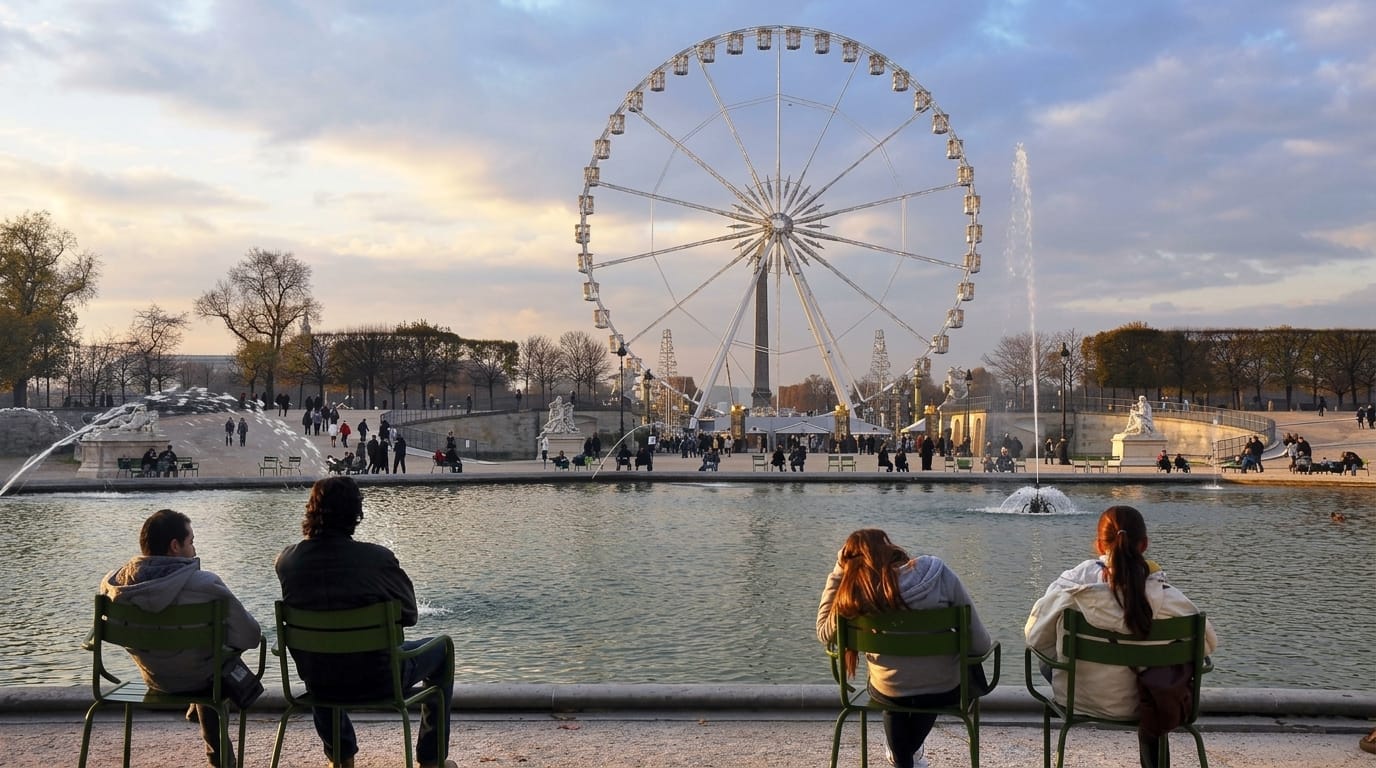
The ground was a clay pit with tile kilns, tuileries, until Catherine de Medici built a palace here in 1564; Andre Le Notre redesigned the garden in 1664, before his work at Versailles, imposing the central axis, terraces and geometry that survive. That axis continues west through the Concorde obelisk and the Champs-Elysees to the Arc de Triomphe and beyond, forming the historic axis of Paris. The palace burned in the Commune of 1871 and was demolished, so the garden now runs straight into the Louvre. Two ponds hold the same movable chairs as the Luxembourg, and sculpture by Maillol, Giacometti and Rodin stands among the trees.
History
In 1564 Catherine de' Medici bought land west of Paris, outside the wall of Charles V, where tile kilns, tuileries, had stood since the 13th century, and built a new palace there; the Florentine Bernard de Carnesse laid out an Italian Renaissance garden five hundred metres long and three hundred wide, with lawns, flower beds, kitchen gardens, a labyrinth and a grotto with faience by Bernard Palissy. The garden was pillaged in the religious wars of 1588, and from 1595 Henry IV and his gardener Claude Mollet restored it, planting mulberries for silkworms and building an ornamental lake fed from the Samaritaine pump of 1608. It opened to the public in 1667, became a public park after the Revolution, spread into the Place du Carrousel after the main block of the palace was pulled down in the 1880s, and in 2024 held the Olympic and Paralympic cauldron (Wikipedia, Tuileries Garden).
What to look for
- Le Notre's axis - the central line running west toward the Arc de Triomphe.
- The round and octagonal ponds - basins with movable chairs around them.
- The sculpture - Maillol, Rodin and modern works among the plantings.
- The missing palace - open ground where the Tuileries palace stood until 1871.
When to go
April to October; a funfair runs along the northern side in summer. The garden is a through-route between the Louvre and Concorde and is busy at all hours in season.
Good to know
The gravel is dusty and hard walking. Shade is limited in the formal sections. The summer funfair changes the character of the northern half considerably.
Nearby
The Louvre lies east; the Orangerie is at the western corner.
Key facts
Source: Wikidata, item Q818517, read on 18 October 2026.
What to pack for Tuileries Garden
Chosen from what this place is for. Tap a kit for the full checklist.
- Head torch + spare batteries - Hands-free light is essential; caves are truly dark. Find on Amazon
- Comfortable walking shoes - Sightseeing means kilometres of pavement and cobbles daily. Find on Amazon
- Grippy closed shoes - Cave floors are wet, muddy and slick with formations. Find on Amazon
- A slim anti-theft daypack - Zips that close properly; keep it in front in crowds and on transit. Find on Amazon
Some links on this page are Amazon affiliate links - if you buy through them we may earn a small commission at no extra cost to you.
All packing kitsPlan your trip
Where to start if Tuileries Garden is going on the list.
Booking links on this page are affiliate links - if you book through them we may earn a small commission at no extra cost to you. It never changes what we write about a place.
Opening times, ticket prices and seasonal closures change - check the official source before you go: official site.