Le Puy-en-Velay
An Auvergne town built across volcanic plugs, one carrying a tenth-century chapel reached by steps cut into the rock.
Updated 19 October 2026
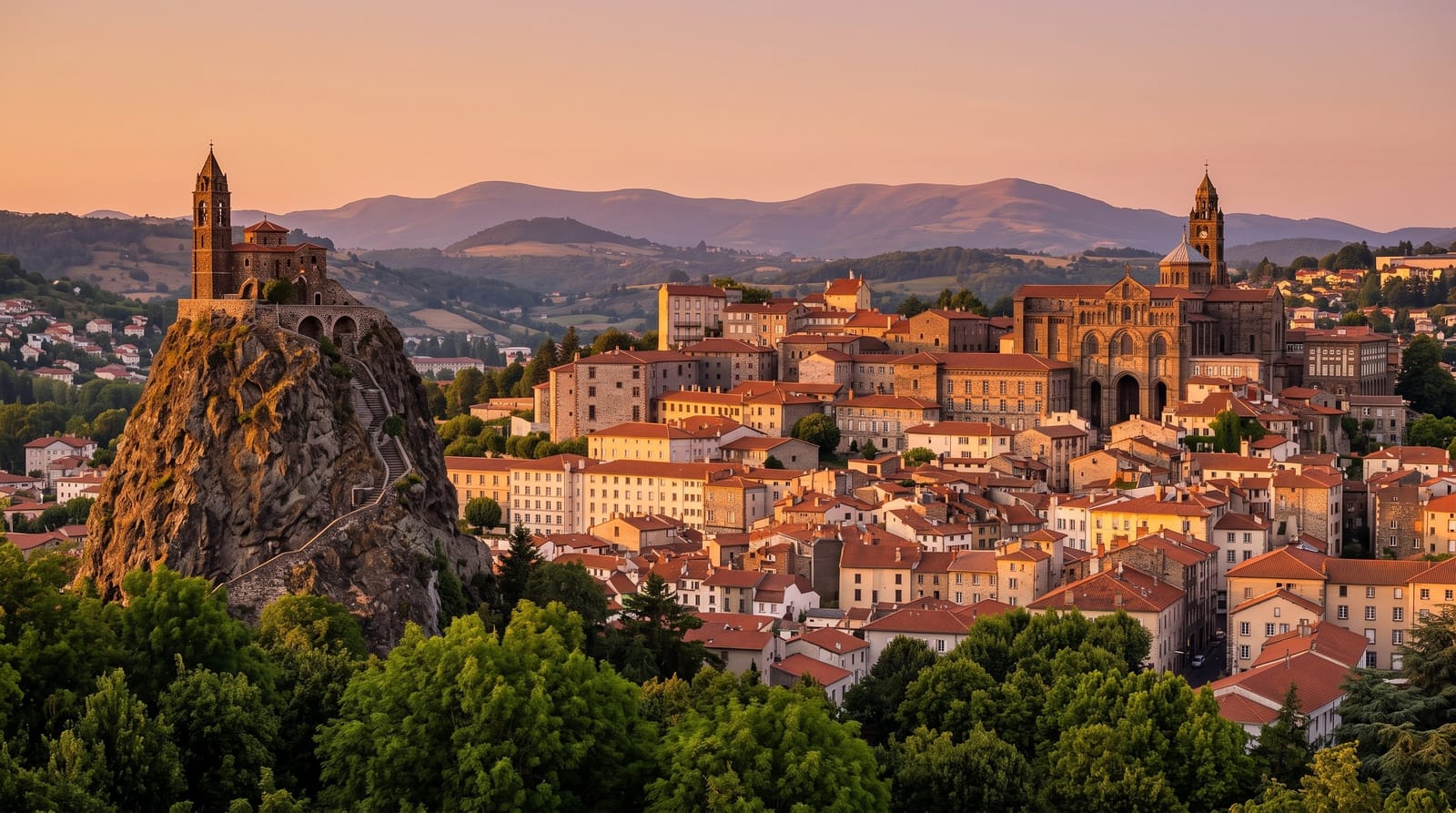
AI illustration
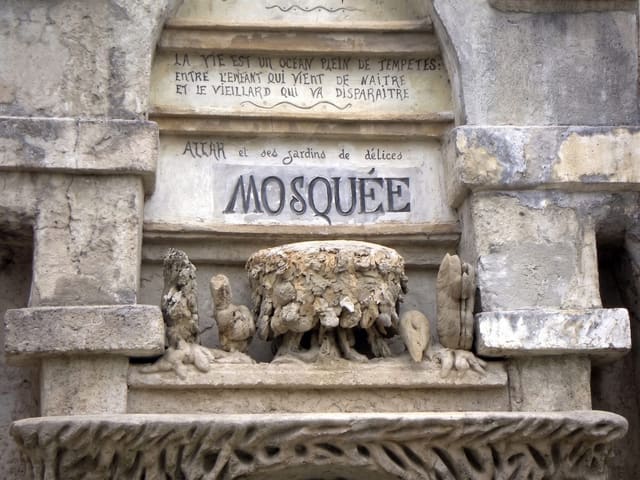
Le Puy is built across old volcanic plugs, and two of them carry buildings. Saint-Michel d'Aiguilhe stands on a needle of basalt with two hundred and sixty-eight steps cut into the rock; the chapel at the top was consecrated in the tenth century and is small enough that thirty people fill it, with a carved doorway showing clear Islamic influence and faded painting inside. The second rock carries a large iron statue with a ladder up through it. Between them the cathedral rises straight out of the street, its staircase climbing into the nave, built in striped bands of black volcanic stone and pale sandstone. The cathedral and the Hotel-Dieu, the old pilgrims' hospital, are components of the Santiago routes World Heritage listing.
History
Le Puy was a major bishopric in early medieval France, its founding wrapped in legend: a martyrology of 858 tells of a priest named George sent with Saint Front to convert Gaul, later said to have founded the church of the town called Vetula, as a document of 1004 named it. The Gallic town of Ruessium took the name Saint-Paulien from one of its legendary bishops, and a Bishop Evodius attended the Council of Valence in 374; tradition says he raised an altar to the Virgin on the pinnacle of Mont Anis, which became the site of the cathedral and a starting point of the pilgrim road to Santiago de Compostela, some 1600 km away. Le Puy was the most popular pilgrimage destination in France in the Middle Ages, and Charlemagne came twice, in 772 and 800; in the early 1180s local peasants led by a carpenter named Durandus formed the sworn association of the Capuciati against the power of the lords (Wikipedia, Le Puy-en-Velay).
Highlights
- Saint-Michel d'Aiguilhe - a chapel on a basalt needle, up 268 steps.
- The cathedral staircase - steps that climb from the street into the nave.
- The cloister - striped arches and a painted cornice beside the cathedral.
- The Rocher Corneille - an iron statue with a ladder inside and the town below.
When to go
May to October is the working season; the Velay plateau sits high and winter is cold, wet and long, with reduced opening hours. Mornings suit the climbs, which are exposed and heat up fast. In mid-September the town fills for a Renaissance festival and beds go early. Walkers set off westwards year round, mostly in spring.
Good to know
Everything worth seeing involves steps, and there are a great many of them; the chapel climb defeats anyone with bad knees and there is no alternative route up. Le Puy is a long, slow journey from anywhere by train. Several sites charge separately and the total adds up. Kitchens close early and Sunday shuts the town down almost entirely.
Nearby
The Loire gorges north, the Mezenc volcanic uplands east and the lentil fields of the Velay plateau.
What to pack for Le Puy-en-Velay
Chosen from what this place is for. Tap a kit for the full checklist.
- Comfortable walking shoes - Sightseeing means kilometres of pavement and cobbles daily. Find on Amazon
- Modest clothing - Shoulders and knees covered - the single most common requirement. Find on Amazon
- A slim anti-theft daypack - Zips that close properly; keep it in front in crowds and on transit. Find on Amazon
- A scarf or shawl - To cover the head or shoulders on entry; women especially at mosques. Find on Amazon
Some links on this page are Amazon affiliate links - if you buy through them we may earn a small commission at no extra cost to you.
All packing kitsPlan your trip
Where to start if Le Puy-en-Velay is going on the list.
Booking links on this page are affiliate links - if you book through them we may earn a small commission at no extra cost to you. It never changes what we write about a place.
Opening times, ticket prices and seasonal closures change - check the official source before you go: official site.