Le Marais
A quarter of aristocratic mansions that Haussmann never rebuilt, which is why its medieval street plan survives.
Updated 19 October 2026
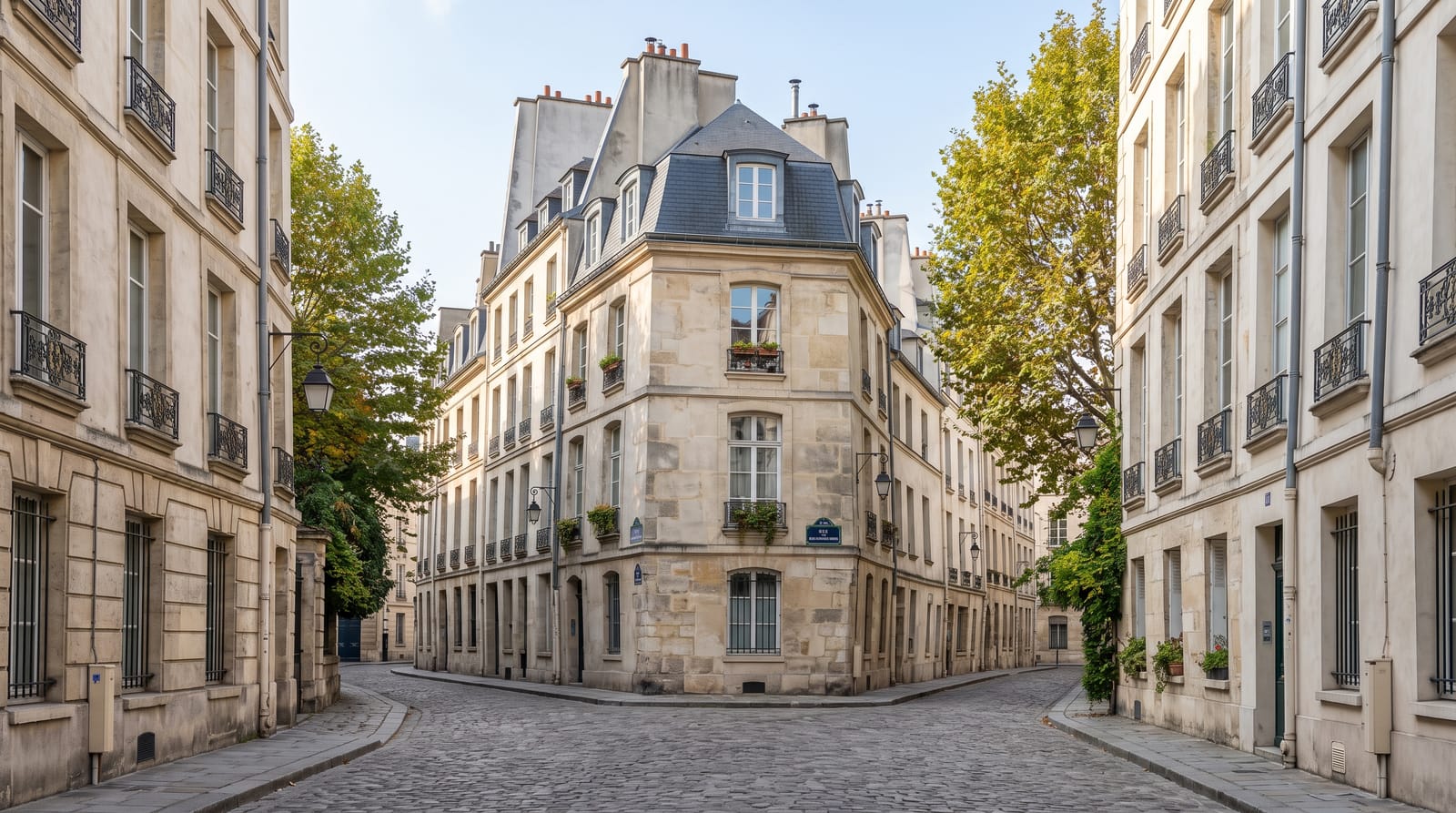
AI illustration
The Marais, the marsh, was drained and built on from the twelfth century and became the fashionable aristocratic quarter in the seventeenth, filling with hotels particuliers, private mansions built around courtyards behind plain street walls. The court moved to Versailles and the district declined, which is why Haussmann's rebuilding largely passed it by and the narrow medieval streets survived. It has been the centre of Jewish Paris since the nineteenth century, particularly around rue des Rosiers, and since the 1980s the centre of gay Paris. Place des Vosges, of 1612, is the oldest planned square in the city, arcaded on all four sides.
History
In 1240 the Knights Templar built a fortified church just outside the walls of Paris in the north of the Marais, and convents and churches grew up around their Temple; in the mid-13th century Charles of Anjou, brother of Louis IX, built a residence here, and in 1361 Charles V built the Hôtel Saint-Pol, where the royal court lived. After Henry IV laid out the Place Royale, today's Place des Vosges, in 1605, the Marais became the nobility's favourite quarter, with mansions such as the Hôtel de Sens, Sully, Beauvais, Carnavalet and Soubise; it lost its fashion in the late 18th century, fell into disrepair after the Revolution and stayed unfashionable until the late 20th century. In the 19th century it became home to one of the main Jewish communities of Paris, reinforced around the rue des Rosiers, the "Pletzl", by Jews from Eastern Europe; Hector Guimard designed its synagogue on the rue Pavée in 1913, and the quarter holds the Museum of Jewish Art and History (Wikipedia, The Marais).
What to look for
- Place des Vosges - the 1612 arcaded square, the oldest planned one in Paris.
- The hotels particuliers - mansions behind plain walls with courtyards inside.
- Rue des Rosiers - the Jewish quarter's street of bakeries and falafel.
- The medieval street plan - narrow lanes Haussmann never straightened.
When to go
Year-round; the Marais is one of the few Paris districts where many shops open on Sunday, which makes it busy then. Weekday mornings are quietest for walking.
Things to know
Most mansions are private or house institutions and cannot be entered; courtyards are sometimes visible from the gate. The main streets are crowded and increasingly given to chain retail. Sunday afternoons are packed.
Nearby
The Picasso Museum is in the quarter; Bastille lies southeast.
Key facts
Source: Wikidata, item Q749573, read on 18 October 2026.
What to pack for Le Marais
Chosen from what this place is for. Tap a kit for the full checklist.
- Comfortable walking shoes - Sightseeing means kilometres of pavement and cobbles daily. Find on Amazon
- Modest clothing - Shoulders and knees covered - the single most common requirement. Find on Amazon
- A slim anti-theft daypack - Zips that close properly; keep it in front in crowds and on transit. Find on Amazon
- A scarf or shawl - To cover the head or shoulders on entry; women especially at mosques. Find on Amazon
Some links on this page are Amazon affiliate links - if you buy through them we may earn a small commission at no extra cost to you.
All packing kitsPlan your trip
Where to start if Le Marais is going on the list.
Booking links on this page are affiliate links - if you book through them we may earn a small commission at no extra cost to you. It never changes what we write about a place.
Opening times, ticket prices and seasonal closures change - check the official source before you go: official site.