Le Havre
A city centre flattened in 1944 and rebuilt in reinforced concrete on a module of 6.24 metres, now UNESCO listed.
Updated 19 October 2026
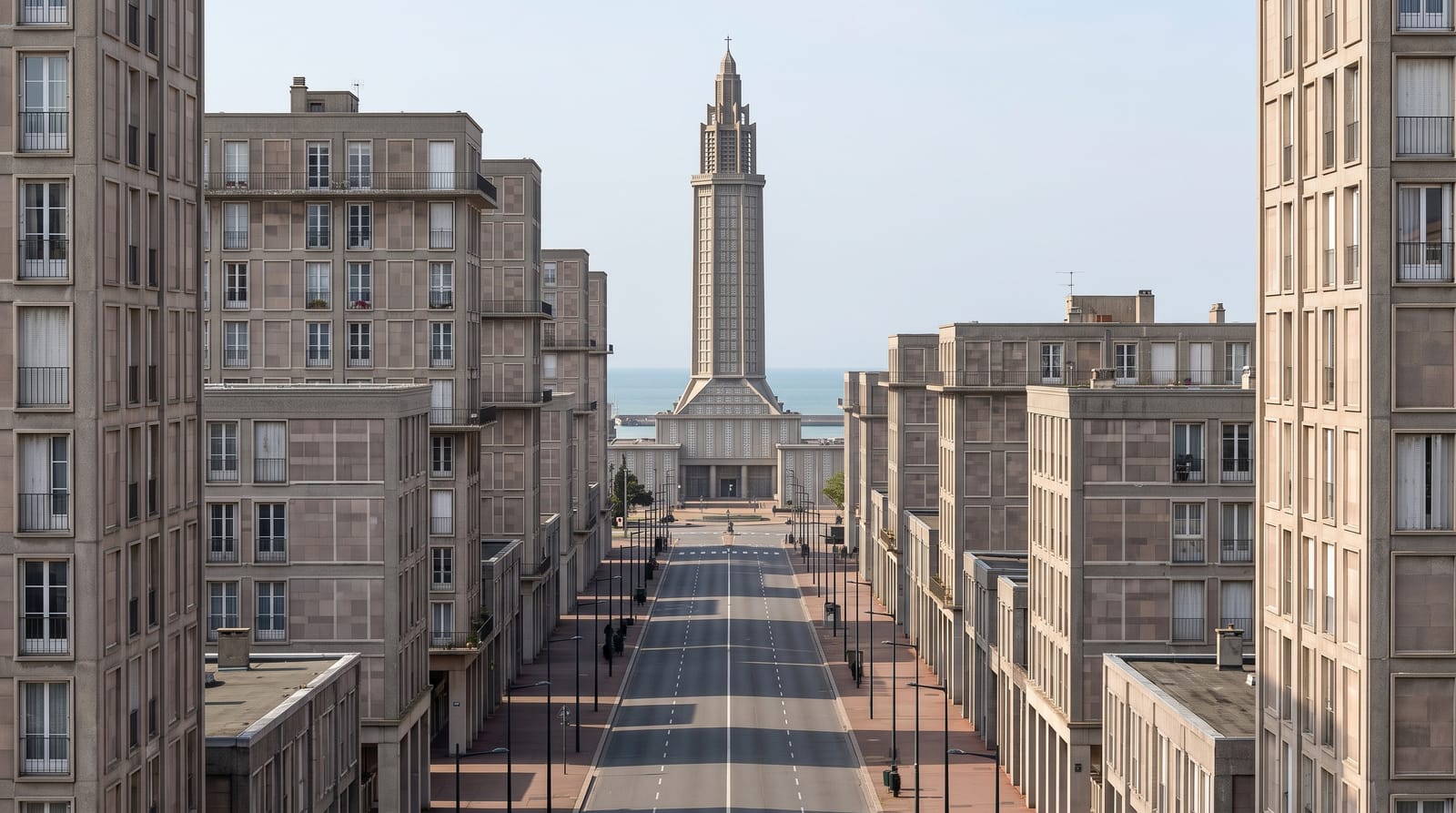
AI illustration
UNESCO World Heritage
Allied bombing in September 1944 destroyed the centre of Le Havre almost entirely, and Auguste Perret was given the reconstruction, which he treated as a chance to build a complete modern city in reinforced concrete: a grid laid out on a module of 6.24 metres, apartment blocks with generous ceiling heights and light, and the church of Saint-Joseph with a hollow lantern tower a hundred and seven metres high, lit from inside by coloured glass. UNESCO inscribed the centre in 2005, unusually for postwar architecture. A show flat is furnished as it would have been in 1950. The MuMa museum holds a major Impressionist collection.
History
King Francis I founded the city and port in 1517 as Franciscopolis, later Le Havre-de-Grâce, to replace the silting harbours of Honfleur and Harfleur; religious wars, conflicts with the English, epidemics and storms held it back until the 18th century, when trade with the West Indies made it grow. In 1793 it was briefly renamed Hâvre-Marat after the revolutionary Jean-Paul Marat, becoming simply Le Havre again on 13 January 1795, and in the early 19th century it was France's leading cotton port. Much of the city was destroyed in 1944, and between 1945 and the 1960s the centre was rebuilt in a modernist style to designs by Auguste Perret (Wikipedia, Le Havre).
What's there
- Saint-Joseph's tower - a hollow concrete lantern lit by coloured glass.
- The Perret grid - a whole city centre on a 6.24 metre module.
- The show apartment - a reconstruction flat furnished as in 1950.
- MuMa - an Impressionist collection with a strong Boudin and Dufy holding.
When to go
April to October; the show flat opens seasonally with guided visits. Saint-Joseph is best seen when sun hits the coloured glass. The city is windy and exposed.
Things to know
Concrete modernism divides opinion sharply and many visitors find the centre bleak. The port dominates the city. Some of the listed buildings are ordinary housing, not visitable.
Nearby
Honfleur lies east across the bridge; Etretat is north.
Key facts
Source: Wikidata, item Q42810, read on 18 October 2026.
What to pack for Le Havre
Chosen from what this place is for. Tap a kit for the full checklist.
- Comfortable walking shoes - Sightseeing means kilometres of pavement and cobbles daily. Find on Amazon
- A slim anti-theft daypack - Zips that close properly; keep it in front in crowds and on transit. Find on Amazon
- A refillable water bottle - Many cities have public fountains; save money and plastic. Find on Amazon
- A light layer + compact umbrella - For museum air-con and a sudden shower. Find on Amazon
Some links on this page are Amazon affiliate links - if you buy through them we may earn a small commission at no extra cost to you.
All packing kitsPlan your trip
Where to start if Le Havre is going on the list.
Booking links on this page are affiliate links - if you book through them we may earn a small commission at no extra cost to you. It never changes what we write about a place.
Opening times, ticket prices and seasonal closures change - check the official source before you go: official site.