Fecamp
A cliff-backed fishing port whose distillery invented both a liqueur and the marketing story behind it.
Updated 19 October 2026
AI illustration
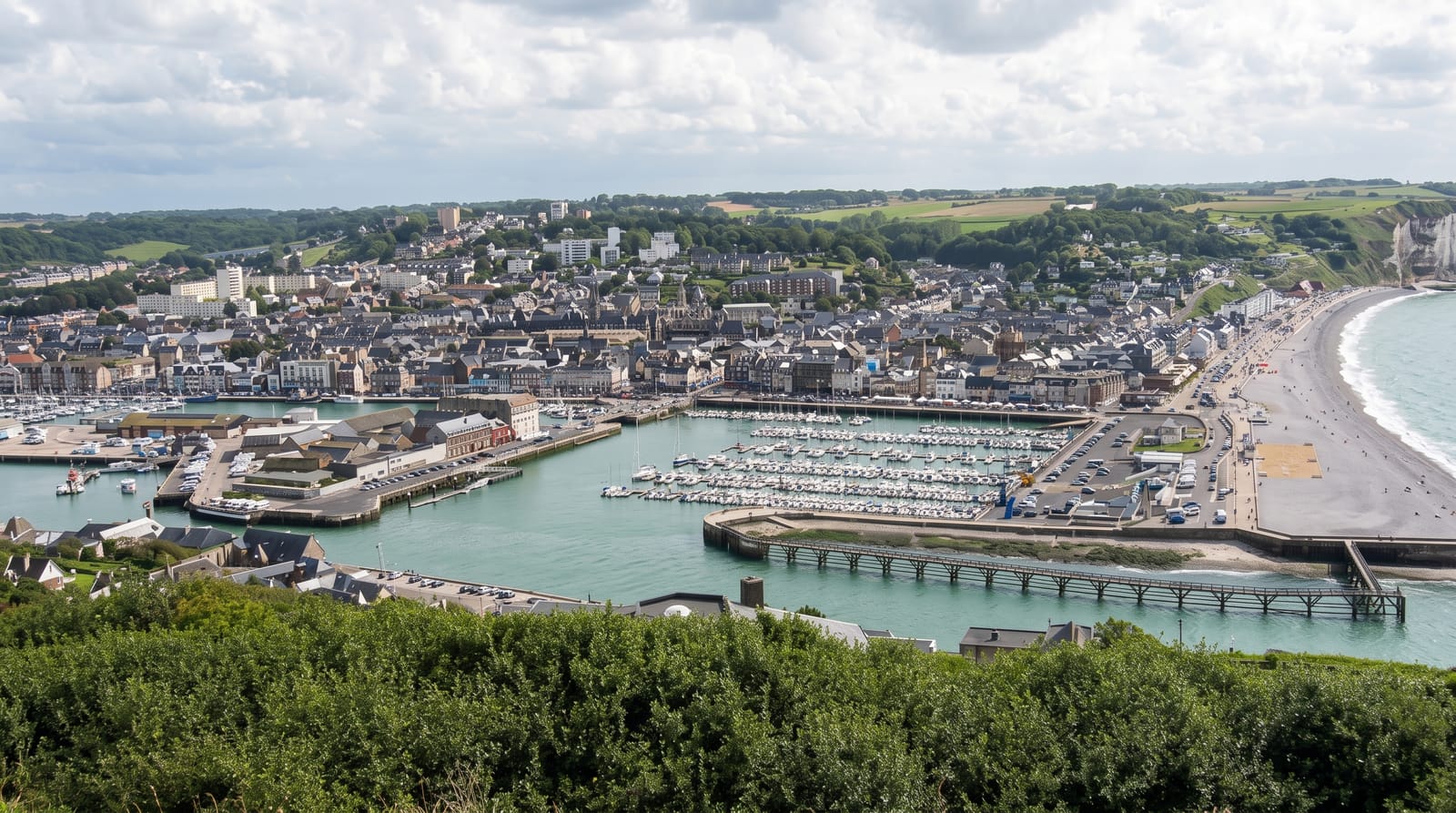
Fecamp sits in a break in the chalk cliffs of the Alabaster Coast and was a major cod-fishing port working the Newfoundland banks for centuries. Its landmark is the Palais Benedictine, built from 1888 by Alexandre Le Grand, a wine merchant who created a herbal liqueur and marketed it with a story that he had found a lost sixteenth-century monastic recipe; the monks of Fecamp had made liqueurs, but the drink is his. He built the palace as a distillery, museum and advertisement in one, in a Gothic and Renaissance pastiche, and it still distils. The abbey church nearby is longer than many cathedrals.
History
A late medieval legend told that a fig-tree trunk carrying the Precious Blood of Christ washed ashore here, giving the name "Fici-campus", but the town appears in 875 as Fiscannum, from a Germanic root meaning "fish"; a Neolithic camp of 21 hectares, ringed by walls and ditches nearly 2000 metres long, lies on the high ground inland, and Gallo-Roman coins, roads and cemeteries have been found. In 932 William Longsword founded the castle that was the residence of the dukes of Normandy until 1204, where Richard I was born in 933; King John granted the town a charter in 1202, the English razed it in 1410 and it was freed in 1449. In July 1593 it rallied to Henry IV, and on 16 October 1651 Charles II of England landed here after his defeat at Worcester; the town has always lived by its harbour and fishing, its salted herrings famous since the 10th century (Wikipedia, Fécamp).
What's there
- The Palais Benedictine - a distillery built as a Gothic and Renaissance pastiche.
- The distillery - copper stills and the herb and spice store, still working.
- The abbey church - a Trinity abbey church of cathedral proportions.
- The chalk cliffs - the Alabaster Coast rising on both sides of the port.
When to go
April to October; the Palais is open year-round but with reduced winter hours. The clifftop walks either side of town need dry weather. The port is working and busiest early.
Things to know
The monastic origin story of the liqueur is nineteenth-century marketing, not history. The Palais tour ends in a tasting and shop. Fecamp town itself is workaday.
Nearby
Etretat lies southwest; Le Havre is further southwest.
Key facts
Source: Wikidata, item Q269732, read on 18 October 2026.
What to pack for Fecamp
Chosen from what this place is for. Tap a kit for the full checklist.
- Travel rod + reel - A packable multi-piece rod fits in a case and covers most holiday fishing. Find on Amazon
- Comfortable walking shoes - Sightseeing means kilometres of pavement and cobbles daily. Find on Amazon
- Modest clothing - Shoulders and knees covered - the single most common requirement. Find on Amazon
- A small tackle selection - Hooks, weights, line and a few lures or flies suited to local waters. Find on Amazon
Some links on this page are Amazon affiliate links - if you buy through them we may earn a small commission at no extra cost to you.
All packing kitsPlan your trip
Where to start if Fecamp is going on the list.
Booking links on this page are affiliate links - if you book through them we may earn a small commission at no extra cost to you. It never changes what we write about a place.
Opening times, ticket prices and seasonal closures change - check the official source before you go: official site.