Chateau de Vincennes
The tallest medieval keep in Europe, built as a fortified royal residence and later used as a prison.
Updated 21 October 2026
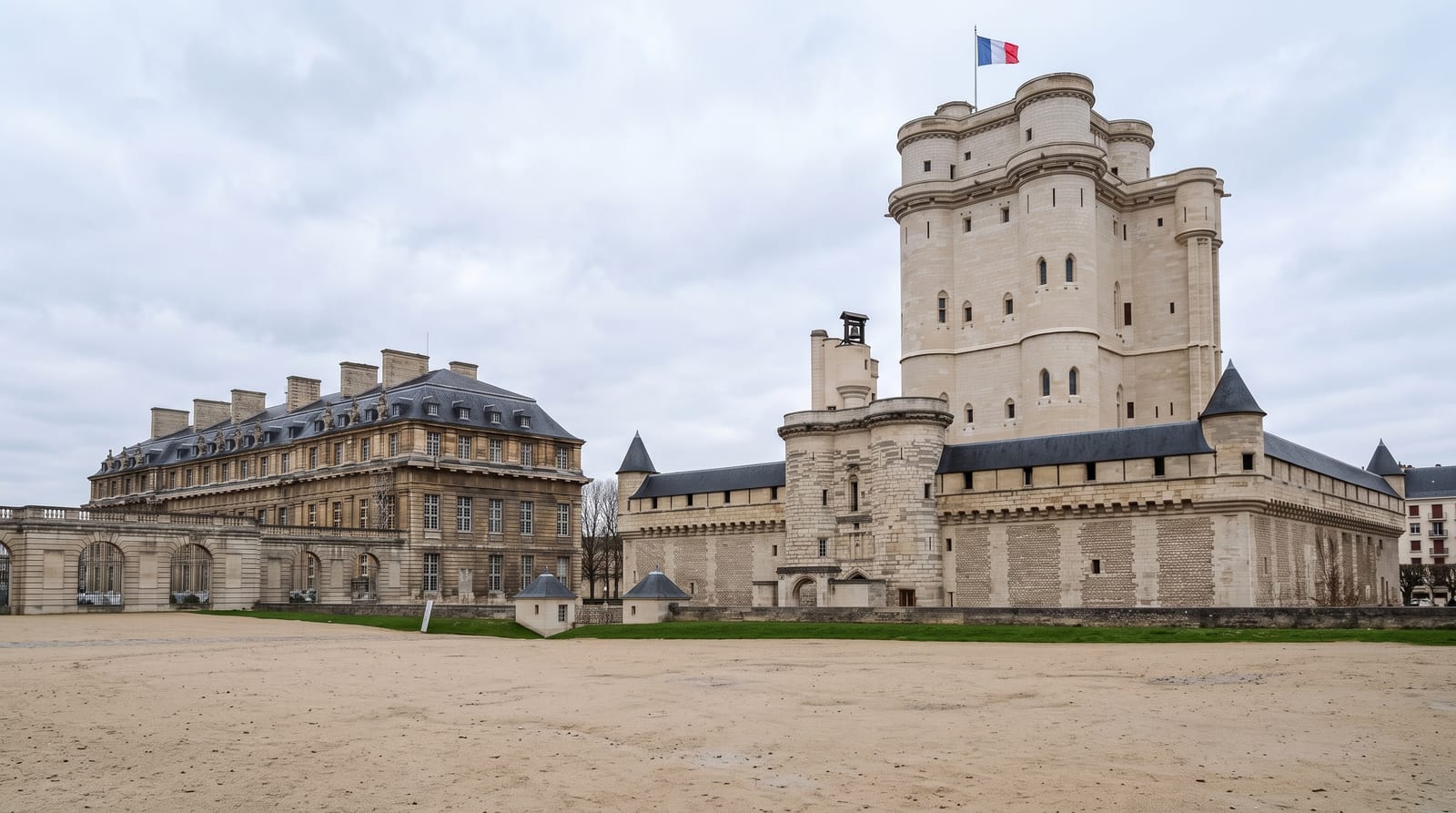
AI illustration
Vincennes began as a hunting lodge and was rebuilt through the fourteenth century into a fortified royal residence, with a donjon of about fifty-two metres that is the tallest surviving medieval keep in Europe, set inside its own moated enclosure within the larger curtain wall. The keep held the king's apartments on stacked floors, with a vaulted chamber on each level. The Sainte-Chapelle in the courtyard, begun in 1379 and finished only in 1552, copies the Paris original in plan. Later the castle became a prison, holding Fouquet, Diderot and Mirabeau among others, and then an arsenal.
History
Louis VII created the first royal residence here in 1178, for the hunting in the forest and the old Roman roads to Sens and Lagny, and Louis IX used it often, bringing the Crown of Thorns here on its way to the Sainte-Chapelle in Paris and saying farewell to his family here before leaving on the crusade from which he did not return. Philip III and Philip IV were married at Vincennes, in 1274 and 1284, and Louis X, Philip V and Charles IV died here. After the defeats of the Hundred Years' War and the unrest in Paris, John II and his son Charles V built a fortress around a massive keep 52 metres high; Charles V moved in around 1367 or 1368, and when the keep was completed in 1369-70 it was the tallest fortified building in Europe, with the moat, gateway and surrounding walls finished by 1371-72. Its Sainte-Chapelle, begun in 1379, was completed only in 1552, and the château later served as a royal refuge, prison and military headquarters (Wikipedia, Château de Vincennes).
The main sights
- The donjon - Europe's tallest medieval keep, climbed floor by floor.
- The Sainte-Chapelle - a royal chapel modelled on the one in Paris.
- The moated enclosure - the keep's own defended precinct within the walls.
- The prisoners' graffiti - inscriptions cut by inmates in the keep chambers.
When to go
Year-round; the keep is cold and the stairs numerous. The Bois de Vincennes beside it makes a good combination in warmer months. Weekday mornings are quiet.
Good to know
Interiors are largely bare stone with little furnishing. The climb through the keep is many steps with no lift. Part of the site remains under military use and closed.
Nearby
The Bois de Vincennes adjoins; central Paris lies west.
Key facts
Source: Wikidata, item Q663673, read on 18 October 2026.
What to pack for Chateau de Vincennes
Chosen from what this place is for. Tap a kit for the full checklist.
- Comfortable walking shoes - Sightseeing means kilometres of pavement and cobbles daily. Find on Amazon
- A slim anti-theft daypack - Zips that close properly; keep it in front in crowds and on transit. Find on Amazon
- A refillable water bottle - Many cities have public fountains; save money and plastic. Find on Amazon
- A light layer + compact umbrella - For museum air-con and a sudden shower. Find on Amazon
Some links on this page are Amazon affiliate links - if you buy through them we may earn a small commission at no extra cost to you.
All packing kitsPlan your trip
Where to start if Chateau de Vincennes is going on the list.
Booking links on this page are affiliate links - if you book through them we may earn a small commission at no extra cost to you. It never changes what we write about a place.
Opening times, ticket prices and seasonal closures change - check the official source before you go: official site.